What the Reformation Did to Europe
Introduzido| English | Significado |
|---|---|
| Edict of Nantes/ˈiːdɪkt ɒv nænts/ | A 1598 French grant of limited rights to Protestants, later revoked. |
| Huguenots | French Calvinist Protestants of the sixteenth and seventeenth centuries. |
| state sovereignty | state sovereignty |
A wedding and a massacre, Paris 1572
- In August 1572, Paris celebrated the wedding of the Protestant Henry of Navarre to the Catholic king's sister. Days later, on St Bartholomew's Day, Catholic crowds killed about 3000 Protestants in Paris and thousands more in other towns.
- Henry survived and became King Henry IV in 1589. To rule a Catholic country he became a Catholic himself, and in 1598 his Edict of Nantes 南特敕令 gave Protestants the right to worship in many places.
What did the Edict of Nantes (1598) do?
Dificuldade 1/5 · Moedas 100 + pequeno bônus na primeira conclusão hoje
Henry IV gave the Huguenots limited rights.
Why religion led to war
- Each side believed the other's faith endangered souls, so compromise felt like a sin.
- Religion was also tied to power: nobles used it against their kings, kings used it to unite their subjects, and foreign rulers helped their fellow believers abroad.
Why did religious differences lead to wars?
Dificuldade 2/5 · Moedas 140 + pequeno bônus na primeira conclusão hoje
Toleration for all was not yet a common idea.
Three great conflicts
- France: eight wars of religion (1562–98) between Catholics and Protestants called Huguenots 胡格诺派, ended by the Edict of Nantes.
- The Netherlands: from 1568 the mostly Protestant north revolted against Catholic Spain; Spain finally recognised the Dutch Republic in 1648.
French Protestants were called ____.
Dificuldade 1/5 · Moedas 100 + pequeno bônus na primeira conclusão hoje
Many fled when the Edict of Nantes was revoked in 1685.
The Thirty Years' War, 1618–48
- It began as a revolt of Protestant nobles in Bohemia against their Catholic Habsburg ruler, and grew into a war of most of Europe. Catholic France even fought on the Protestant side against the Habsburgs.
- Armies lived by robbing the countryside, and Germany lost perhaps a third of its people to fighting, hunger and disease.
In the Thirty Years' War, Catholic France fought on the Protestant side.
Dificuldade 1/5 · Moedas 100 + pequeno bônus na primeira conclusão hoje
France wanted to weaken the Habsburgs.
Worked example: three settlements compared. Augsburg (1555) let each German prince choose Lutheranism or Catholicism. Nantes (1598) let French Protestants worship under a Catholic king. Westphalia (1648) added Calvinism to Augsburg's choices and recognised the Dutch Republic and Switzerland. Each settlement gave the decision about religion to a ruler or a state, not to the pope or the emperor. That is how the religious wars helped create state sovereignty 国家主权.
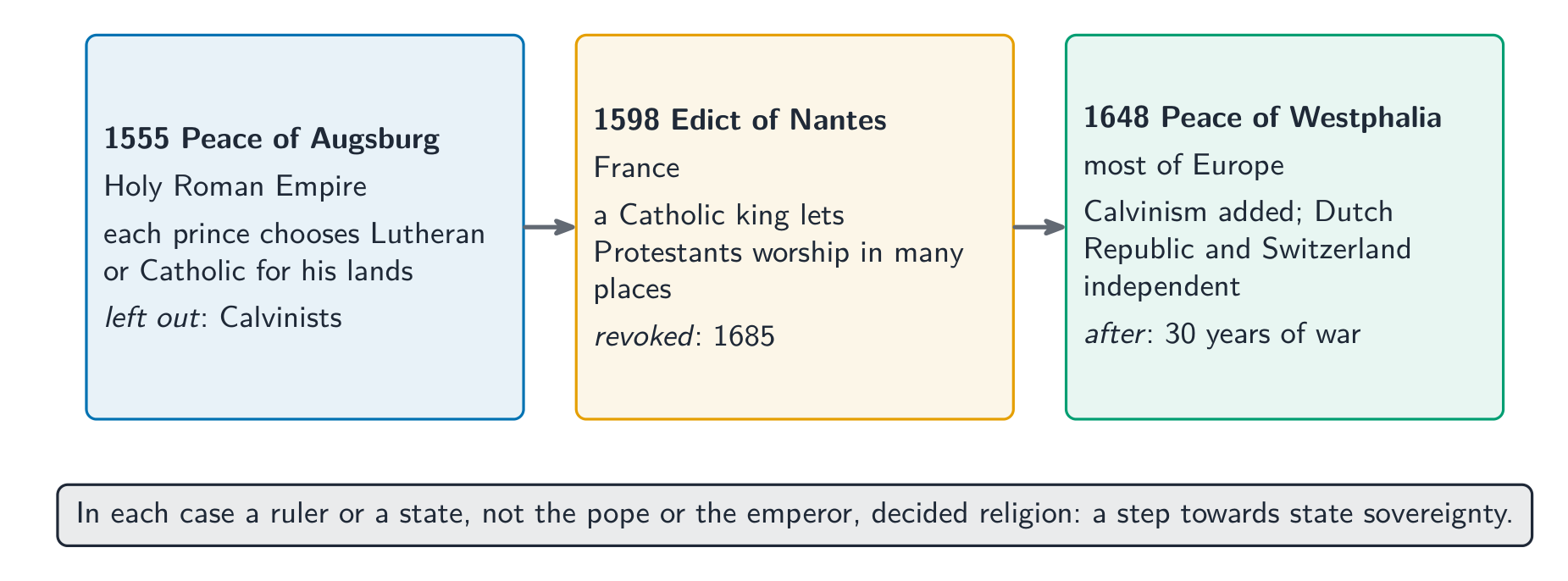
Put the settlements in order.
Dificuldade 3/5 · Moedas 200 + pequeno bônus na primeira conclusão hoje
1555, 1598, 1648.
Effects on society and culture
- Both Protestants and Catholics opened schools so that people could learn their faith; Jesuit colleges and Protestant town schools spread literacy.
- Fear and conflict also fed the witch hunts, which peaked between about 1560 and 1650: perhaps 40 000–60 000 people, most of them women, were executed.
Belief or power?
Sort each cause or decision in the wars of religion.
When did the witch hunts peak?
Dificuldade 1/5 · Moedas 100 + pequeno bônus na primeira conclusão hoje
The age of the religious wars.
Do not say the wars were only about religion, or not about religion at all. Belief made the conflicts bitter, while power and money decided who fought whom. France's Catholic Cardinal Richelieu paid Protestant Sweden to fight the Catholic emperor because both wanted to weaken the Habsburgs.
Cardinal Richelieu helped Protestant Sweden because he had become a Protestant.
Dificuldade 1/5 · Moedas 100 + pequeno bônus na primeira conclusão hoje
He stayed Catholic; he wanted to weaken the Habsburgs.
The Reformation led to a century of religious wars: in France (1562–98), the Netherlands (1568–1648) and Germany (1618–48). Belief made them bitter, but politics shaped them. The settlements of Augsburg, Nantes and Westphalia gave rulers and states the right to decide religion, which strengthened state sovereignty, while schools spread and witch hunts peaked.
Explain how the religious wars of 1562-1648 changed political power in Europe.
Link the wars to sovereignty.