The Expansion of the Slave Trade
Introduzido| English | Significado |
|---|---|
| plantation/plænˈteɪʃn/ | A large estate growing a cash crop, such as sugar, often with enslaved labour. |
| triangular trade | The Atlantic trade linking Europe, West Africa and the Americas: goods to Africa, enslaved people to the Americas, plantation crops to Europe. |
Elmina, 1482
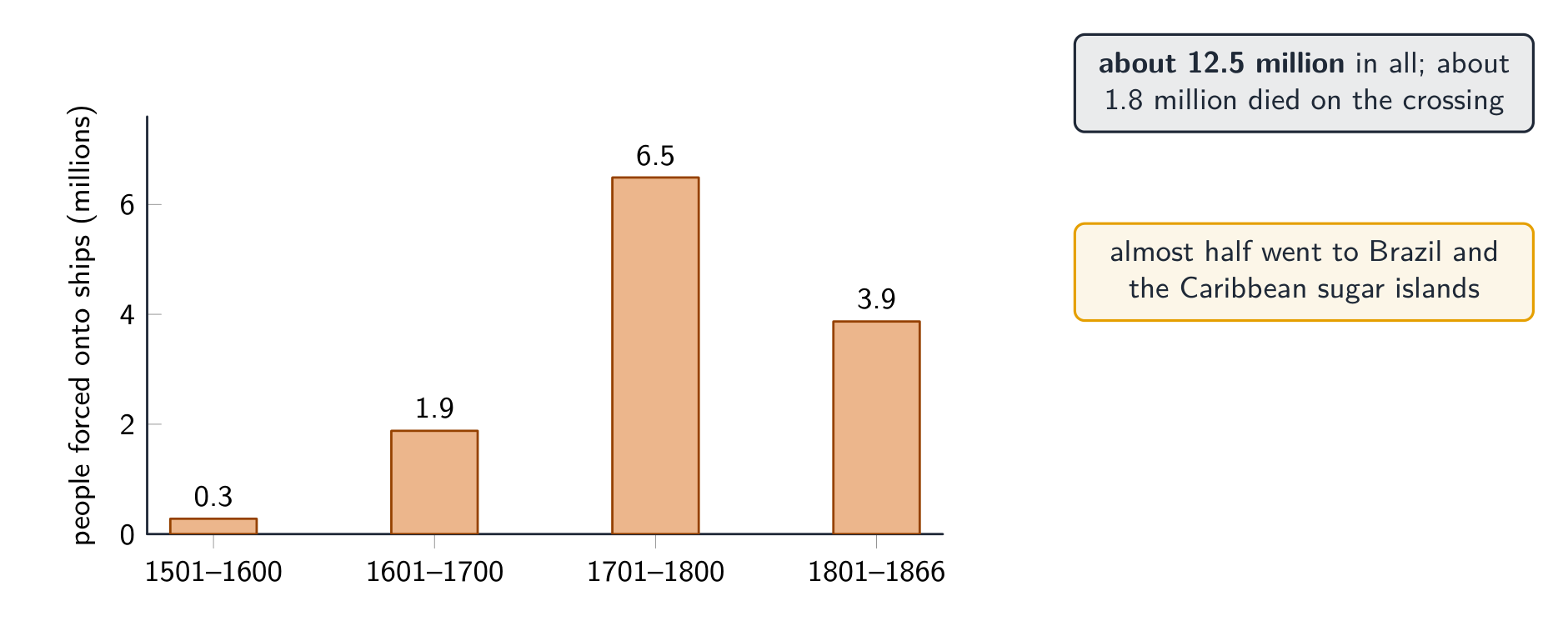
- In 1482 the Portuguese built São Jorge da Mina (Elmina) on the coast of today's Ghana, to trade for gold. Within a century, the castle's dungeons held captive Africans waiting for ships. Over the next four hundred years, about 12.5 million Africans were forced onto ships across the Atlantic.
- The slave trade existed before the Americas, but American plantations expanded it enormously.
Sugar and the plantation
- Portugal grew sugar with enslaved African labour on Atlantic islands — Madeira and São Tomé — in the 1400s.
- The plantation 种植园 model moved to Brazil in the 1500s and to the Caribbean in the 1600s; Barbados switched to sugar in the 1640s.
Where did Portugal first combine sugar plantations with enslaved African labour?
Dificuldade 1/5 · Moedas 100 + pequeno bônus na primeira conclusão hoje
Before the Americas.
Why labour came from Africa
- European diseases and forced labour killed most of the native people of the Caribbean and Brazil.
- Plantations needed huge numbers of workers in hot, deadly conditions, and European traders bought captives from African rulers and merchants on the coast.
Why did plantations in the Americas rely on enslaved Africans?
Dificuldade 2/5 · Moedas 140 + pequeno bônus na primeira conclusão hoje
Demand for labour.
Worked example: the triangular trade
- Leg 1: ships carried European textiles, guns and metal goods to West Africa, where they were exchanged for captives.
- Leg 2: the Middle Passage carried captives to the Americas; about 1.8 million died on the voyage.
- Leg 3: sugar, tobacco and later cotton returned to Europe. This triangular trade 三角贸易 enriched ports such as Liverpool, Bristol and Nantes while destroying African lives and communities.
Follow the plantation economy to the slave trade
The expansion of the trade is a consequence of a demand created elsewhere.
Put the legs of the triangular trade in order, starting from Europe.
Dificuldade 3/5 · Moedas 200 + pequeno bônus na primeira conclusão hoje
The triangle.
Where the captives went
- About 40% of enslaved Africans went to Brazil, and most of the rest to the Caribbean; only about 4% to mainland North America.
- Death rates on sugar plantations were so high that new captives were constantly imported.
Where did the largest share of enslaved Africans go?
Dificuldade 1/5 · Moedas 100 + pequeno bônus na primeira conclusão hoje
About 40%.
Who ran the trade
- Portugal dominated at first, then the Dutch, and from the late 1600s Britain and France.
- Joint-stock companies, such as England's Royal African Company (1672), organized and financed the trade.
Joint-stock companies helped organize and finance the slave trade.
Dificuldade 1/5 · Moedas 100 + pequeno bônus na primeira conclusão hoje
For example, the Royal African Company.
Europeans did not invent slavery, but they changed it. Slavery existed in Africa, Europe and the Islamic world before 1500. The Atlantic system was new in its scale, its use of race, and its hereditary chattel slavery for plantations.
The Atlantic slave trade was the same as earlier forms of slavery.
Dificuldade 1/5 · Moedas 100 + pequeno bônus na primeira conclusão hoje
It differed in scale, race and heredity.
Sugar plantations, first on Atlantic islands and then in Brazil and the Caribbean, created a huge demand for labour as native populations collapsed. The triangular trade carried about 12.5 million Africans across the Atlantic, enriching European ports and shaping the Atlantic world.
Explain why the Atlantic slave trade expanded between 1500 and 1700.
Causation.