The Italian Renaissance
Introduzido| English | Significado |
|---|---|
| philology | The close study of language and texts to find their original meaning and date. |
| humanist | A Renaissance scholar who studied the literature, history and philosophy of ancient Greece and Rome. |
| individualism/ˌɪndɪˈvɪdʒuːəlɪzəm/ | individualismo |
| secularism/ˈsekjʊlərɪzəm/ | secularismo |
| civic humanism/ˈsɪvɪk ˈhjuːmənɪzəm/ | A Renaissance ideal that educated citizens should serve the republic. |
| linear perspective/ˈlɪnɪə pəˈspektɪv/ | A method of representing depth by making parallel lines appear to converge towards vanishing points. |
A forged document exposed, 1440
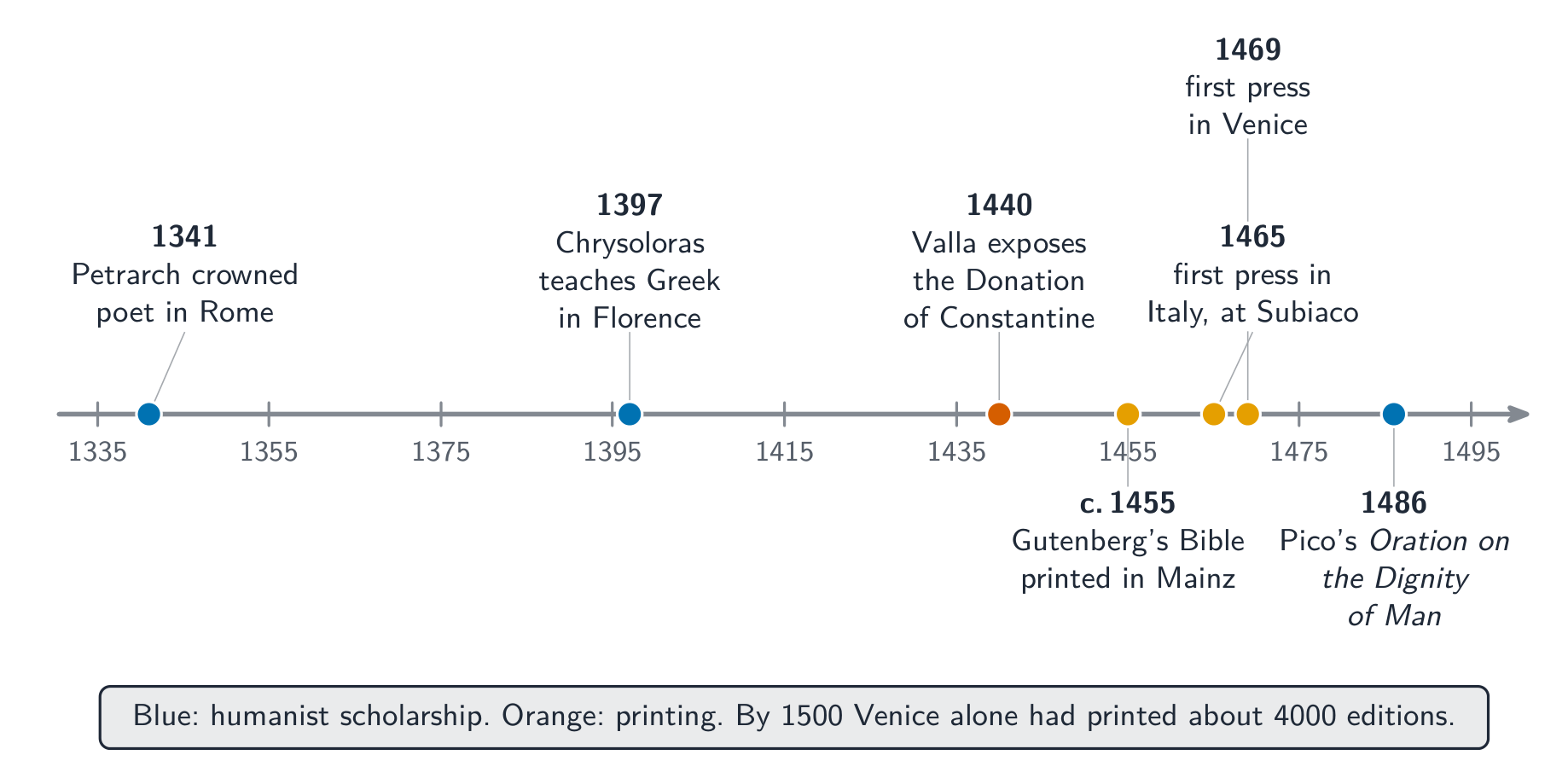
- In 1440, the scholar Lorenzo Valla proved that the "Donation of Constantine" — a document the popes used to claim power over western Europe — was a forgery. Its Latin used words that did not exist in Constantine's time, the fourth century. Valla showed that the careful study of language could test even the Church's documents.
- The Italian Renaissance began as a new way of reading old texts and spread to politics and art.
How did Valla prove the Donation of Constantine was a forgery?
Dificuldade 1/5 · Moedas 100 + pequeno bônus na primeira conclusão hoje
Philology.
Humanism
- Humanists 人文主义者 studied Greek and Roman literature, history and philosophy. Petrarch, in the fourteenth century, searched monasteries for lost Latin manuscripts.
- Their method was philology 语文学 — the close study of language and texts to find their original meaning.
New values
- Humanists valued individualism 个人主义 — pride in a person's own talents — and secularism 世俗主义, interest in this world as well as the next.
- From the 1460s, printing presses in Italy spread classical texts and humanist ideas.
Method, political programme, or patronage?
Sort each element of the Italian Renaissance.
Match each term to its meaning.
Dificuldade 2/5 · Moedas 140 + pequeno bônus na primeira conclusão hoje
Humanist ideas.
Worked example: humanism in Florence
- Civic humanism 公民人文主义: Florentine leaders such as Leonardo Bruni argued, using Roman examples, that citizens should take an active part in governing their republic.
- Politics: Machiavelli's The Prince (1513) gave rulers advice based on how people actually behave, not on Christian ideals — a secular model of politics.
- Patronage: the Medici family, Florence's bankers, paid artists and builders to show their wealth and power.
Why is The Prince seen as secular?
Dificuldade 1/5 · Moedas 100 + pequeno bônus na primeira conclusão hoje
A model of politics from experience.
Art and perspective
- Artists such as Brunelleschi and Masaccio used linear perspective 线性透视 — geometry that makes a flat picture look three-dimensional.
- Leonardo da Vinci and Michelangelo studied the human body closely to paint and carve it realistically.
Linear perspective uses geometry to make a flat picture look three-dimensional.
Dificuldade 1/5 · Moedas 100 + pequeno bônus na primeira conclusão hoje
Brunelleschi and Masaccio.
Who paid?
- Popes, princes and rich merchants commissioned works for prestige. Pope Julius II paid Michelangelo to paint the Sistine Chapel ceiling (1508–12).
- Art was a way of showing power, wealth and piety.
Who commissioned Renaissance art?
Dificuldade 2/5 · Moedas 140 + pequeno bônus na primeira conclusão hoje
For prestige and piety.
Renaissance thinkers were not anti-religious. Most were Christians. Secularism meant more interest in this world, not rejection of God; the popes were among the greatest patrons.
Renaissance humanists rejected Christianity.
Dificuldade 1/5 · Moedas 100 + pequeno bônus na primeira conclusão hoje
Most were Christians.
Italian humanists recovered and studied Greek and Roman texts, using philology to test documents. Their values of individualism and secularism shaped civic humanism, Machiavelli's politics and an art of perspective and realism, paid for by rich patrons such as the Medici and the popes.
Explain how humanism influenced politics in Renaissance Italy.
Influence.