Energy from Biomass
Introduzido| English | Significado |
|---|---|
| biomass energy/ˌbaɪəʊˈmæs ˈenədʒi/ | Energia de biomassa |
| ethanol/ˈeθənɒl/ | Etanol |
| biogas/ˌbaɪəʊˈɡæs/ | Biogás |
| renewable/rɪˈnjuːəbl/ | renovável |
| particulates/pəˈtɪkjʊleɪts/ | Partículas |
| deforestation/diːˌfɒrɪˈsteɪʃn/ | Desmatamento |
A fuel that grows back
- In Brazil, most cars can run on ethanol 乙醇 made from sugarcane, and millions of homes in Africa and Asia still cook with wood and charcoal. In the USA, about a third of the corn crop is turned into ethanol and blended into gasoline.
- Biomass 生物质 is material from living or recently living things: wood, crop waste, charcoal, dried animal dung, and crops grown for fuel. It is used for heat, electricity and transport fuel.
Biomass energy comes from…
Dificuldade 1/5 · Moedas 100 + pequeno bônus na primeira conclusão hoje
Biomass is organic material — wood, crop waste, dung — burned or converted to fuel.
Select todos sources of biomass energy.
Dificuldade 2/5 · Moedas 140 + pequeno bônus na primeira conclusão hoje
Firewood, crop waste, and dung are all biomass. Uranium is a nuclear fuel, not biomass.
Three ways to use biomass
- Burn it directly (wood, charcoal, dung, crop waste) for cooking, heating, or to boil water for steam turbines in a power plant.
- Turn crops into liquid fuel: corn or sugarcane is fermented to ethanol 乙醇, a substitute for gasoline; vegetable oils make biodiesel. Or let waste rot without oxygen to make biogas 沼气 (methane).
Corn and sugarcane can be turned into a liquid biofuel called ____.
Dificuldade 1/5 · Moedas 100 + pequeno bônus na primeira conclusão hoje
Ethanol is a biofuel made from crops, often blended into gasoline.
Burning biomass pollutes
- Biomass produces heat at a relatively low cost, but burning it releases CO₂, carbon monoxide, nitrogen oxides, particulates and VOCs, the same kinds of pollutants as other burning.
- Indoor cooking fires fill homes with smoke (see topic 7.5). Overharvesting trees for fuel causes deforestation 森林砍伐, soil erosion and habitat loss, as in Haiti, where most forest has been cut, much of it for charcoal.
Burning biomass produces no smoke or air pollution.
Dificuldade 1/5 · Moedas 100 + pequeno bônus na primeira conclusão hoje
False. Like any combustion, burning biomass releases smoke and fine particulates that harm air quality and lungs.
Select todos pollutants released by burning biomass.
Dificuldade 2/5 · Moedas 140 + pequeno bônus na primeira conclusão hoje
Burning biomass releases CO₂, CO, NO$_x$, particulates and VOCs. CFCs come from old refrigerants, not from burning.
Is ethanol "carbon-neutral"?
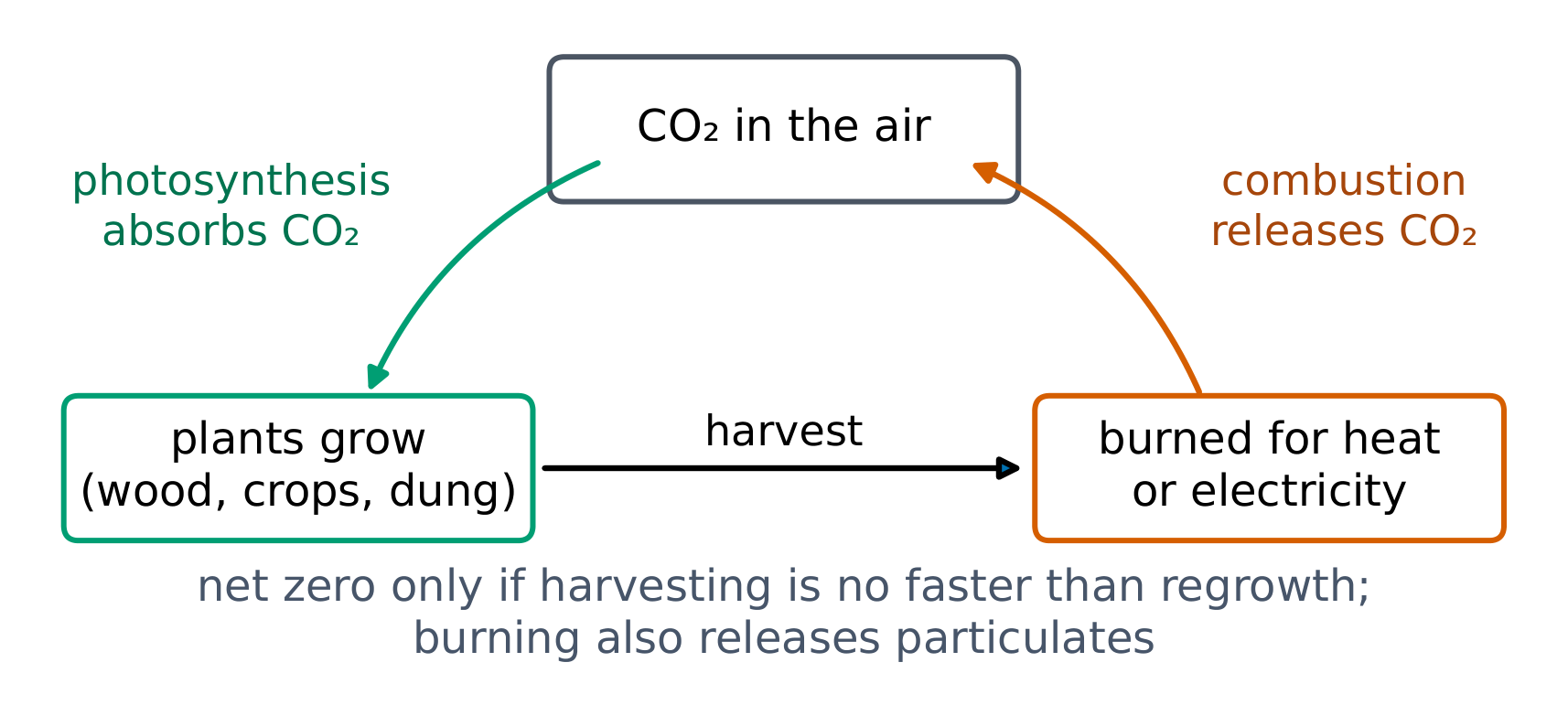
- The carbon in ethanol was taken out of the air by the corn or sugarcane through photosynthesis only months earlier. So burning ethanol does not add new carbon to the atmosphere; it returns carbon that was recently removed. Burning gasoline releases carbon locked underground for millions of years.
- But growing and processing the crop uses fossil fuels: tractors, fertilizer, transport and heating the distillery. So in practice ethanol is not fully carbon-neutral.
Biomass is considered renewable because…
Dificuldade 1/5 · Moedas 100 + pequeno bônus na primeira conclusão hoje
Crops and trees regrow, so biomass can be replaced — that is what makes it renewable.
Burning ethanol does not add new carbon to the atmosphere because…
Dificuldade 1/5 · Moedas 100 + pequeno bônus na primeira conclusão hoje
Ethanol (C₂H₅OH) does contain carbon, but it came from CO₂ the plant absorbed only months before.
Energy return on energy investment
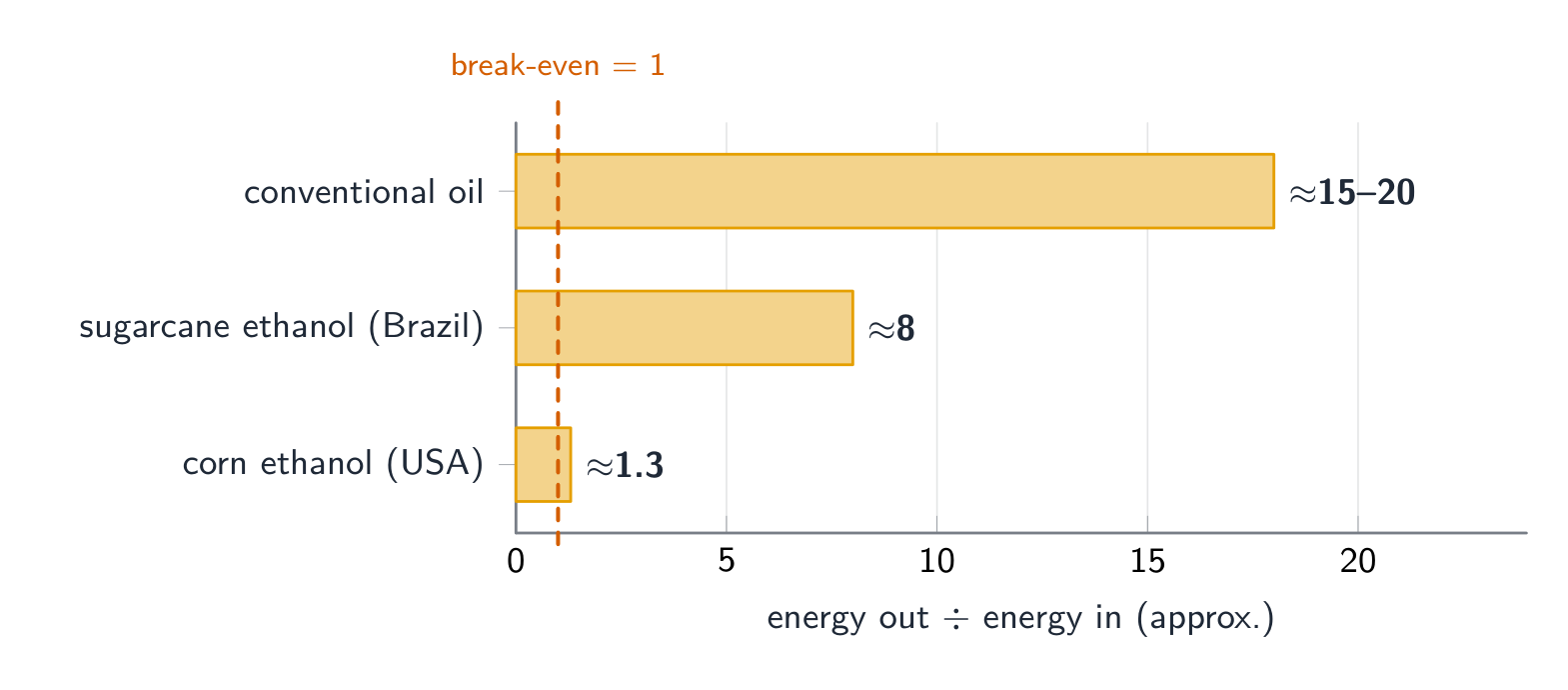
- EROI (energy return on energy investment 能源投资回报率) = energy you get out ÷ energy you put in. An EROI below 1 means the fuel uses more energy than it gives.
- Corn ethanol has a low EROI, only a little above 1, because growing, harvesting and distilling corn takes so much energy. Sugarcane ethanol does better, because sugarcane grows fast and its waste fibre (bagasse) is burned to run the factory.
A fuel with an EROI of 0.8 gives back more energy than it took to produce.
Dificuldade 1/5 · Moedas 100 + pequeno bônus na primeira conclusão hoje
An EROI below 1 means more energy goes in than comes out.
Worked calculation
Making 1 litre of corn ethanol uses 18 MJ of energy (farming, fertilizer, distilling). Burning the litre releases 21 MJ. Calculate the EROI, and the net energy gained.
- EROI = energy out ÷ energy in = 21 ÷ 18 ≈ 1.2.
- Net energy = 21 − 18 = 3 MJ per litre.
- So about 86% of the ethanol's energy (18 of 21 MJ) was used just to make it.
A biofuel plant uses 50 MJ of energy to make fuel that releases 60 MJ when burned. What is its EROI?
Dificuldade 2/5 · Moedas 140 + pequeno bônus na primeira conclusão hoje
EROI = energy out ÷ energy in = 60 ÷ 50 = 1.2.
Trade-offs
| Benefit | Cost |
|---|---|
| renewable if regrown; can use waste (sawdust, dung, crop scraps) | burning releases CO, NO$_x$, particulates and VOCs |
| cheap, local heat for poorer communities | overharvesting trees causes deforestation |
| ethanol adds no new carbon when burned | low EROI (corn); fossil fuels used to grow it |
| ethanol cuts imports of oil | fuel crops compete with food crops for land and water; can raise food prices |
Benefício ou custo da energia de biomassa?
Sort each feature of burning biomass into a benefit or a cost.
Worked FRQ answer
(A) Identify ONE air pollutant released when wood is burned for heat. Particulate matter (also accepted: CO, NO$_x$, VOCs, CO₂).
(B) Explain why burning ethanol is described as not adding additional carbon to the atmosphere. The carbon in ethanol came from CO₂ that the corn absorbed during photosynthesis while it grew, so burning it returns that same carbon to the air.
(C) Describe ONE disadvantage of using corn ethanol as a fuel. Its energy return on energy investment is low: growing and processing the corn uses almost as much energy (much of it from fossil fuels) as the ethanol provides.
- Why it scores: (B) mentions photosynthesis and the recent removal of CO₂. (C) states the disadvantage and explains it; "it is expensive" without a reason would not score.
- Renewable does not mean clean. Burning biomass still produces CO, NO$_x$, particulates and VOCs.
- "Does not add new carbon" refers only to the burning step. The fossil fuels used on the farm and in the factory still add carbon.
- EROI is a ratio, not a difference. 21 MJ out and 18 MJ in is an EROI of 1.2, not 3.
Biomass (wood, charcoal, dung, crop waste, fuel crops) is burned for heat at low cost, but releases CO₂, CO, NO$_x$, particulates and VOCs, and overharvesting trees causes deforestation. Ethanol can replace gasoline; burning it adds no new carbon because the crop took that carbon from the air, but its energy return on energy investment is low, especially from corn.