Escolha de Palavras e Conotação
Introduzido| English | Significado |
|---|---|
| connotative and denotative meanings/kɒnəˈtætɪv ænd dɪˈnəʊtətɪv ˈmiːnɪŋz/ | sentido conotativo e denotativo |
Ambitious or expensive?
- Call a policy ambitious and the reader leans one way; call it expensive and they lean the other.
- No fact changed between the two sentences.
- That gap between what a word refers to and what it carries is where diction analysis lives.
Calling a fee “modest” does not shrink the bill; it changes the expression on the reader’s face.
Denotation and connotation
- Words have both connotative and denotative meanings 内涵义与外延义.
- Denotation is what a word refers to; connotation is what it carries with it.
- Two words with the same denotation can produce opposite dispositions in a reader.
Mesma denotação, conotação diferente
Classifique cada membro do par pela disposição que carrega.
Conotação é...
Dificuldade 1/5 · Moedas 100 + pequeno bônus na primeira conclusão hoje
Denotação refere; conotação carrega. Duas palavras podem compartilhar a primeira e diferir na segunda.
Descriptive words carry a perspective
- Descriptive words — adjectives and adverbs — not only qualify or modify what they describe.
- They also convey a perspective toward it.
- So a modifier is never neutral: choosing one is taking a position, however quietly.
Adjetivos e advérbios modificam o que descrevem sem transmitir uma perspectiva.
Dificuldade 1/5 · Moedas 100 + pequeno bônus na primeira conclusão hoje
O CED diz que palavras descritivas também transmitem uma perspectiva — um modificador nunca é neutro.
"The writer uses strong diction" earns nothing. Diction analysis requires naming the connotation — what the chosen word carries that a neutral synonym would not — and saying what that does to the reader's disposition.
Selecione todas as funções que a escolha de palavra precisa tem.
Dificuldade 2/5 · Moedas 140 + pequeno bônus na primeira conclusão hoje
Uma palavra inflada usada ligeiramente errada soa como uma perda de controle.
Precision
- Precise word choice reduces confusion and helps an audience perceive the writer's perspective.
- Precision is not the same as sophistication — the exactly right common word beats an impressive wrong one.
- An inflated word used slightly wrongly reads as a loss of control, which examiners notice.
Para analisar uma palavra carregada, pergunte qual seria seu sinônimo ____.
Dificuldade 1/5 · Moedas 100 + pequeno bônus na primeira conclusão hoje
A diferença entre os dois é exatamente o que o escritor adicionou.
Combine cada par ao que a escolha adiciona.
Dificuldade 2/5 · Moedas 140 + pequeno bônus na primeira conclusão hoje
Onde a denotação é compartilhada, tudo o que difere é uma escolha retórica.
Analysing diction
- Find a loaded word and ask what a neutral synonym would have been.
- The difference between the two is exactly what the writer added.
- Say what that addition does to the reader's disposition — that is the analysis.
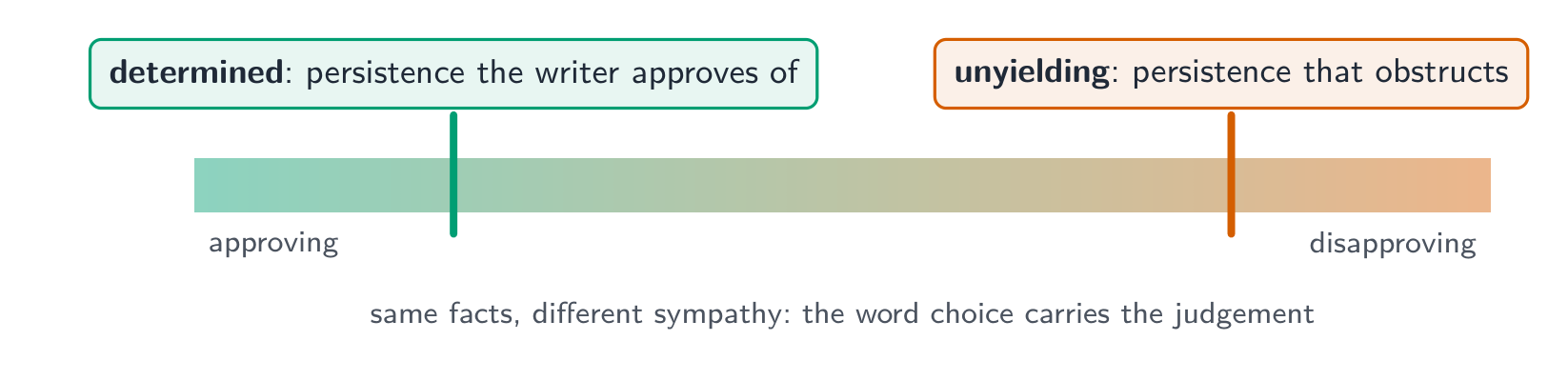
A writer calls the supporters determined in one paragraph and unyielding in the next. Both denote persistence; the first approves and the second obstructs. The facts described did not change — the reader's sympathy did.
Denotation is what a word refers to; connotation is what it carries. Descriptive words convey a perspective as well as modify, and precise word choice helps a reader perceive it. To analyse diction, name the neutral synonym and say what the writer's choice added.
Write from the word inexpensive
- A writer changes 'cheap' to 'inexpensive' for the same low price.
- Say what changed, denotation or connotation.
Uma revisão chama uma refeição de barata, e depois um repasso diz que o mesmo preço é barato. O que mudou e o que permaneceu?
Mesmo referente, diferente atitude.
O que mudou quando barata se tornou barato?
Dificuldade 1/5 · Moedas 100 + pequeno bônus na primeira conclusão hoje
Barato mantém o preço e perde o desdém.