Leveraging AI in Cyber Defense
Introduzido| English | Significado |
|---|---|
| alerts/əˈlɜːts/ | warnings raised by a security system when an event looks suspicious |
| false positive | A harmless event flagged as an attack; a false negative is an attack that is missed. |
| false negative | a real attack or condition that a system fails to detect |
Machines that patched themselves, 2016
- In August 2016, at the DARPA Cyber Grand Challenge in Las Vegas, seven computer systems competed with no humans at the keyboard. Each had to find bugs in unfamiliar software, patch its own copies and exploit the others'. The winner, Mayhem, from the company ForAllSecure, did all three automatically.
- AI now helps defenders in the same way: it sorts huge numbers of events, raises alerts 警报, and suggests fixes — while humans make the final decisions.
In the 2016 Cyber Grand Challenge, systems found and patched bugs with no humans at the keyboard.
Dificuldade 1/5 · Moedas 100 + pequeno bônus na primeira conclusão hoje
Mayhem won.
The problem of scale
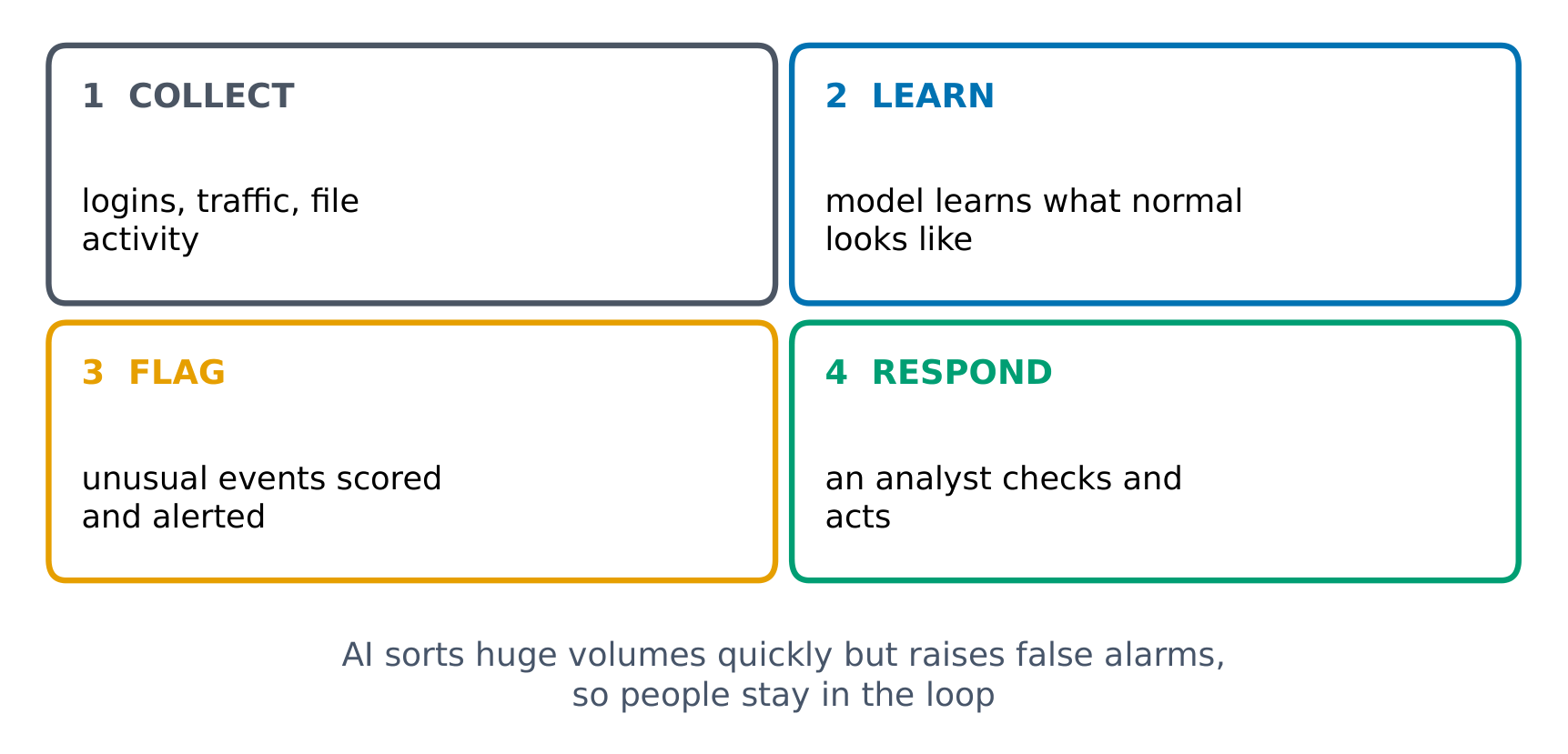
- A medium-sized organisation's network can log millions of events a day: logins, file transfers, connections. No team can read them all.
- AI models learn what normal activity looks like and score each new event by how unusual it is (anomaly detection).
Can AI do this defensive job well?
AI excels at large-scale sorting and recommending, but a human must review its advice.
Why do defenders use AI for monitoring?
Dificuldade 1/5 · Moedas 100 + pequeno bônus na primeira conclusão hoje
Scale.
What AI can do for defenders
- Triage: rank alerts so analysts look at the most likely attacks first.
- Recommend: review firewall rules or scan code and suggest safer settings; respond automatically to clear cases, such as isolating an infected laptop.
Which can AI do for defenders?
Dificuldade 2/5 · Moedas 140 + pequeno bônus na primeira conclusão hoje
No system guarantees safety.
False positives and false negatives
- A false positive 误报 is a harmless event flagged as an attack; a false negative 漏报 is an attack that is missed.
- Lowering the alert threshold catches more attacks but creates more false positives; humans choose the trade-off.
Match each outcome to its name.
Dificuldade 2/5 · Moedas 140 + pequeno bônus na primeira conclusão hoje
Two kinds of error.
Worked example: an alert threshold
A hospital logs 20,000,000 events a day. An AI flags 0.01% of them.
- Alerts: $20{,}000{,}000 \times 0.0001 = 2{,}000$ alerts a day — still too many for two analysts.
- Raise the threshold so only the top 0.0005% are flagged: 100 alerts a day, which the team can check.
- Risk: some real attacks may now fall below the threshold, so regular reviews of missed incidents are needed.
A network logs 5,000,000 events a day and the AI flags 0.02%. How many alerts is that?
Dificuldade 2/5 · Moedas 140 + pequeno bônus na primeira conclusão hoje
5,000,000 × 0.0002.
Raising the alert threshold reduces false positives but may miss more attacks.
Dificuldade 1/5 · Moedas 100 + pequeno bônus na primeira conclusão hoje
A trade-off.
A human in the loop
- AI advice can be wrong: a suggested rule might block real patients' records. Analysts approve changes, especially ones that are hard to undo.
- Attackers use AI too — to write convincing phishing emails or probe defences — so AI is dual-use.
Only defenders use AI in cybersecurity.
Dificuldade 1/5 · Moedas 100 + pequeno bônus na primeira conclusão hoje
Attackers use it too.
An AI alert is a probability, not proof. Treat it as a lead for a human to investigate, and record when it was right or wrong to improve the model.
AI helps defenders handle scale: it learns normal behaviour, ranks alerts, recommends safer settings and responds to clear cases. Thresholds trade false positives against false negatives, and a human must review important decisions.
A school wants AI to block suspicious logins automatically. Give one benefit, one risk and one safeguard.
Benefit, risk, safeguard.