Regras de Derivada: Constante, Soma, Diferença e Múltiplo Constante
Introduzido| English | Significado |
|---|---|
| polynomial/ˌpɒlɪˈnəʊmɪəl/ | polinômio |
Four rules that break a polynomial apart
- The Power Rule handles one term. To differentiate a whole polynomial 多项式 you need to combine terms.
- Four simple rules let you do it term by term, in your head.
- They cover constants, sums, differences, and coefficients.
- Together with the Power Rule, they differentiate any polynomial in one pass.
Constant, sum, and difference
- Constant rule: the derivative of a constant is $0$. A flat line has zero slope: $\dfrac{d}{dx}[7]=0$.
- Sum rule: $\dfrac{d}{dx}[f+g]=f'+g'$ — differentiate each piece and add.
- Difference rule: $\dfrac{d}{dx}[f-g]=f'-g'$ — same, with a minus.
- So you can split a long expression and handle each term separately.
O que é $\dfrac{d}{dx}[12]$?
Dificuldade 2/5 · Moedas 140 + pequeno bônus na primeira conclusão hoje
A derivada de qualquer constante é $0$.
Pela regra da soma, $\dfrac{d}{dx}[f+g]=f'+$ ____.
Dificuldade 1/5 · Moedas 100 + pequeno bônus na primeira conclusão hoje
Diferencie cada parte e some.
Constant multiple
- Constant multiple rule: a coefficient just rides along: $\dfrac{d}{dx}[k\,f]=k\,f'$.
- $\dfrac{d}{dx}[5x^3]=5\cdot 3x^2=15x^2$.
- The number out front is untouched by differentiation; only the $x$-part changes.
- Combine with the sum rule: $\dfrac{d}{dx}[5x^3-4x]=15x^2-4$.
Um cúbico e sua inclinação variável
y = ax³ + bx
A derivada de um polinômio é outro polinômio — arraste os coeficientes e visualize onde a inclinação é positiva ou negativa.
Se $f(x)=5x^3$, encontre $f'(2)$.
Dificuldade 2/5 · Moedas 140 + pequeno bônus na primeira conclusão hoje
$f'(x)=15x^2$, logo $f'(2)=15\cdot4=60$.
Para $\dfrac{d}{dx}[4x^2+3x-8]$, selecione todos os derivadas corretas dos termos.
Dificuldade 2/5 · Moedas 140 + pequeno bônus na primeira conclusão hoje
A constante $-8$ diferencia para $0$, não para $-8$.
Differentiate a polynomial in one pass
- Read the polynomial term by term, applying the Power Rule and coefficients as you go.
- $\dfrac{d}{dx}[3x^4-2x^2+7x-9]=12x^3-4x+7-0=12x^3-4x+7$.
- Notice the constant $-9$ vanishes, and the $7x$ becomes just $7$.
- With practice you write the derivative directly, no scratch work.
Diferencie $f(x)=3x^4-2x^2+7x-9$.
Dificuldade 1/5 · Moedas 100 + pequeno bônus na primeira conclusão hoje
Termo por termo: $12x^3$, $-4x$, $+7$, e a constante $\to 0$.
A regra da soma permite calcular $\dfrac{d}{dx}[f\cdot g]$ como $f'\cdot g'$.
Dificuldade 1/5 · Moedas 100 + pequeno bônus na primeira conclusão hoje
As regras de soma/diferença aplicam-se separadamente a $+$ e $-$ apenas; um produto exige a Regra do Produto.
There is no "product rule shortcut" hiding here: $\frac{d}{dx}[f\cdot g]$ is not $f'\cdot g'$. The sum/difference rules split across $+$ and $-$ only. Products and quotients need their own rules (lessons 2.8–2.9). Also, the derivative of a constant is $0$, not the constant itself.
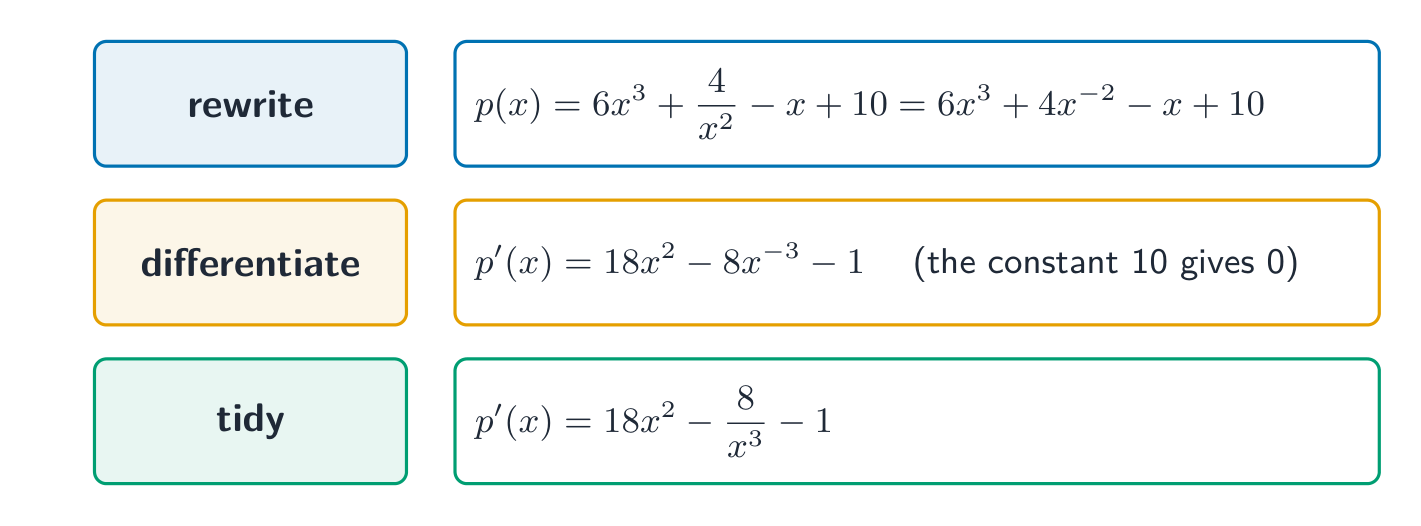
Differentiate $p(x)=6x^3+\dfrac{4}{x^2}-x+10$.
- Rewrite: $p(x)=6x^3+4x^{-2}-x+10$.
- Term by term: $6\cdot3x^2$, $4\cdot(-2)x^{-3}$, $-1$, and $0$.
- $p'(x)=18x^2-8x^{-3}-1=18x^2-\dfrac{8}{x^3}-1$.
Four combining rules: constant $\to 0$; sum/difference differentiate term by term; constant multiple keeps the coefficient out front ($\frac{d}{dx}[kf]=kf'$). With the Power Rule these differentiate any polynomial in a single pass — but they split only across $+$ and $-$, never across a product.