Connecting Infinite Limits and Vertical Asymptotes
Introduzido| English | Significado |
|---|---|
| infinite limit/ˈɪnfɪnət ˈlɪmɪt/ | limite infinito |
| vertical asymptote/ˈvɜːtɪkl ˈæsɪmptəʊt/ | assíntota vertical |
When the output runs away to infinity
- Sometimes as $x\to c$ the function grows without bound. We write $\displaystyle\lim_{x\to c}f(x)=\infty$ (or $-\infty$): an infinite limit 无穷极限.
- "$=\infty$" describes how the limit fails. It is not a number, and the limit does not exist as a finite value.
Escrita $\lim_{x\to c}f(x)=\infty$ means the limit exists as a finite number.
Dificuldade 1/5 · Moedas 100 + pequeno bônus na primeira conclusão hoje
It is shorthand for unbounded growth; as a finite number the limit does not exist.
Read each side with a sign check
- Substitution gives nonzero over 0. Find the sign of the numerator and of the tiny denominator on each side; the signs decide $+\infty$ or $-\infty$.
- $\dfrac1{x-2}$: for $x\to2^-$ the bottom is a tiny negative, so $\to-\infty$; for $x\to2^+$ it is a tiny positive, so $\to+\infty$.
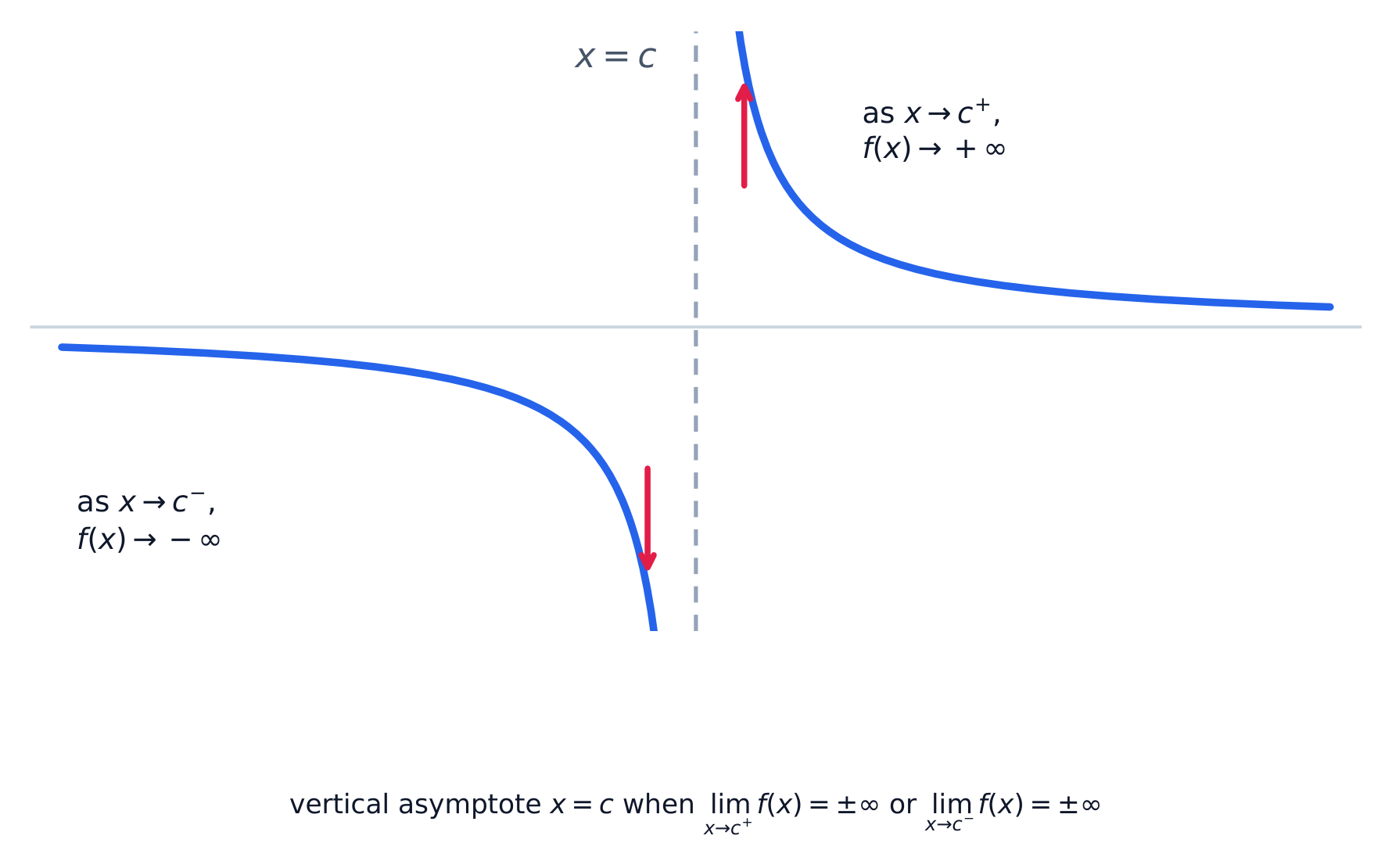
A vertical asymptote 竖直渐近线 x = c: f grows without bound as x approaches c
Watch it climb the asymptote
y = a / (x − b)
As $x$ nears $b$, the reciprocal shoots to $+\infty$ from one side and $-\infty$ from the other — the line $x=b$ is a vertical asymptote.
A favor $f(x)=\dfrac1{x-2}$, what is $\displaystyle\lim_{x\to2^-}f(x)$?
Dificuldade 1/5 · Moedas 100 + pequeno bônus na primeira conclusão hoje
Just left of $2$, $x-2$ is a tiny negative, so $\frac{1}{\text{tiny}^-}\to-\infty$.
Spotting the vertical asymptote
- A vertical asymptote 竖直渐近线 $x=c$ is where the graph shoots to $\pm\infty$. For a rational function: the denominator is 0 at $c$ and the numerator is not (after cancelling).
- If both are 0, factor first: it may be a removable hole instead.
At what $x$-value does $f(x)=\dfrac{x+1}{x-4}$ have a vertical asymptote?
Dificuldade 2/5 · Moedas 140 + pequeno bônus na primeira conclusão hoje
Denominator zero at $x=4$, numerator $=5\neq0$ → asymptote $x=4$.
The line $x=c$ that a graph hugs as it shoots to $\pm\infty$ is a vertical ____.
Dificuldade 1/5 · Moedas 100 + pequeno bônus na primeira conclusão hoje
It marks an infinite discontinuity.
A negative numerator. Find $\displaystyle\lim_{x\to3^+}\dfrac{x-5}{x-3}$ and $\displaystyle\lim_{x\to3^-}\dfrac{x-5}{x-3}$.
- Near 3 the top is about $-2$ (negative). From the right the bottom is a tiny positive: negative ÷ positive → $-\infty$.
- From the left the bottom is a tiny negative: negative ÷ negative → $+\infty$.
What is $\displaystyle\lim_{x\to4^-}\dfrac{x+3}{x-4}$?
Dificuldade 1/5 · Moedas 100 + pequeno bônus na primeira conclusão hoje
The top is about 7 (positive). For $x$ just below 4, $x-4$ is a tiny negative. Positive ÷ tiny negative → $-\infty$.
A squared denominator. Find $\displaystyle\lim_{x\to1}\dfrac{x-5}{(x-1)^2}$.
- $(x-1)^2$ is a tiny positive on both sides; the top is about $-4$.
- Both sides go to $-\infty$, so we may write $\displaystyle\lim_{x\to1}\dfrac{x-5}{(x-1)^2}=-\infty$.
What is $\displaystyle\lim_{x\to-2}\dfrac{x+1}{(x+2)^2}$?
Dificuldade 1/5 · Moedas 100 + pequeno bônus na primeira conclusão hoje
Near $-2$ the top is about $-1$; $(x+2)^2$ is a tiny positive on both sides. Negative ÷ tiny positive → $-\infty$ from both sides.
Hole or asymptote? Find the vertical asymptotes of $\dfrac{x^2-4}{x^2-x-2}$.
- $\dfrac{(x-2)(x+2)}{(x-2)(x+1)}=\dfrac{x+2}{x+1}$ for $x\neq2$.
- $x=2$ cancels: a hole. $x=-1$ stays (top $=1$): the only vertical asymptote is $x=-1$.
A favor $\dfrac{x^2-9}{x-3}$ at $x=3$, both top and bottom are zero. This is...
Dificuldade 1/5 · Moedas 100 + pequeno bônus na primeira conclusão hoje
Both zero means cancel: $x+3\to6$. It is a removable hole, not an asymptote.
A rational function has a vertical asymptote at $x=c$ when which hold?
Dificuldade 2/5 · Moedas 140 + pequeno bônus na primeira conclusão hoje
Denominator zero, numerator nonzero → blow-up. If the numerator is also zero, it may be a removable hole.
- A zero denominator is not automatically an asymptote. Cancel first.
- Don't stop at "$\infty$": check the sign on each side. Opposite signs mean the two-sided limit does not exist, not even as $\pm\infty$.
- An even power like $(x-1)^2$ keeps the same sign on both sides.
An infinite limit $\lim_{x\to c}f(x)=\pm\infty$ means unbounded growth. It is a description, not a value. Use the signs of the top and the tiny bottom on each side. After cancelling, a zero denominator with a nonzero numerator gives a vertical asymptote.