Selecionando Procedimentos para Determinar Limites
Introduzido| English | Significado |
|---|---|
| flowchart/ˈfləʊtʃɑːt/ | fluxograma |
| procedure/prəˈsiːdʒə/ | procedimento |
A limit is a "which tool?" puzzle
- You now own several ways to find a limit — the skill is picking the right one fast.
- Rushing into heavy algebra when substitution would work wastes time; guessing when it gives $\tfrac00$ wastes marks.
- Think of every limit as a short decision: look, try, then choose.
- This lesson is the flowchart 流程图 that ties the earlier tools together.
The decision flow
- Step 1 — try direct substitution. Plug $c$ in.
- If you get a real number, that is the limit. Done.
- If you get $\dfrac{0}{0}$ (indeterminate), go to Step 2.
- If you get $\dfrac{\text{nonzero}}{0}$, the size blows up — check for a vertical asymptote (an infinite limit or DNE), not algebra.
Investigar uma função racional
y = ax² + bx + c
Mude a forma e pergunte se inserir dá um número, um buraco ($\tfrac00$) ou uma explosão ($\tfrac{n}{0}$) — esse triagem escolhe a sua ferramenta.
A substituição direta em $\lim_{x\to 4}\dfrac{x-4}{x^2-16}$ dá $\tfrac00$. O que fazer a seguir?
Dificuldade 1/5 · Moedas 100 + pequeno bônus na primeira conclusão hoje
Polinómio sobre polinómio, ambos zero em $4$ → fatorizar: $\frac{x-4}{(x-4)(x+4)}=\frac{1}{x+4}\to\frac18$.
O primeiro procedimento a tentar em quase qualquer limite é a substituição ____.
Dificuldade 1/5 · Moedas 100 + pequeno bônus na primeira conclusão hoje
É mais rápida quando funciona e indica qual ramificação tomar quando não funciona.
Step 2 — match the form to a technique
- Polynomial over polynomial, both zero at $c$ → factor and cancel.
- A square root causing the zero → rationalize with the conjugate.
- A difference of fractions → combine over a common denominator, then cancel.
- Special famous forms (like $\frac{\sin x}{x}$) → recognize the known limit or the Squeeze Theorem.
A substituição em $\lim_{x\to 3}\dfrac{x+1}{x-3}$ dá $\dfrac{4}{0}$. Isto sinaliza...
Dificuldade 1/5 · Moedas 100 + pequeno bônus na primeira conclusão hoje
Não-zero sobre zero explode; a fatorização não ajuda. O limite bilateral é DNE (um lado $+\infty$, outro $-\infty$).
Selecione todas as correspondências corretas entre método e forma.
Dificuldade 2/5 · Moedas 140 + pequeno bônus na primeira conclusão hoje
Os primeiros três correspondem. Não-zero sobre zero é uma assíntota, não algo que fatoração resolve.
Avalie $\displaystyle\lim_{x\to 5}\dfrac{x^2-25}{x-5}$.
Dificuldade 2/5 · Moedas 140 + pequeno bônus na primeira conclusão hoje
$\tfrac00$ → fator: $x+5 \to 10$.
Step 3 — justify and sanity-check
- State why your method is valid: "substitution works because the function is continuous here," or "cancelling is valid for $x\neq c$."
- Check the answer is consistent — does a quick table or the graph's shape agree?
- A good solution names its procedure 步骤 and confirms the result, not just a bare number.
- Efficiency comes from choosing well the first time, not from trying everything.
$\tfrac00$ e $\tfrac{5}{0}$ devem ser tratados da mesma forma.
Dificuldade 1/5 · Moedas 100 + pequeno bônus na primeira conclusão hoje
$\tfrac00$ é indeterminado (simplifique); $\tfrac{5}{0}$ explode (assíntota). Situações diferentes, respostas diferentes.
Do not confuse the two "over zero" outcomes. $\dfrac00$ is indeterminate → simplify with algebra. But $\dfrac{5}{0}$ (nonzero over zero) is not indeterminate → the magnitude grows without bound, so you are looking at an infinite limit / vertical asymptote, and factoring will not help.
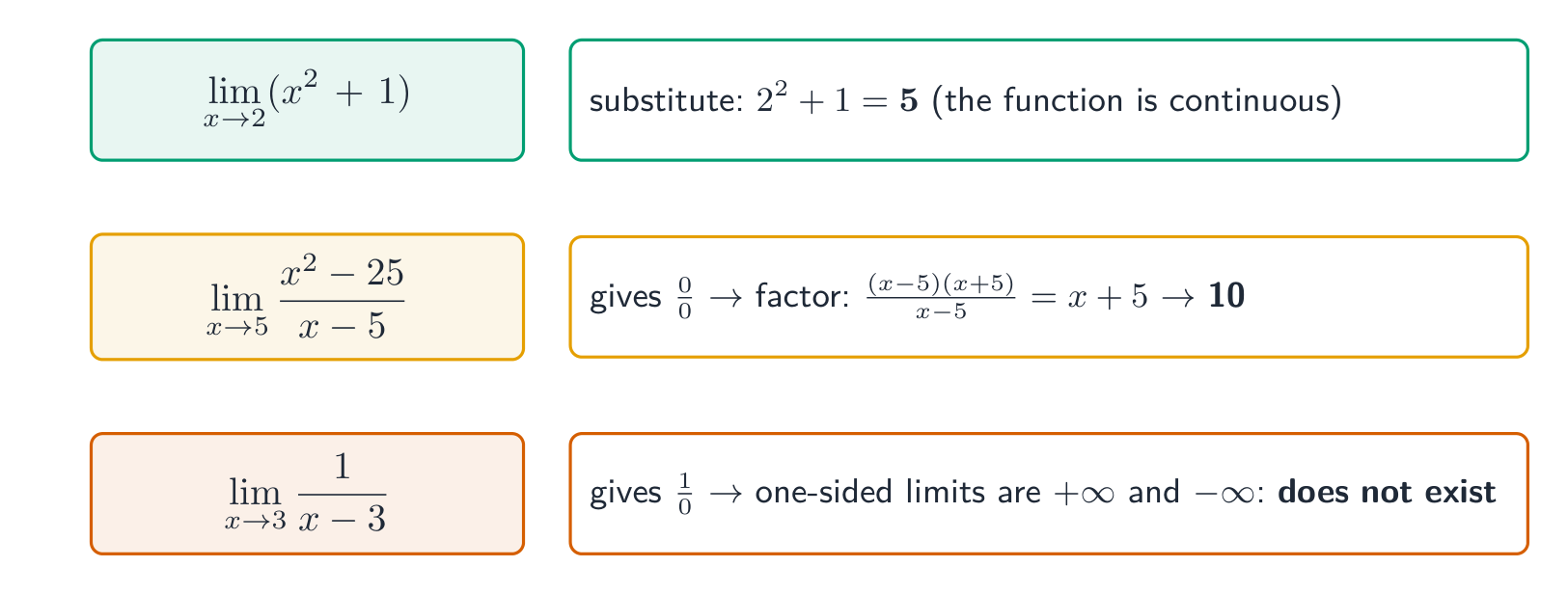
Choose a method for each, then evaluate:
- $\displaystyle\lim_{x\to 2}(x^2+1)$: substitution → $5$. (Continuous — no tricks.)
- $\displaystyle\lim_{x\to 5}\dfrac{x^2-25}{x-5}$: substitution gives $\tfrac00$ → factor → $x+5 \to 10$.
- $\displaystyle\lim_{x\to 3}\dfrac{1}{x-3}$: substitution gives $\tfrac{1}{0}$ → not algebra; the one-sided limits are $\pm\infty$, so the two-sided limit is DNE.
Selecting a procedure is a quick flow: substitute first. A real number is the answer; $\tfrac00$ means simplify (factor / rationalize / combine, or a known limit); $\tfrac{\text{nonzero}}{0}$ means an infinite limit or asymptote, not algebra. Then justify the choice and sanity-check the result.