Energy in simple harmonic motion · Energia no movimento harmônico simples
| English | Português |
|---|---|
| equilibrium/ˌiːkwɪˈlɪbrɪəm/ | equilíbrio |
| damping/ˈdæmpɪŋ/ | amortecimento |
Where the energy goes at the top of a swing
- At the highest point of a swing you are, for an instant, completely still. Your kinetic energy is exactly zero.
- A moment later you are moving faster than at any other point in the arc. Nothing pushed you; the energy was never gone.
- It was in the potential store, and it came straight back out. An oscillation is that exchange, repeated for as long as friction allows.
- This lesson is the energy of an oscillator: how it swaps, why the total is constant, and why the total depends on the square of the amplitude.
Para onde vai a energia no topo de um balanço
- No ponto mais alto de um balanço, você está, por um instante, completamente parado. Sua energia cinética é exatamente zero.
- Um momento depois você se move mais rápido do que em qualquer outro ponto do arco. Ninguém te empurrou; a energia nunca desapareceu.
- Estava no reservatório de potencial, e voltou direto para fora. Uma oscilação é esse intercâmbio, repetido por tanto tempo quanto a atrito permitir.
- Esta lição é sobre a energia de um oscilador: como ela troca, por que o total é constante e por que o total depende do quadrado da amplitude.
The swap
- At the equilibrium 平衡 position the speed is greatest, so the kinetic energy is maximum and the potential energy is at its minimum.
- At the extremes the oscillator is momentarily at rest, so the kinetic energy is zero and the potential energy is at its maximum.
- In between, the two trade continuously. The exchange happens twice per full oscillation, since the oscillator passes through the centre twice.
Two curves in opposite phase, and a flat line above them
A troca
- Na posição de equilíbrio 平衡位置, a velocidade é maior, logo a energia cinética é máxima e a energia potencial está em seu mínimo.
- Nas extremidades, o oscilador está momentaneamente parado, logo a energia cinética é zero e a energia potencial está em seu máximo.
- No meio, as duas trocam continuamente. A troca acontece duas vezes por oscilação completa, pois o oscilador passa pelo centro duas vezes.
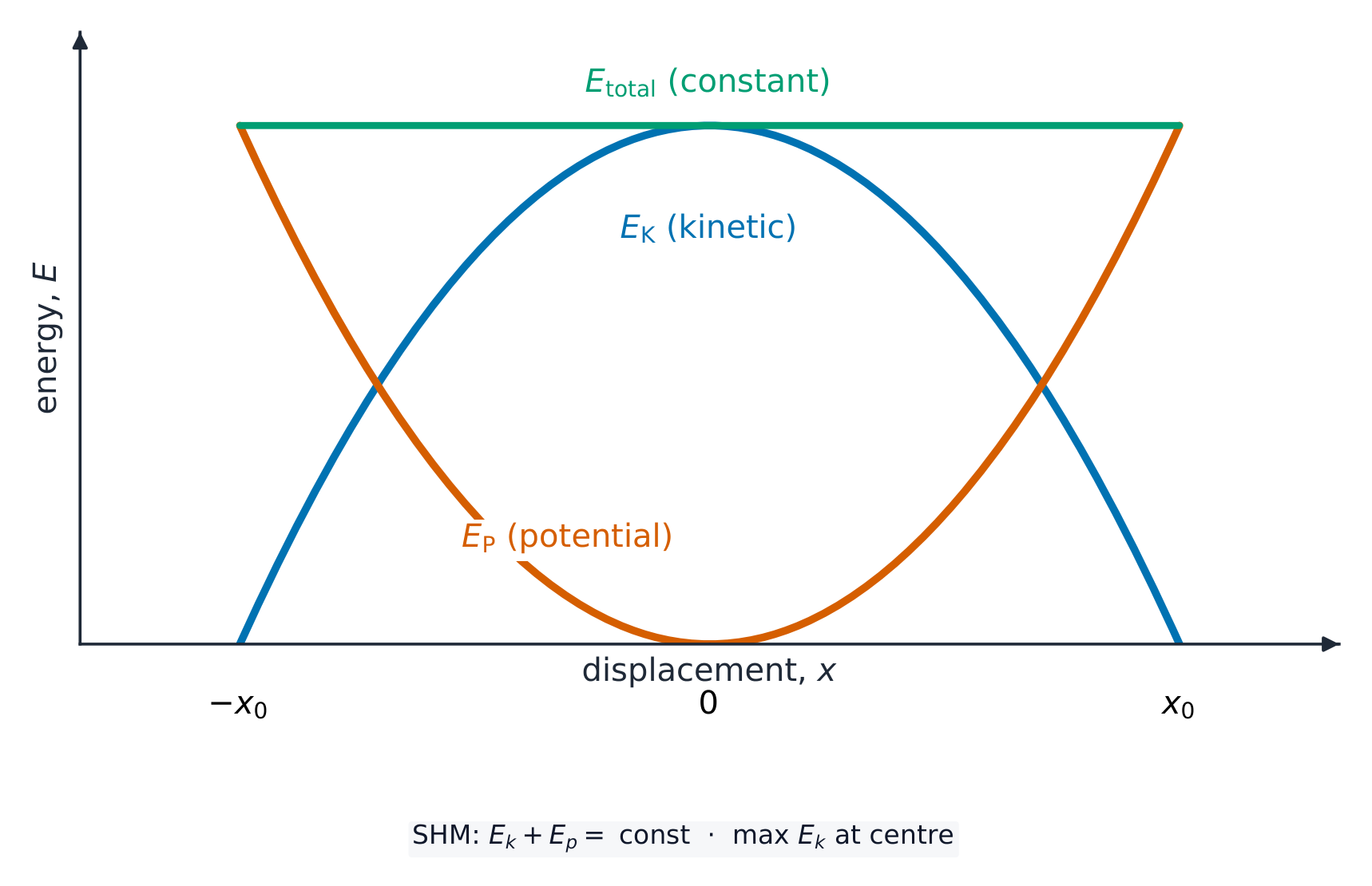
Duas curvas em fase oposta, e uma linha plana acima delas
The kinetic energy of an oscillator is greatest: · A energia cinética de um oscilador é maior:
Speed is greatest at the middle, so KE peaks there while PE is at its lowest. · A velocidade é máxima no meio, logo a EC atinge pico lá enquanto a EP está no mínimo.
At the extreme positions of the motion, all the energy is potential. · Nas posições extremas do movimento, toda a energia é potencial.
The oscillator is momentarily at rest there, so KE = 0 and all the energy is potential. · O oscilador está momentaneamente parado ali, logo EC = 0 e toda a energia é potencial.
The total is constant
- With no damping 阻尼, no resistive force removing energy, the total energy stays constant. This is conservation of energy applied to the oscillator.
- The easiest place to evaluate it is at the centre, where all of it is kinetic and the speed is $\omega x_0$:
- On a graph against displacement, the kinetic energy is a downward parabola, the potential energy an upward one, and their sum is a horizontal line.
The two parabolas add to a constant at every displacement
O total é constante
- Sem amortecimento 阻尼, nenhuma força resistiva removendo energia, a energia total permanece constante. Isso é conservação de energia aplicada ao oscilador.
- O lugar mais fácil de avaliá-lo é no centro, onde tudo é cinético e a velocidade é $\omega x_0$:
- Em um gráfico contra o deslocamento, a energia cinética é uma parábola voltada para baixo, a energia potencial uma voltada para cima, e sua soma é uma linha horizontal.
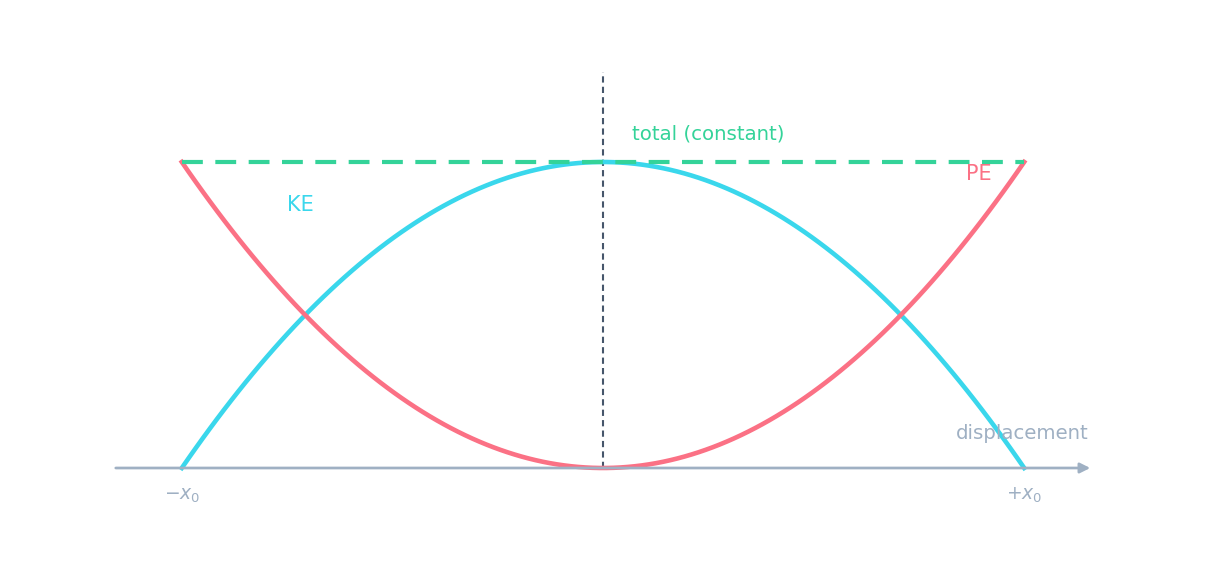
As duas parábolas somam uma constante em todo o deslocamento
Energy in SHM · Energia no MHS
KE + PE = constant · EC + EP = constante
Energy trades between kinetic (fastest at the centre) and potential · ação (max at the ends). · A energia transita entre cinética (máxima no centro) e potencial (máxima nos extremos).
With no damping, the total energy of an oscillator stays constant. · Sem amortecimento, a energia total de um oscilador permanece constante.
Energy just swaps between KE and PE; their sum is conserved. · A energia apenas troca entre EC e EP; a soma é conservada.
Energy and amplitude
- Because $E = \tfrac12 m\omega^2 x_0^2$, the total energy is proportional to the square of the amplitude.
- Double the amplitude and the energy is four times as large. Triple it and the energy is nine times.
- This is the relationship the exam tests most often, and answering "twice" for a doubled amplitude is the commonest error in the subtopic.
Energia e amplitude
- Como $E = \tfrac12 m\omega^2 x_0^2$, a energia total é proporcional ao quadrado da amplitude.
- Dobre a amplitude e a energia será quatro vezes maior. Triplique e a energia será nove vezes.
- Esta é a relação que a prova testa com mais frequência, e responder "dobro" para uma amplitude dobrada é o erro mais comum no subtema.
If the amplitude doubles, the total energy of an oscillator becomes: · Se a amplitude dobrar, a energia total de um oscilador torna-se:
$E \propto x_0^{2}$, so doubling $x_0$ gives $2^{2} = 4$ times the energy. · $E \propto x_0^{2}$, logo dobrar $x_0$ resulta em $2^{2} = 4$ vezes a energia.
The amplitude of an undamped oscillator is doubled. What happens to its total energy? · A amplitude de um oscilador sem amortecimento é dobrada. O que acontece com sua energia total?
E is proportional to the square of the amplitude, from E = m omega^2 x0^2 / 2. Answering "twice" is the commonest error in this subtopic. · E é proporcional ao quadrado da amplitude, de E = m omega^2 x0^2 / 2. Responder "o dobro" é o erro mais comum neste subtópico.
Worked example: find the total energy
- An oscillator of mass $0.20\ \text{kg}$ has angular frequency $10\ \text{rad/s}$ and amplitude $0.050\ \text{m}$. Find its total energy and its kinetic energy at a displacement of $0.030\ \text{m}$.
- Total: $E = \tfrac12 m \omega^2 x_0^2 = \tfrac12 \times 0.20 \times 10^2 \times 0.050^2 = 0.025\ \text{J}$.
- At $x = 0.030\ \text{m}$: $v = \omega\sqrt{x_0^2 - x^2} = 10\sqrt{0.050^2 - 0.030^2} = 0.40\ \text{m/s}$, so $E_{\text{k}} = \tfrac12 \times 0.20 \times 0.40^2 = 0.016\ \text{J}$.
- The potential energy there is the difference, $0.025 - 0.016 = 0.009\ \text{J}$. Using the constant total to get the second energy is quicker and safer than a separate formula.
Exemplo resolvido: encontre a energia total
- Um oscilador de massa $0.20\ \text{kg}$ tem frequência angular $10\ \text{rad/s}$ e amplitude $0.050\ \text{m}$. Encontre sua energia total e sua energia cinética em um deslocamento de $0.030\ \text{m}$.
- Total: $E = \tfrac12 m \omega^2 x_0^2 = \tfrac12 \times 0.20 \times 10^2 \times 0.050^2 = 0.025\ \text{J}$.
- Em $x = 0.030\ \text{m}$: $v = \omega\sqrt{x_0^2 - x^2} = 10\sqrt{0.050^2 - 0.030^2} = 0.40\ \text{m/s}$, logo $E_{\text{k}} = \tfrac12 \times 0.20 \times 0.40^2 = 0.016\ \text{J}$.
- A energia potencial lá é a diferença, $0.025 - 0.016 = 0.009\ \text{J}$. Usar o total constante para obter a segunda energia é mais rápido e seguro do que uma fórmula separada.
An oscillator has $m = 0.20\ \text{kg}$, $\omega = 10\ \dfrac{\text{rad}}{\text{s}}$ and amplitude $0.10\ \text{m}$. What is its total energy? · Um oscilador tem $m = 0.20\ \text{kg}$, $\omega = 10\ \dfrac{\text{rad}}{\text{s}}$ e amplitude $0.10\ \text{m}$. Qual é sua energia total?
$E = \tfrac{1}{2}m\omega^{2}x_0^{2} = \tfrac{1}{2} \times 0.20 \times 10^{2} \times 0.10^{2} = 0.10\ \text{J}$.
An oscillator of mass 0.20 kg has omega = 10 rad/s and amplitude 0.050 m. What is its total energy, in joules? · Um oscilador de massa 0.20 kg tem omega = 10 rad/s e amplitude 0.050 m. Qual é a sua energia total, em joules?
E = m omega^2 x0^2 / 2 = 0.20 x 100 x 0.0025 / 2 = 0.025 J. Evaluating at the centre, where all the energy is kinetic, is the quickest route. · E = m omega^2 x0^2 / 2 = 0.20 x 100 x 0.0025 / 2 = 0.025 J. Avaliar no centro, onde toda a energia é cinética, é o caminho mais rápido.
If the total energy is 0.025 J and the kinetic energy at some displacement is 0.016 J, the potential energy there is ____ J. · Se a energia total é 0.025 J e a energia cinética em algum deslocamento é 0.016 J, a energia potencial lá é ____ J.
The total is constant, so the potential energy is simply the total minus the kinetic. That subtraction is quicker and safer than a separate formula. · A total é constante, logo a energia potencial é simplesmente a total menos a cinética. Essa subtração é mais rápida e segura do que usar uma fórmula separada.
Worked example: reading the energy graphs
- Sketch how the kinetic energy, the potential energy and the total energy of an undamped oscillator vary with displacement.
- Kinetic energy: maximum at $x = 0$, falling to zero at $x = \pm x_0$, a downward parabola.
- Potential energy: zero at $x = 0$, rising to the maximum at $x = \pm x_0$, an upward parabola, and the mirror image of the first.
- Total: a horizontal line at the value of either maximum, since the two curves always add to the same amount.
- Against time instead of displacement, both curves are still parabola-shaped in energy but now oscillate at twice the frequency of the displacement, because energy peaks twice per cycle.
Exemplo resolvido: lendo os gráficos de energia
- Esboce como a energia cinética, a energia potencial e a energia total de um oscilador sem amortecimento variam com o deslocamento.
- Energia cinética: máxima em $x = 0$, caindo para zero em $x = \pm x_0$, uma parábola voltada para baixo.
- Energia potencial: zero em $x = 0$, subindo até o máximo em $x = \pm x_0$, uma parábola voltada para cima, e a imagem espelhada da primeira.
- Total: uma linha horizontal no valor de qualquer máximo, já que as duas curvas sempre somam a mesma quantidade.
- Contra o tempo em vez do deslocamento, ambas as curvas ainda têm formato parabólico na energia, mas agora oscilam com dobro da frequência do deslocamento, porque os picos de energia ocorrem duas vezes por ciclo.
Match each energy of an undamped oscillator to its graph against displacement. · Relacione cada forma de energia de um oscilador sem amortecimento ao seu gráfico contra o deslocamento.
The two parabolas are mirror images, so they add to the same value at every displacement. That flat line is conservation of energy drawn out. · As duas parábolas são imagens espelhadas, logo somam o mesmo valor em qualquer deslocamento. Essa linha plana representa a conservação de energia desenhada explicitamente.
Plotted against time, the kinetic energy of an oscillator repeats at twice the frequency of the displacement. · Traçado contra o tempo, a energia cinética de um oscilador repete-se com o dobro da frequência do deslocamento.
The oscillator passes through the centre twice per cycle, so kinetic energy peaks twice per cycle while displacement peaks once. · O oscilador passa pelo centro duas vezes por ciclo, logo a energia cinética atinge pico duas vezes por ciclo enquanto o deslocamento atinge pico apenas uma vez.
Energy against time runs at double the frequency
- Plot the displacement against time and you get one cycle per period. Plot the kinetic energy against time and you get two.
- The reason is the square. Kinetic energy depends on $v^2$, and $v$ passes through its maximum magnitude twice in every cycle, once going each way.
- So both energy curves complete two maxima per oscillation, and their frequency is double that of the displacement.
- The two curves are exact mirrors of each other about the half-total line, and their sum is a horizontal line at the total energy.
- A sketch question here is marked on three things: the doubled frequency, the two curves being out of step by half their period, and the flat total.
Energia contra o tempo corre com dobro da frequência
- Plote o deslocamento contra o tempo e você terá um ciclo por período. Plote a energia cinética contra o tempo e você terá dois.
- A razão é o quadrado. A energia cinética depende de $v^2$, e $v$ passa por sua magnitude máxima duas vezes em cada ciclo, uma vez em cada sentido.
- Então ambas as curvas de energia completam dois máximos por oscilação, e sua frequência é dupla que a do deslocamento.
- As duas curvas são reflexos exatos uma da outra sobre a linha de metade do total, e sua soma é uma linha horizontal na energia total.
- Uma questão de esboço aqui é pontuada em três coisas: a frequência dobrada, as duas curvas estarem defasadas pela metade seu período, e o total plano.
The kinetic energy of an oscillator varies at twice the frequency of its displacement. · A energia cinética de um oscilador varia com o dobro da frequência de seu deslocamento.
KE depends on v squared, and the speed reaches its maximum twice per cycle, once in each direction. The potential energy does the same, and the two sum to a flat line. · EC depende de v squared, e a velocidade atinge seu máximo duas vezes por ciclo, uma em cada direção. A energia potencial faz o mesmo, e as duas somam uma linha plana.
Marks that slip away
- Energy is proportional to amplitude squared. Doubling the amplitude gives four times the energy, not twice.
- Kinetic energy is maximum at the centre, potential at the ends. Do not swap them.
- Against time, the energy curves repeat at twice the frequency of the displacement, because there are two energy peaks per oscillation.
- The total is constant only when there is no damping. Say so when the question mentions resistive forces.
Marcas que escapam
- A energia é proporcional ao quadrado da amplitude. Dobrar a amplitude dá quatro vezes a energia, não o dobro.
- A energia cinética é máxima no centro, a potencial nas extremidades. Não troque-as.
- Contra o tempo, as curvas de energia se repetem com dobro da frequência do deslocamento, porque há dois picos de energia por oscilação.
- O total é constante apenas quando não há amortecimento. Diga isso quando a questão mencionar forças resistivas.
You've got it
- kinetic energy is maximum at the centre and zero at the extremes; potential energy does the opposite, and they exchange twice per cycle
- with no damping the total is constant: $E = \tfrac12 m\omega^2 x_0^2$, most easily evaluated at the centre where all of it is kinetic
- against displacement the energies are two opposite parabolas whose sum is a horizontal line
- $E \propto x_0^2$: double the amplitude, four times the energy
Entendeu?
- a energia cinética é máxima no centro e zero nas extremidades; a energia potencial faz o oposto, e elas trocam duas vezes por ciclo
- sem amortecimento o total é constante: $E = \tfrac12 m\omega^2 x_0^2$, mais facilmente avaliado no centro onde tudo é cinético
- contra o deslocamento as energias são duas parábolas opostas cuja soma é uma linha horizontal
- $E \propto x_0^2$: ** dobre a amplitude, quatro vezes a energia**