Damped and forced oscillations · Oscilações amortecidas e forçadas
| English | Português |
|---|---|
| driving force/ˈdraɪvɪŋ fɔːs/ | força motriz |
| damping/ˈdæmpɪŋ/ | amortecimento |
| forced oscillations/fɔːst ˌɒsɪˈleɪʃnz/ | oscilações forçadas |
| resonance/ˈrezənəns/ | ressonância |
| driving frequency/ˈdraɪvɪŋ ˈfriːkwənsi/ | frequência motora |
| natural frequency/ˈnætʃərəl ˈfriːkwənsi/ | frequência natural |
The bridge that had to be closed on its opening day
- London's Millennium Bridge opened in June 2000. Within hours it was swaying sideways so alarmingly that it was closed, and it stayed closed for nearly two years.
- Nobody had done anything wrong with the steel. The problem was that a small sideways sway made people adjust their step, that adjustment pushed the bridge at exactly the rhythm it liked, and the sway grew.
- A driving force at the right frequency, an oscillator with too little damping: those two ingredients build amplitude out of almost nothing.
- This lesson is damping 阻尼, forced oscillations 受迫振动, and resonance 共振.
A ponte que teve que ser fechada em seu dia de abertura
- A Ponte Millennium de Londres foi inaugurada em junho de 2000. Em poucas horas, ela estava oscilando lateralmente de forma tão alarmante que foi fechada, e permaneceu fechada por quase dois anos.
- Ninguém fez nada de errado com o aço. O problema era que uma pequena oscilação lateral fazia as pessoas ajustarem seu passo, esse ajuste empurrava a ponte exatamente no ritmo que ela gostava, e a oscilação crescia.
- Uma força motora na frequência certa, um oscilador com pouco amortecimento: esses dois ingredientes constroem amplitude a partir de quase nada.
- Esta lição é amortecimento 阻尼, oscilações forçadas 受迫振动 e ressonância 共振.
Damping
- Damping is the removal of energy from an oscillator by a resistive force such as friction or air drag.
- The amplitude decreases with time, and the lost energy is transferred to thermal energy in the oscillator and its surroundings.
- The frequency is essentially unchanged for light damping, so the oscillation keeps its rhythm as it fades. That is a bell: same note, dying away.
The envelope shrinks; the spacing of the peaks does not
Amortecimento
- Amortecimento é a remoção de energia de um oscilador por uma força resistiva como atrito ou arrasto aerodinâmico.
- A amplitude diminui com o tempo, e a energia perdida é transferida para energia térmica no oscilador e em seus arredores.
- A frequência permanece essencialmente inalterada para amortecimento leve, logo a oscilação mantém seu ritmo enquanto desvanece. É como um sino: mesma nota, morrendo aos poucos.

A envolvente encolhe; o espaçamento dos picos não muda
Damping of an oscillation is caused by: · O amortecimento de uma oscilação é causado por:
Friction or drag carries energy away as heat, so each swing is smaller than the last. · Atrito ou arrasto dissipam energia como calor, logo cada oscilação é menor que a anterior.
Damping reduces the frequency of an oscillation rather than its amplitude. · O amortecimento reduz a frequência de uma oscilação em vez de sua amplitude.
The amplitude falls as energy becomes thermal. For light damping the frequency is essentially unchanged, which is why a bell keeps its note as it fades. · A amplitude cai conforme a energia se torna térmica. Para amortecimento leve, a frequência é essencialmente inalterada, razão pela qual um sino mantém seu tom enquanto diminui.
The three degrees of damping
- Light damping: the amplitude decreases slowly over many oscillations. The system still oscillates.
- Critical damping: the system returns to equilibrium in the shortest possible time without oscillating or overshooting. This is what a car suspension and an analogue meter needle are designed for.
- Heavy damping: the system returns to equilibrium slowly and without oscillating, taking longer than critical. A heavy door closer is the example.
- The exam distinction is between critical and heavy: both avoid oscillating, but only critical does it in the shortest time.
Two curves that both avoid overshooting, one much slower than the other
Os três graus de amortecimento
- Amortecimento leve: a amplitude diminui lentamente ao longo de muitas oscilações. O sistema ainda oscila.
- Amortecimento crítico: o sistema retorna ao equilíbrio no menor tempo possível sem oscilar ou ultrapassar. Este é o objetivo de suspensões automotivas e agulhas de medidores analógicos.
- Amortecimento pesado: o sistema retorna ao equilíbrio lentamente e sem oscilar, levando mais tempo que o crítico. Um fechador de porta pesado é o exemplo.
- A distinção na prova é entre crítico e pesado: ambos evitam oscilar, mas apenas o crítico o faz no menor tempo.
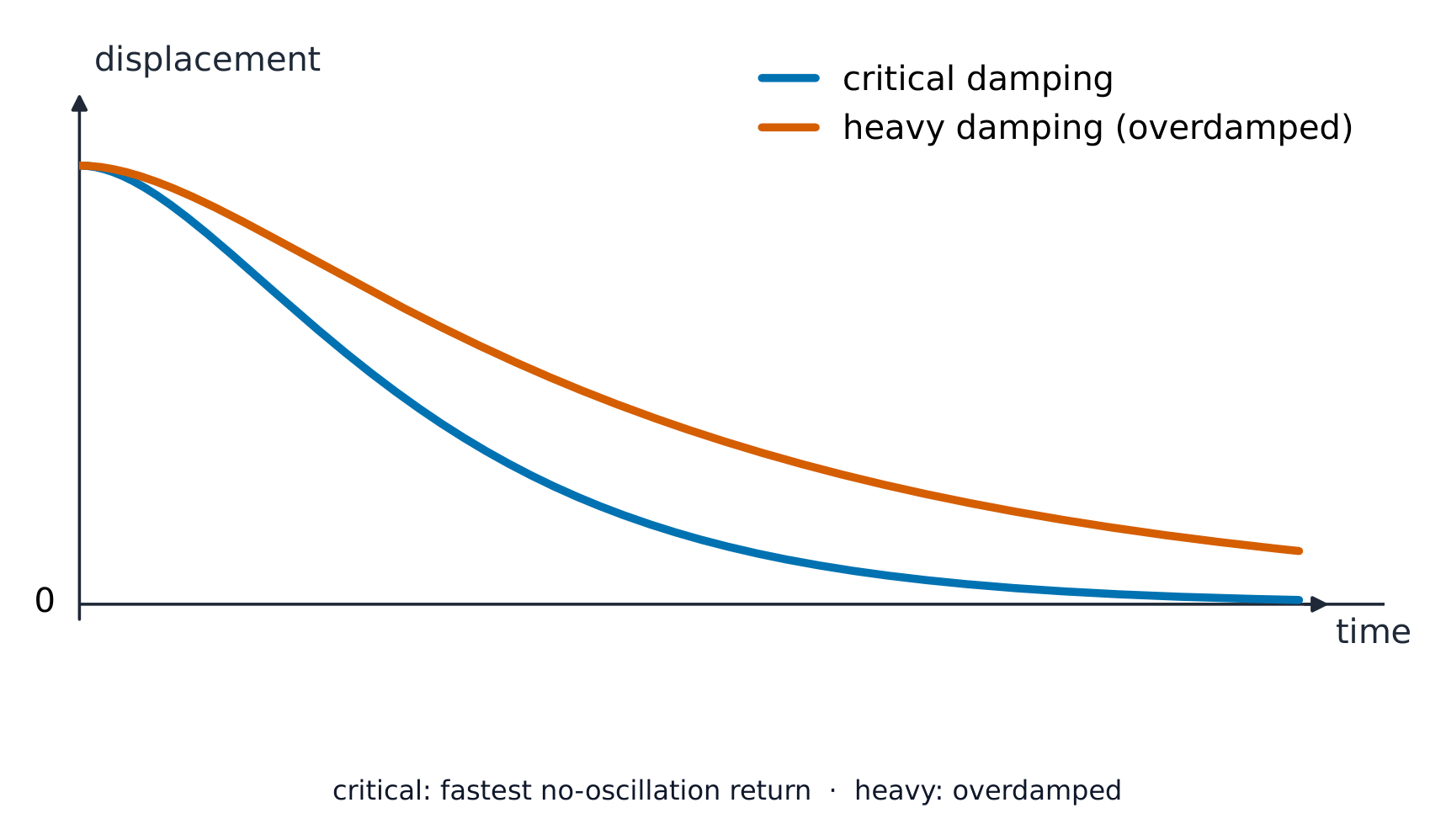
Duas curvas que evitam sobrepassar, sendo uma muito mais lenta que a outra
Match each type of damping to its behaviour. · Relacione cada tipo de amortecimento ao seu comportamento.
Critical damping returns to equilibrium in the shortest time without overshooting; heavy damping is slower still. · O amortecimento crítico retorna ao equilíbrio no menor tempo possível sem ultrapassar; o amortecimento pesado é ainda mais lento.
Worked example: choose the damping
- A car's suspension is designed so that after hitting a bump the car returns to its normal height quickly and without bouncing. What damping is used, and why?
- Critical damping: it returns the system to equilibrium in the shortest time with no oscillation, so the car neither bounces (light damping) nor sags back slowly (heavy damping).
- An analogue ammeter needle must settle on a reading as quickly as possible. Critical damping again, and for the same reason: a needle that overshoots must be waited for, and one that is heavily damped is slow to read.
- Name the type, then give both properties: shortest time and no oscillation.
Exemplo resolvido: escolher o amortecimento
- A suspensão de um carro é projetada para que, após bater num buraco, o carro retorne à sua altura normal rapidamente e sem oscilar. Que tipo de amortecimento é usado e porquê?
- Amortecimento crítico: retorna o sistema ao equilíbrio no menor tempo possível sem oscilação, logo o carro não oscila (amortecimento leve) nem desce lentamente (amortecimento pesado).
- A agulha de um amperímetro analógico deve se estabilizar na leitura o mais rápido possível. Amortecimento crítico novamente, pelo mesmo motivo: uma agulha que sobrepassa exige espera, e uma com amortecimento pesado é lenta para ler.
- Nomeie o tipo e dê ambas as propriedades: menor tempo e ausência de oscilação.
A car suspension returns the car to its normal height quickly without bouncing. Which damping is this, and why? · A suspensão de um carro retorna o veículo à altura normal rapidamente sem balançar. Que tipo de amortecimento é esse e por quê?
Heavy damping also avoids oscillating but takes longer, so the car would sag back slowly. Give both properties: shortest time and no oscillation. · O amortecimento pesado também evita oscilações, mas leva mais tempo, assim o carro afundaria lentamente. Cite ambas as propriedades: menor tempo e ausência de oscilação.
Forced oscillations
- A forced oscillation happens when a driving force 驱动力 of frequency $f_{\text{d}}$ is applied to a system.
- After the start-up settles, the system oscillates at the driving frequency 驱动频率, not at its own natural frequency.
- Its natural frequency 固有频率 $f_0$ is the frequency at which it oscillates when displaced and left alone, with no driving force.
- Both facts matter and are often confused: the driving frequency sets how fast it oscillates, and the natural frequency decides how big the response is.
Oscilações forçadas
- Uma oscilação forçada ocorre quando uma força motriz 驱动力 de frequência $f_{\text{d}}$ é aplicada a um sistema.
- Após a fase inicial se estabilizar, o sistema oscila na frequência da força motriz 驱动频率, não na sua frequência natural própria.
- Sua frequência natural 固有频率 $f_0$ é a frequência com que oscila quando deslocado e deixado sozinho, sem força motriz.
- Ambos os fatos são importantes e frequentemente confundidos: a frequência da força motriz define como rápida é a oscilação, e a frequência natural decide quão grande é a resposta.
A forced oscillator vibrates at: · Um oscilador forçado vibra em:
It follows the driver — it oscillates at the driving frequency $f_{\text{d}}$. · Ele segue o motor — oscila na frequência da força motriz $f_{\text{d}}$.
Once the start-up has settled, a forced oscillator vibrates at the ____ frequency. · Depois que o regime transitório se estabelece, um oscilador forçado vibra na frequência ____.
The driving frequency sets how fast it oscillates; the natural frequency decides only how large the response is. · A frequência motriz define a rapidez da oscilação; a frequência natural decide apenas a magnitude da resposta.
Resonance
- Resonance occurs when the driving frequency equals the natural frequency of the system. The amplitude is then a maximum, and there is maximum transfer of energy from the driver to the system.
- The lighter the damping, the higher and sharper the resonance peak, and the closer the peak sits to $f_0$. Heavier damping gives a lower, broader peak.
- Everyday resonance: pushing a swing in time with it, a wine glass shattered by a sung note, a radio tuned to a station, and the Millennium Bridge.
Same natural frequency, very different responses
Ressonância
- Ressonância ocorre quando a frequência da força motriz é igual à frequência natural do sistema. A amplitude torna-se então um máximo, e há máxima transferência de energia do motor para o sistema.
- Quanto menor o amortecimento, o pico de ressonância é mais alto e estreito, e fica mais próximo de $f_0$. Maior amortecimento produz um pico mais baixo e largo.
- Ressonância no dia a dia: empurrar um balanço no ritmo certo, um copo de vinho estilhaçado por uma nota cantada, um rádio sintonizado em uma emissora e a Ponte Millennium.

Mesma frequência natural, respostas muito diferentes
Resonance happens when the driving frequency equals the ____ frequency. · Ressonância ocorre quando a frequência motriz é igual à ____ frequência.
At $f_{\text{d}} = f_0$ the driver feeds energy in most effectively and the amplitude peaks. · Em $f_{\text{d}} = f_0$, o motor transfere energia com maior eficiência e a amplitude atinge o pico.
Lighter damping gives a sharper, higher resonance peak. · Menor amortecimento resulta em um pico de ressonância mais agudo e alto.
Less energy is lost each cycle, so the amplitude builds higher and the peak is narrower. · Menos energia é perdida por ciclo, logo a amplitude aumenta mais e o pico fica mais estreito.
Worked example: describe a resonance curve
- Sketch and describe how the amplitude of a lightly damped driven oscillator varies with driving frequency. [3]
- The amplitude is small at low driving frequency, rises to a sharp maximum when the driving frequency equals the natural frequency, and falls again at higher frequencies.
- With greater damping the peak is lower and broader, and occurs at a slightly lower frequency.
- The mark most often lost is failing to say where the peak is: at the natural frequency, which is the whole definition of resonance.
Exemplo resolvido: descrever uma curva de ressonância
- Desenhe e descreva como a amplitude de um oscilador forçado com amortecimento leve varia com a frequência da força motriz. [3]
- A amplitude é pequena em baixa frequência da força motriz, sobe até um máximo agudo quando a frequência da força motriz é igual à frequência natural, e cai novamente em frequências mais altas.
- Com maior amortecimento o pico é mais baixo e largo, e ocorre numa frequência ligeiramente inferior.
- O erro mais comum é não dizer onde está o pico: na frequência natural, que é toda a definição de ressonância.
Resonance · Ressonância
Drive the swing at different frequencies. Far from its natural frequency it barely moves; tune them to match and the amplitude explodes — resonance, the same effect that can shake a bridge apart. · Acione o balanço em diferentes frequências. Longe de sua frequência natural, ele mal se move; ajuste-as para corresponder e a amplitude explode — ressonância, o mesmo efeito que pode destruir uma ponte.
Describing a resonance curve, which statements earn marks? Select all · todos that apply. · Ao descrever uma curva de ressonância, quais afirmações rendem pontos? Selecione todas as que se aplicam.
Beyond the peak the amplitude falls again. Saying where the peak is, at the natural frequency, is the mark most often lost. · Além do pico, a amplitude cai novamente. Dizer onde o pico ocorre, na frequência natural, é a marca mais frequentemente perdida.
Wanted and unwanted
- Wanted: a radio or television tuned by matching a circuit's natural frequency to the broadcast; a microwave oven driving water molecules; magnetic resonance imaging; a musical instrument's air column or string.
- Unwanted: a bridge or building driven by wind, footsteps or an earthquake; a vibrating car panel at one particular engine speed.
- The engineering answer to unwanted resonance is to increase the damping, which lowers and broadens the peak, or to change the natural frequency so it no longer matches the driver.
Desejável e indesejável
- Desejável: um rádio ou televisão sintonizados combinando a frequência natural de um circuito com a transmissão; um micro-ondas acionando moléculas de água; ressonância magnética; a coluna de ar ou corda de um instrumento musical.
- Indesejável: uma ponte ou edifício acionado por vento, passos ou terremoto; um painel de carro vibrando a uma determinada rotação do motor.
- A solução de engenharia para ressonância indesejável é aumentar o amortecimento, o que abaixa e alarga o pico, ou alterar a frequência natural para que deixe de coincidir com o motor.
Select all · todos the examples of resonance. · Selecione todas os exemplos de ressonância.
Each of the first three matches a driving frequency to a natural frequency. A rolling ball is not a driven oscillation. · Cada uma das três primeiras corresponde a uma frequência motriz igual à frequência natural. Uma bola rolando não é uma oscilação forçada.
Marks that slip away
- A damped oscillator loses amplitude, not frequency. Say what decreases.
- Critical damping is the shortest time without oscillating; heavy damping also avoids oscillating but is slower. Give both properties.
- A forced oscillator vibrates at the driving frequency. Its natural frequency decides only how large the response is.
- Resonance is the driving frequency equal to the natural frequency, not merely close to it. Name where the peak is.
Marcas que escapam
- Um oscilador amortecido perde amplitude, não frequência. Diga o que diminui.
- O amortecimento crítico é o menor tempo sem oscilar; o amortecimento pesado também evita oscilações mas é mais lento. Dê ambas as propriedades.
- Um oscilador forçado vibra na frequência motriz. Sua frequência natural decide apenas quão grande é a resposta.
- Ressonância é a frequência da força motriz igual à frequência natural, não apenas próxima. Nomeie onde está o pico.
An engineer must stop a footbridge resonating with pedestrians' footsteps. Put a sensible approach in order. · Um engenheiro deve evitar que uma passarela entre em ressonância com os passos dos pedestres. Organize uma abordagem sensata.
The two engineering answers to unwanted resonance are more damping or a different natural frequency. Both were used on the Millennium Bridge. · As duas soluções de engenharia para ressonância indesejada são mais amortecimento ou uma frequência natural diferente. Ambas foram usadas na Ponte Millennium.
You've got it
- damping is a resistive force removing energy, so the amplitude falls and the energy becomes thermal; the rhythm is essentially unchanged
- light damping decays slowly and still oscillates; critical returns to equilibrium in the shortest time without oscillating; heavy also does not oscillate but is slower
- a forced oscillator vibrates at the driving frequency, whatever its natural frequency
- resonance is driving frequency equal to natural frequency, giving maximum amplitude and maximum energy transfer; lighter damping gives a higher, sharper peak
Entendeu?
- amortecimento é uma força resistiva removendo energia, logo a amplitude cai e a energia torna-se térmica; o ritmo permanece essencialmente inalterado
- amortecimento leve decai lentamente e ainda oscila; crítico retorna ao equilíbrio no menor tempo sem oscilar; pesado também não oscila mas é mais lento
- um oscilador forçado vibra na frequência motriz, independentemente de sua frequência natural
- ressonância é frequência motriz igual à frequência natural, dando amplitude máxima e máxima transferência de energia; amortecimento leve resulta em pico mais alto e estreito