Temperature scales · Escalas de temperatura
| English | Português |
|---|---|
| thermometer/θɜːˈmɒmɪtə/ | termômetro |
| thermocouple/ˈθɜːməkʌpl/ | termopar |
| thermodynamic/ˌθɜːməʊdaɪˈnæmɪk/ | termodinâmico |
| kelvin/ˈkelvɪn/ | kelvin |
| absolute zero/ˈæbsəluːt ˈzɪərəʊ/ | zero absoluto |
| Celsius/ˈselsɪəs/ | Celsius |
How a thermometer 温度计 works
- A thermometer needs something that changes with temperature.
- A liquid expands, a metal's resistance rises, a gas swells.
- Read that change and you read the temperature.
Como um termômetro 温度计 funciona
- Um termômetro precisa de algo que mude com a temperatura.
- Um líquido expande, a resistência de um metal aumenta, um gás se expande.
- Leia essa variação e você lê a temperatura.
Temperature scale lab · Laboratório de escala de temperatura
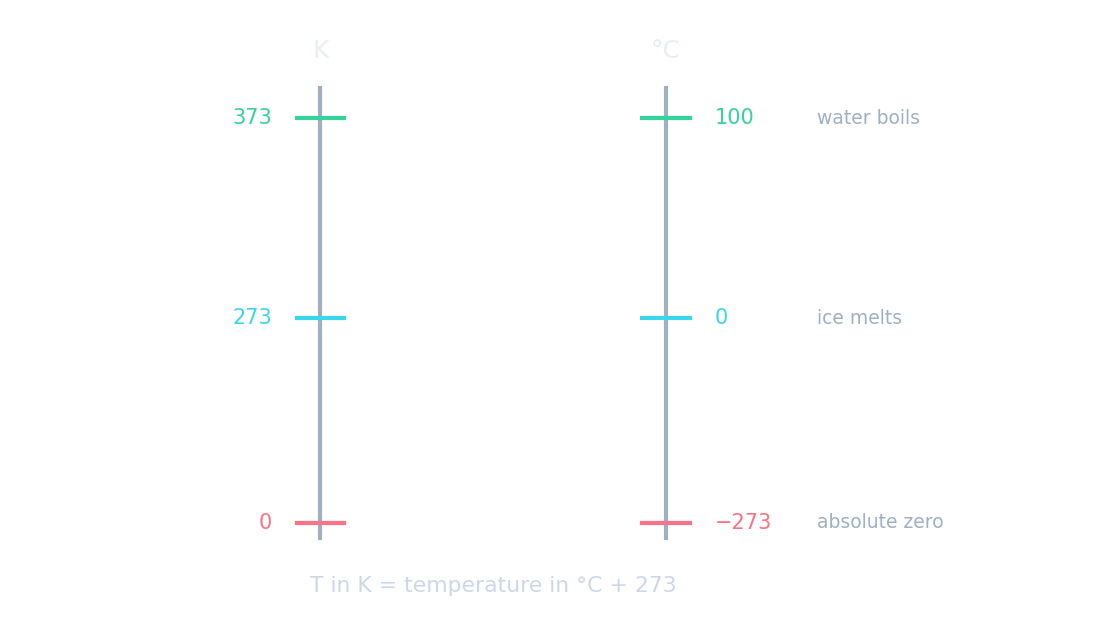
Kelvin index = Celsius index + 2.73 · Índice Kelvin = Índice Celsius + 2.73
Slide Celsius temperature and see the Kelvin scale shift by 273. · Deslize a temperatura Celsius e veja a escala Kelvin mudar em 273.
Kinds of thermometer
- Anything that changes repeatably with temperature works:
- expansion of a liquid, resistance of a metal, e.m.f. of a thermocouple 热电偶, volume of a gas.
A thermometer measures temperature on a defined scale
Tipos de termômetro
- Qualquer coisa que mude repetidamente com a temperatura serve:
- expansão de um líquido, resistência de um metal, t.e.m. de termopar 热电偶, volume de um gás.

Um termômetro mede a temperatura em uma escala definida
Select all · todos the properties that can be used to measure temperature. · Selecione todas as propriedades que podem ser usadas para medir a temperatura.
Any property that changes repeatably with temperature works. The fixed colour of the case does not. · Qualquer propriedade que mude repetidamente com a temperatura funciona. A cor fixa da caixa não funciona.
The absolute scale
- The thermodynamic 热力学 (absolute) scale uses the kelvin 开尔文 (K) and depends on no single substance.
- Absolute zero 绝对零度 ($0\ \text{K}$) is the lowest possible temperature — least internal energy. Nothing is colder.
A escala absoluta
- A escala termodinâmica 热力学 (absoluta) usa o kelvin 开尔文 (K) e não depende de nenhuma substância específica.
- Zero absoluto 绝对零度 ($0\ \text{K}$) é a temperatura mais baixa possível — menor energia interna. Nada é mais frio.
Absolute zero (0 K) is: · Zero absoluto (0 K) é:
At 0 K a system has its least possible internal energy; nothing can be made colder. · A 0 K, um sistema possui sua menor energia interna possível; nada pode ficar mais frio.
Kelvin and Celsius 摄氏度
- $T/\text{K} = \theta/°\text{C} + 273.15$. So $0\ °\text{C} = 273\ \text{K}$.
- A kelvin and a Celsius degree are the same size, so a change of $1\ \text{K} = 1\ °\text{C}$.
- Always use kelvin in gas-law calculations.
Extrapolating the pressure-temperature line back to zero pressure gives absolute zero, about -273 degC
Kelvin e Celsius 摄氏度
- $T/\text{K} = \theta/°\text{C} + 273.15$. Então $0\ °\text{C} = 273\ \text{K}$.
- Um grau kelvin e um grau Celsius têm o mesmo tamanho, então uma variação de $1\ \text{K} = 1\ °\text{C}$.
- Use sempre kelvin em cálculos de leis dos gases.

Extrapolar a linha pressão-temperatura de volta até zero pressão dá o zero absoluto, cerca de -273 degC
What is $27\ °\text{C}$ in kelvin? · O que é $27\ °\text{C}$ em kelvin?
$T/\text{K} = \theta/°\text{C} + 273 = 27 + 273 = 300\ \text{K}$.
A temperature rise of 1 K is the same as a rise of 1 °C. · Um aumento de temperatura de 1 K é o mesmo que um aumento de 1 °C.
The two scales have the same size of degree — only their zero points differ (by 273.15). · As duas escalas têm a mesma magnitude de grau — apenas seus pontos zero diferem (por 273.15).
In gas-law calculations, the temperature must be in: · Em cálculos de leis dos gases, a temperatura deve estar em:
Gas laws use absolute temperature — kelvin. Using °C gives wrong answers. · As leis dos gases usam temperatura absoluta — kelvin. Usar °C dá respostas erradas.
A temperature is 27 degrees Celsius. What is it in kelvin? · Uma temperatura é 27 graus Celsius. Qual é ela em kelvin?
T = 27 + 273 = 300 K. A temperature DIFFERENCE, though, is the same number in both scales: a rise of 27 C is a rise of 27 K. · T = 27 + 273 = 300 K. Uma DIFERENÇA de temperatura, no entanto, é o mesmo número em ambas as escalas: um aumento de 27°C é um aumento de 27 K.
Why the thermodynamic scale is special
- It does not depend on the property of any particular substance — it is defined from the behaviour of an ideal gas, with absolute zero and the triple point of water as its fixed points.
- A liquid-in-glass thermometer assumes its liquid expands uniformly with temperature. That is only approximately true, so it agrees with the thermodynamic scale exactly only at the points where it was calibrated.
- That is the exam's "explain why a liquid-in-glass thermometer does not measure thermodynamic temperature".
Por que a escala termodinâmica é especial
- Ela não depende da propriedade de nenhuma substância específica — é definida pelo comportamento de um gás ideal, com zero absoluto e o ponto triplo da água como pontos fixos.
- Um termômetro de líquido em vidro assume que seu líquido se expande uniformemente com a temperatura. Isso só é aproximadamente verdade, então ele concorda exatamente com a escala termodinâmica apenas nos pontos onde foi calibrado.
- Essa é a resposta do exame para "explique por que um termômetro de líquido em vidro não mede temperatura termodinâmica".
What makes the thermodynamic scale special? Select all · todos that apply. · O que torna a escala termodinâmica especial? Selecione todas as que se aplicam.
The unit is a consequence, not the defining feature. A mercury thermometer's scale depends on how mercury happens to expand; this one depends on nothing of the sort. · A unidade é uma consequência, não a característica definidora. A escala de um termômetro de mercúrio depende de como o mercúrio se expande; este não depende disso.
Choosing a thermometer
- Platinum resistance: resistance varies linearly and repeatably with temperature over a wide range — very accurate. But it has a large thermal capacity, so it is slow and cannot follow a rapidly changing temperature.
- Thermocouple: two metal junctions give an e.m.f.; tiny, fast, wide range, measures at a point — ideal for a changing temperature.
- Liquid in glass: cheap and simple; limited range, slow, and reads only where the bulb is.
Escolhendo um termômetro
- Resistência de platina: a resistência varia linearmente e repetidamente com a temperatura sobre uma faixa ampla — muito preciso. Mas tem alta capacidade térmica, então é lento e não consegue seguir uma temperatura que muda rapidamente.
- Termopar: duas junções metálicas fornecem uma t.e.m.; pequeno, rápido, faixa ampla, mede em um ponto — ideal para temperaturas variáveis.
- Líquido em vidro: barato e simples; faixa limitada, lento e lê apenas onde está a bulbo.
Match each thermometer to its key feature. · Combine cada termômetro com sua característica principal.
A large thermal capacity makes the resistance thermometer accurate but slow; a thermocouple's tiny junction responds fast; the absolute scale is defined from ideal-gas behaviour, not a material. · Uma grande capacidade térmica torna o termômetro de resistência preciso, mas lento; um termopar tem junção minúscula e responde rápido; a escala absoluta é definida pelo comportamento do gás ideal, não por um material.
Match each thermometer to the property it uses. · Combine cada termômetro com a propriedade que utiliza.
A thermocouple has a small thermal capacity and responds fast, which is why it is chosen for a rapidly changing temperature. · Um termopar tem pequena capacidade térmica e responde rapidamente, sendo escolhido para temperatura variável rapidamente.
Worked example: finding absolute zero, then converting
A fixed volume of gas has pressure $100\ \text{kPa}$ at $0\ °\text{C}$ and $136.6\ \text{kPa}$ at $100\ °\text{C}$. Then: a gas is heated from $27\ °\text{C}$ to $742\ °\text{C}$.
- Gradient: $\dfrac{136.6 - 100}{100} = 0.366\ \dfrac{\text{kPa}}{°\text{C}}$; pressure is a straight line in temperature.
- Extrapolate to zero pressure: $\theta = -\dfrac{100}{0.366} = -273\ °\text{C}$ — absolute zero.
- Convert: $27\ °\text{C} = 300\ \text{K}$; $742\ °\text{C} = 1015\ \text{K}$.
- Temperature change: $742 - 27 = 715\ °\text{C} = 715\ \text{K}$ — a difference is the same number on both scales.
- Check: absolute zero is where the pressure of an ideal gas would fall to zero; the gas would liquefy long before, which is why the point is found by extrapolation, not by cooling.
Exemplo resolvido: encontrando o zero absoluto, depois convertendo
Um volume fixo de gás tem pressão $100\ \text{kPa}$ em $0\ °\text{C}$ e $136.6\ \text{kPa}$ em $100\ °\text{C}$. Então: um gás é aquecido de $27\ °\text{C}$ para $742\ °\text{C}$.
- Declive: $\dfrac{136.6 - 100}{100} = 0.366\ \dfrac{\text{kPa}}{°\text{C}}$; a pressão é uma linha reta na temperatura.
- Extrapolado para zero pressão: $\theta = -\dfrac{100}{0.366} = -273\ °\text{C}$ — zero absoluto.
- Converter: $27\ °\text{C} = 300\ \text{K}$; $742\ °\text{C} = 1015\ \text{K}$.
- Variação de temperatura: $742 - 27 = 715\ °\text{C} = 715\ \text{K}$ — uma diferença é o mesmo número nas duas escalas.
- Verificar: zero absoluto é onde a pressão de um gás ideal cairia a zero; o gás liquefaria muito antes, razão pela qual esse ponto é encontrado por extrapolação, não por resfriamento.
A gas is heated from $20\ °\text{C}$ to · até $95\ °\text{C}$. What is the temperature change, in K? · Um gás é aquecido de $20\ °\text{C}$ a $95\ °\text{C}$. Qual é a variação de temperatura, em K?
A change is the same number on both scales: $95 - 20 = 75\ °\text{C} = 75\ \text{K}$. Adding 273 would be wrong here. · Uma variação é o mesmo número nas duas escalas: $95 - 20 = 75\ °\text{C} = 75\ \text{K}$. Somar 273 seria errado aqui.
Add $273$ to convert a Celsius temperature to kelvin, but a temperature difference is the same number on both scales — do not add $273$ to a $\Delta T$. A kelvin temperature can never be negative. And absolute zero is the temperature of minimum internal energy, not zero energy — "the molecules stop moving" is not an accepted answer.
Adicione $273$ para converter uma temperatura em Celsius para kelvin, mas uma diferença de temperatura é o mesmo número nas duas escalas — não adicione $273$ a um $\Delta T$. Uma temperatura em kelvin nunca pode ser negativa. E zero absoluto é a temperatura de energia interna mínima, não energia zero — "as moléculas param de se mover" não é uma resposta aceita.
Absolute zero is the temperature at which a substance has its ____ internal energy. · O zero absoluto é a temperatura na qual uma substância tem sua ____ energia interna.
Not zero energy — the minimum possible. That is why "the molecules stop moving" is not accepted. · Não é energia zero — é o mínimo possível. Por isso "as moléculas param de se mover" não é aceito.
You've got it
- a thermometer uses any property that changes repeatably with temperature; the thermodynamic scale depends on no substance
- absolute zero $= 0\ \text{K} = -273.15\ °\text{C}$, the lowest possible temperature (minimum internal energy)
- $T/\text{K} = \theta/°\text{C} + 273$; a difference is the same in K and °C; use kelvin in gas laws
Entendeu?
- um termômetro usa qualquer propriedade que mude repetidamente com a temperatura; a escala termodinâmica depende de nenhuma substância
- zero absoluto $= 0\ \text{K} = -273.15\ °\text{C}$, a temperatura mais baixa possível (energia interna mínima)
- $T/\text{K} = \theta/°\text{C} + 273$; uma diferença é a mesma em K e °C; use kelvin em leis dos gases