Centripetal force · Força centrípeta
| English | Português |
|---|---|
| tangent/ˈtændʒənt/ | tangente |
| centripetal acceleration/senˈtrɪpɪtl əkˌseləˈreɪʃn/ | aceleração centrípeta |
| centripetal force/senˈtrɪpɪtl fɔːs/ | força centrípeta |
| perpendicular/ˌpɜːpənˈdɪkjʊlə/ | perpendiculares |
| tension/ˈtenʃn/ | tensão |
| banked/bæŋkt/ | inclinado |
Let go and it flies off
- Swing a ball on a string in a circle, then let go.
- It shoots off in a straight line — not outwards, but along the tangent 切线.
- So while it circled, something must have pulled it inward.
Solte e ele voará
- Balanceie uma bola atada a uma corda em um círculo, depois solte-a.
- Ela dispara em linha reta — não para fora, mas ao longo da tangente 切线.
- Então, enquanto circulava, algo deve tê-la puxado para dentro.
Centripetal acceleration 向心加速度
- Constant speed, but ever-changing direction, means the velocity changes — an acceleration.
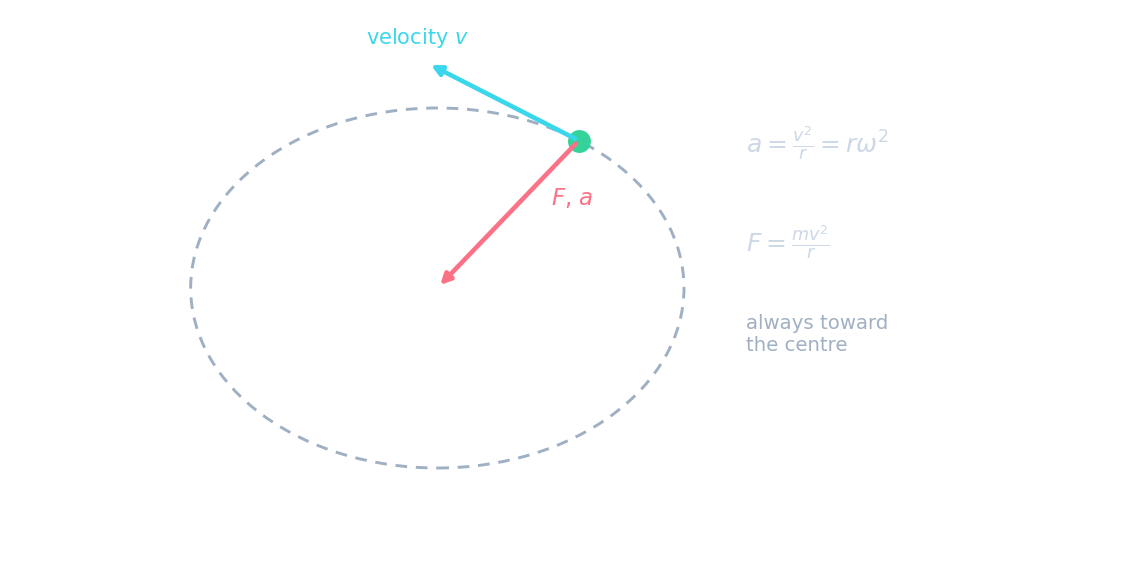
- It points to the centre: $a = \dfrac{v^{2}}{r} = r\omega^{2}$ (and, since $v = r\omega$, also $a = v\omega$).
Aceleração centrípeta 向心加速度
- Velocidade constante, mas direção sempre mudando, significa que a velocidade muda — uma aceleração.
- Aponta para o centro: $a = \dfrac{v^{2}}{r} = r\omega^{2}$ (e, já que $v = r\omega$, também $a = v\omega$).
Centripetal force and speed · Força centrípeta e velocidade
F = mv²/r
For circular motion the force needed grows with the square of the speed — double v, four times the force. · Para o movimento circular, a força necessária cresce com o quadrado da velocidade — duplique v, quatro vezes a força.
An object moving round a circle at constant speed is still accelerating because: · Um objeto movendo-se em círculo a velocidade constante ainda está acelerando porque:
Velocity is a vector. Even at constant speed, the changing direction means a changing velocity — an acceleration toward the centre. · Velocidade é um vetor. Mesmo com velocidade constante, a mudança de direção implica mudança no vetor velocidade — uma aceleração em direção ao centro.
An object moves at $4.0\ \dfrac{\text{m}}{\text{s}}$ round a circle of radius $2.0\ \text{m}$. Find its centripetal acceleration. · Um objeto move-se a $4.0\ \dfrac{\text{m}}{\text{s}}$ ao redor de um círculo de raio $2.0\ \text{m}$. Encontre sua aceleração centrípeta.
$a = \dfrac{v^{2}}{r} = \dfrac{4.0^{2}}{2.0} = 8.0\ \dfrac{\text{m}}{\text{s}^2}$.
Centripetal force 向心力
- By $F = ma$: $F = \dfrac{mv^{2}}{r} = mr\omega^{2}$, pointing to the centre.
- It is always perpendicular 垂直 to the velocity, so it does no work and the speed stays constant.
A spinning fairground ride needs a centripetal force toward the centre
Força centrípeta 向心力
- Por $F = ma$: $F = \dfrac{mv^{2}}{r} = mr\omega^{2}$, apontando para o centro.
- Sempre é perpendicular 垂直 à velocidade, então não faz trabalho e a velocidade permanece constante.

Um brinquedo giratório de parque de diversões precisa de uma força centrípeta em direção ao centro
The centripetal force points toward the centre of the circle. · A força centrípeta aponta para o centro do círculo.
Yes — always toward the centre, perpendicular to the velocity. · Sim — sempre para o centro, perpendicular à velocidade.
A $2.0\ \text{kg}$ ball moves at $4.0\ \dfrac{\text{m}}{\text{s}}$ round a circle of radius $2.0\ \text{m}$. What centripetal force is needed? · Uma bola de massa $2.0\ \text{kg}$ move-se a $4.0\ \dfrac{\text{m}}{\text{s}}$ ao redor de um círculo de raio $2.0\ \text{m}$. Que força centrípeta é necessária?
$F = \dfrac{mv^{2}}{r} = \dfrac{2.0 \times 4.0^{2}}{2.0} = 16\ \text{N}$.
Not a new force
- "Centripetal force" is not a new kind of force.
- It is the net result of the real forces — tension 张力, gravity, friction, a normal force.
The velocity points along the tangent; the force and acceleration point to the centre
Não é uma nova força
- "Força centrípeta" não é um novo tipo de força.
- É o resultado líquido das forças reais — tensão 张力, gravidade, atrito, força normal.

A velocidade aponta ao longo da tangente; a força e a aceleração apontam para o centro
The centripetal force is: · A força centrípeta é:
It is whatever real force(s) happen to point to the centre — not a separate force of its own. · É qualquer força real que happens to aponte para o centro — não uma força separada por si mesma.
Where it comes from
- Ball on a string → tension. Car on a flat corner → friction.
- Planet or satellite → gravity. Banked 倾斜 track → the inward part of the normal force.
On a banked track the horizontal part of the road's force provides the centripetal force
De onde vem
- Bola atada a uma corda → tensão. Carro em curva plana → atrito.
- Planeta ou satélite → gravidade. Pista inclinada 倾斜 → a componente para dentro da força normal.

Em uma pista inclinada a parte horizontal da força da estrada fornece a força centrípeta
Match each circular motion to the force that provides the centripetal force. · Combine cada movimento circular com a força que fornece a força centrípeta.
Different situations, different real forces — but each points to the centre and provides $\dfrac{mv^{2}}{r}$. · Diferentes situações, diferentes forças reais — mas todas apontam para o centro e fornecem $\dfrac{mv^{2}}{r}$.
Worked example: how fast round the corner?
A $1200\ \text{kg}$ car takes a flat bend of radius $50\ \text{m}$. The largest friction force the tyres can provide is $8200\ \text{N}$.
- Friction is the centripetal force: $F = \dfrac{mv^{2}}{r}$, so the fastest safe speed has $\dfrac{1200\,v^{2}}{50} = 8200$.
- Solve: $v^{2} = \dfrac{8200 \times 50}{1200} = 342$, so $v = 18\ \dfrac{\text{m}}{\text{s}}$ (about $65\ \dfrac{\text{km}}{\text{h}}$).
- Tighter bend: halve $r$ and $v_{\text{max}}$ falls by $\sqrt{2}$ — the required force grows as $\dfrac{1}{r}$.
- Check: on a wet road the available friction drops, so the safe speed drops too, which is what the physics says and what road signs assume.
Exemplo resolvido: quão rápido na curva?
Um carro de $1200\ \text{kg}$ toma uma curva plana de raio $50\ \text{m}$. A maior força de atrito que os pneus podem fornecer é $8200\ \text{N}$.
- O atrito é a força centrípeta: $F = \dfrac{mv^{2}}{r}$, então a velocidade segura máxima tem $\dfrac{1200\,v^{2}}{50} = 8200$.
- Resolva: $v^{2} = \dfrac{8200 \times 50}{1200} = 342$, então $v = 18\ \dfrac{\text{m}}{\text{s}}$ (cerca de $65\ \dfrac{\text{km}}{\text{h}}$).
- Curva mais apertada: reduza $r$ pela metade e $v_{\text{max}}$ cai por $\sqrt{2}$ — a força necessária cresce conforme $\dfrac{1}{r}$.
- Verificação: numa estrada molhada o atrito disponível diminui, então a velocidade segura também diminui, o que a física diz e o que os sinais de trânsito assumem.
A $800\ \text{kg}$ car rounds a flat bend of radius $40\ \text{m}$. The maximum friction force available is $6400\ \text{N}$. What is the maximum safe speed, in m/s? · Um carro de massa $800\ \text{kg}$ faz uma curva plana de raio $40\ \text{m}$. A força de atrito máxima disponível é $6400\ \text{N}$. Qual é a velocidade máxima segura, em m/s?
$\dfrac{mv^{2}}{r} = F$, so $v^{2} = \dfrac{6400 \times 40}{800} = 320$ and · e $v = 17.9\ \dfrac{\text{m}}{\text{s}}$. · $\dfrac{mv^{2}}{r} = F$, logo $v^{2} = \dfrac{6400 \times 40}{800} = 320$ e $v = 17.9\ \dfrac{\text{m}}{\text{s}}$.
Vertical circles
- Going round an upright loop, the speed changes (gravity does work).
- At the top, weight and tension both point to the centre: $T + mg = \dfrac{mv^{2}}{r}$. At the bottom they oppose: $T - mg = \dfrac{mv^{2}}{r}$.
- The slowest speed at the top with the string just tight is $v_{\text{min}} = \sqrt{gr}$ (set tension $= 0$).
Going round a vertical circle, gravity helps at the top and opposes at the bottom — so the string tension is largest at the bottom
Círculos verticais
- Ao dar volta em uma laçada vertical, a velocidade muda (a gravidade realiza trabalho).
- No topo, peso e tensão apontam ambos para o centro: $T + mg = \dfrac{mv^{2}}{r}$. No fundo eles se opõem: $T - mg = \dfrac{mv^{2}}{r}$.
- A velocidade mínima no topo com a corda apenas esticada é $v_{\text{min}} = \sqrt{gr}$ (configure a tensão $= 0$).

Ao girar em um círculo vertical, a gravidade auxilia no topo e se opõe na base — então a tensão da corda é maior na base
At the top of a vertical loop, the slowest speed (string just tight) is: · No topo de um loop vertical, a menor velocidade (corda apenas esticada) é:
With tension $= 0$, gravity alone is the centripetal force: $mg = \dfrac{mv^{2}}{r}$, so $v_{\text{min}} = \sqrt{gr}$. · Com tensão $= 0$, a gravidade sozinha é a força centrípeta: $mg = \dfrac{mv^{2}}{r}$, logo $v_{\text{min}} = \sqrt{gr}$.
Worked example: tension top and bottom
A $0.50\ \text{kg}$ ball on a $1.0\ \text{m}$ string is whirled in a vertical circle. At the bottom its speed is $8.0\ \dfrac{\text{m}}{\text{s}}$.
- Bottom: $T - mg = \dfrac{mv^{2}}{r}$, so $T = 0.50 \times 9.81 + \dfrac{0.50 \times 8.0^{2}}{1.0} = 4.9 + 32 = 37\ \text{N}$.
- Speed at the top: energy conservation over a rise of $2r$: $v_{\text{top}}^{2} = 8.0^{2} - 2g(2.0) = 64 - 39 = 25$, so $v_{\text{top}} = 5.0\ \dfrac{\text{m}}{\text{s}}$.
- Top: $T + mg = \dfrac{mv^{2}}{r}$, so $T = \dfrac{0.50 \times 25}{1.0} - 4.9 = 12.5 - 4.9 = 7.6\ \text{N}$.
- Check: the tension is far larger at the bottom, which is where a string breaks. At the top $v_{\text{top}} > \sqrt{gr} = 3.1\ \dfrac{\text{m}}{\text{s}}$, so the string stays taut.
Exemplo resolvido: tração no topo e na base
Uma bola $0.50\ \text{kg}$ presa a uma corda $1.0\ \text{m}$ é girada em um círculo vertical. Na base, sua velocidade é $8.0\ \dfrac{\text{m}}{\text{s}}$.
- Base: $T - mg = \dfrac{mv^{2}}{r}$, logo $T = 0.50 \times 9.81 + \dfrac{0.50 \times 8.0^{2}}{1.0} = 4.9 + 32 = 37\ \text{N}$.
- Velocidade no topo: conservação de energia sobre uma elevação de $2r$: $v_{\text{top}}^{2} = 8.0^{2} - 2g(2.0) = 64 - 39 = 25$, logo $v_{\text{top}} = 5.0\ \dfrac{\text{m}}{\text{s}}$.
- Topo: $T + mg = \dfrac{mv^{2}}{r}$, logo $T = \dfrac{0.50 \times 25}{1.0} - 4.9 = 12.5 - 4.9 = 7.6\ \text{N}$.
- Verificação: a tração é muito maior na base, que é onde a corda rompe. No topo $v_{\text{top}} > \sqrt{gr} = 3.1\ \dfrac{\text{m}}{\text{s}}$, logo a corda permanece esticada.
Never draw "centripetal force" as an extra arrow on a force diagram — it is the resultant of the real forces, and there is no outward "centrifugal" force in this course. At the top of a loop the weight helps ($T + mg$); at the bottom it opposes ($T - mg$). And in a vertical circle the speed is not constant, so use energy conservation to move between top and bottom.
Nunca desenhe "força centrípeta" como uma seta extra em um diagrama de forças — ela é a resultante das forças reais, e não existe força "centrífuga" externa neste curso. No topo de uma volta, o peso ajuda ($T + mg$); no base, ele se opõe ($T - mg$). E em um círculo vertical, a velocidade não é constante, então use conservação de energia para transitar entre o topo e a base.
At the top of a vertical circle the string tension is smallest, because there the ____ of the ball also acts towards the centre. · No topo de um círculo vertical, a tensão na corda é mínima, pois ali a ____ da bola também age em direção ao centro.
At the top $T + mg = \dfrac{mv^{2}}{r}$: the weight supplies part of the centripetal force, so the string needs to supply less. · No topo $T + mg = \dfrac{mv^{2}}{r}$: o peso fornece parte da força centrípeta, logo a corda precisa fornecer menos.
You've got it
- circular motion needs an inward (centripetal) acceleration $a = \dfrac{v^{2}}{r} = r\omega^{2} = v\omega$
- centripetal force $F = \dfrac{mv^{2}}{r}$ — the net of real forces, toward the centre; it does no work
- vertical loop: $T + mg = \dfrac{mv^{2}}{r}$ at the top, $T - mg = \dfrac{mv^{2}}{r}$ at the bottom; $v_{\text{min}} = \sqrt{gr}$ at the top
Entendeu?
- movimento circular requer uma aceleração para dentro (centrípeta) $a = \dfrac{v^{2}}{r} = r\omega^{2} = v\omega$
- força centrípeta $F = \dfrac{mv^{2}}{r}$ — a soma líquida de forças reais, apontando para o centro; ela não realiza trabalho
- volta vertical: $T + mg = \dfrac{mv^{2}}{r}$ no topo, $T - mg = \dfrac{mv^{2}}{r}$ na base; $v_{\text{min}} = \sqrt{gr}$ no topo