Practical circuits and internal resistance · Circuitos práticos e resistência interna
| English | Português |
|---|---|
| internal resistance/ɪnˈtɜːnl rɪˈzɪstəns/ | resistência interna |
| terminal potential difference/ˈtɜːmɪnl pəˈtenʃl ˈdɪfrəns/ | diferença de potencial nos terminais |
| lost volts/lɒst vəʊlts/ | volts perdidos |
| short circuit/ʃɔːt ˈsɜːkɪt/ | curto-circuito |
| parallel/ˈpærəlel/ | paralelo |
| ammeters/ˈæmiːtəz/ | amperímetros |
| voltmeters/ˈvəʊltmiːtəz/ | voltímetros |
| series/ˈsɪəriːz/ | série |
Why the headlights dim
- Start a car and the headlights dim for a moment.
- The starter motor draws a huge current, and the battery's own voltage sags.
- Every real source has some internal resistance 内阻.
Por que os faróis escurecem
- Inicie um carro e os faróis escurecem momentaneamente.
- O motor de partida consome uma corrente enorme, e a tensão própria da bateria cai.
- Toda fonte real tem alguma resistência interna 内阻.
e.m.f. and p.d.
- e.m.f. $\varepsilon$ — energy each coulomb is given by the source.
- p.d. — energy each coulomb gives up to a component. Both in volts.
A real circuit built on a breadboard, being measured with a multimeter
f.e.m. e p.d.
- f.e.m. $\varepsilon$ — energia que cada coulomb é dada pela fonte.
- p.d. — energia que cada coulomb entrega a um componente. Ambas em volts.

Um circuito real montado em breadboard, sendo medido com multímetro
Internal resistance · Resistência interna
V = ε − I·r
Terminal p.d. falls with current: it starts at the e.m.f. ε and drops by I·r. · A p.d. terminal cai com a corrente: começa na f.e.m. ε e cai por I·r.
The e.m.f. is the energy given to each unit of charge by the ____. · A f.e.m. é a energia dada a cada unidade de carga pela ____.
The source (battery, cell, generator) supplies energy to the charge; a component takes it back out (the p.d.). · A fonte (bateria, célula, gerador) fornece energia à carga; um componente a retira (a d.d.p.).
Internal resistance
- A real source has internal resistance $r$, so some energy is lost inside it.
- The terminal potential difference 端电压 (terminal p.d.) delivered outside is $V = \varepsilon - Ir$.
- The $Ir$ is called the lost volts 内阻压降 — energy per coulomb turned to heat inside the source.
Resistência interna
- Uma fonte real tem resistência interna $r$, então parte da energia é perdida internamente.
- A diferença de potencial terminal 端电压 (p.d. terminal) fornecida externamente é $V = \varepsilon - Ir$.
- A $Ir$ é chamada de volts perdidos 内阻压降 — energia por coulomb convertida em calor dentro da fonte.
A cell of e.m.f. $12\ \text{V}$ and internal resistance $0.50\ \Omega$ drives a current of $2.0\ \text{A}$. What is the terminal p.d.? · Uma pilha de f.e.m. $12\ \text{V}$ e resistência interna $0.50\ \Omega$ aciona uma corrente de $2.0\ \text{A}$. Qual é a p.d. terminal?
$V = \varepsilon - Ir = 12 - 2.0 \times 0.50 = 11\ \text{V}$.
What happens as current changes
- No current ($I = 0$): terminal p.d. equals the e.m.f.
- More current: the terminal p.d. drops (that $Ir$ loss grows).
- Short circuit 短路 ($R_{\text{ext}} \to 0$): $I = \dfrac{\varepsilon}{r}$ — a large current.
O que acontece conforme a corrente muda
- Sem corrente ($I = 0$): p.d. terminal igual à f.e.m.
- Mais corrente: a p.d. terminal cai (essa $Ir$ perda aumenta).
- Short circuit 短路 ($R_{\text{ext}} \to 0$): $I = \dfrac{\varepsilon}{r}$ — uma grande corrente.
A cell of e.m.f. $6.0\ \text{V}$ and internal resistance $0.50\ \Omega$ is short-circuited. What current flows? · Uma pilha de f.e.m. $6.0\ \text{V}$ e resistência interna $0.50\ \Omega$ está em curto-circuito. Que corrente flui?
With $R_{\text{ext}} \to 0$, $I = \dfrac{\varepsilon}{r} = \dfrac{6.0}{0.50} = 12\ \text{A}$. · Com $R_{\text{ext}} \to 0$, $I = \dfrac{\varepsilon}{r} = \dfrac{6.0}{0.50} = 12\ \text{A}$.
Worked example: a battery and two lamps
A battery of e.m.f. $6.0\ \text{V}$ and internal resistance $0.80\ \Omega$ drives a current of $1.5\ \text{A}$ through two lamps X and Y in parallel. X has resistance $4.0\ \Omega$.
- Terminal p.d.: $V = \varepsilon - Ir = 6.0 - 1.5 \times 0.80 = 4.8\ \text{V}$.
- Current in X: the parallel lamps share the terminal p.d., so $I_{\text{X}} = \dfrac{4.8}{4.0} = 1.2\ \text{A}$.
- Current in Y: Kirchhoff's first law at the junction: $I_{\text{Y}} = 1.5 - 1.2 = 0.30\ \text{A}$.
- Power in Y: $P = VI = 4.8 \times 0.30 = 1.4\ \text{W}$.
- Check: $1.2\ \text{V}$ is lost inside the battery, so only $4.8\ \text{V}$ of the $6.0\ \text{V}$ reaches the lamps. Both lamps see the same p.d. because they are in parallel.
Exemplo resolvido: uma bateria e duas lâmpadas
Uma bateria de f.e.m. $6.0\ \text{V}$ e resistência interna $0.80\ \Omega$ alimenta uma corrente de $1.5\ \text{A}$ através de duas lâmpadas X e Y em paralelo. X tem resistência $4.0\ \Omega$.
- Tensão nos terminais: $V = \varepsilon - Ir = 6.0 - 1.5 \times 0.80 = 4.8\ \text{V}$.
- Corrente em X: as lâmpadas em paralelo compartilham a tensão nos terminais, logo $I_{\text{X}} = \dfrac{4.8}{4.0} = 1.2\ \text{A}$.
- Corrente em Y: primeira lei de Kirchhoff no nó: $I_{\text{Y}} = 1.5 - 1.2 = 0.30\ \text{A}$.
- Potência em Y: $P = VI = 4.8 \times 0.30 = 1.4\ \text{W}$.
- Verificação: $1.2\ \text{V}$ é perdido dentro da bateria, logo apenas $4.8\ \text{V}$ dos $6.0\ \text{V}$ chega às lâmpadas. Ambas as lâmpadas veem a mesma tensão porque estão em paralelo.
A battery of e.m.f. $9.0\ \text{V}$ and internal resistance $1.0\ \Omega$ delivers $2.0\ \text{A}$ to two resistors in parallel. One of them, of resistance $10\ \Omega$, takes part of the current. What current, in A, flows in the other resistor? · Uma bateria de f.e.m. $9.0\ \text{V}$ e resistência interna $1.0\ \Omega$ entrega $2.0\ \text{A}$ a dois resistores em paralelo. Um deles, de resistência $10\ \Omega$, leva parte da corrente. Que corrente, em A, flui no outro resistor?
Terminal p.d. $= 9.0 - 2.0 \times 1.0 = 7.0\ \text{V}$; the $10\ \Omega$ resistor takes $\dfrac{7.0}{10} = 0.70\ \text{A}$; the other takes $2.0 - 0.70 = 1.3\ \text{A}$. · P.d. terminal $= 9.0 - 2.0 \times 1.0 = 7.0\ \text{V}$; o resistor $10\ \Omega$ leva $\dfrac{7.0}{10} = 0.70\ \text{A}$; o outro leva $2.0 - 0.70 = 1.3\ \text{A}$.
Measuring the internal resistance
- Vary the external resistor and plot terminal p.d. $V$ against current $I$.
- The line's intercept is $\varepsilon$ and its gradient is $-r$.
Medindo a resistência interna
- Varie o resistor externo e plote a tensão nos terminals $V$ contra a corrente $I$.
- O intercepto da reta é $\varepsilon$ e seu coeficiente angular é $-r$.
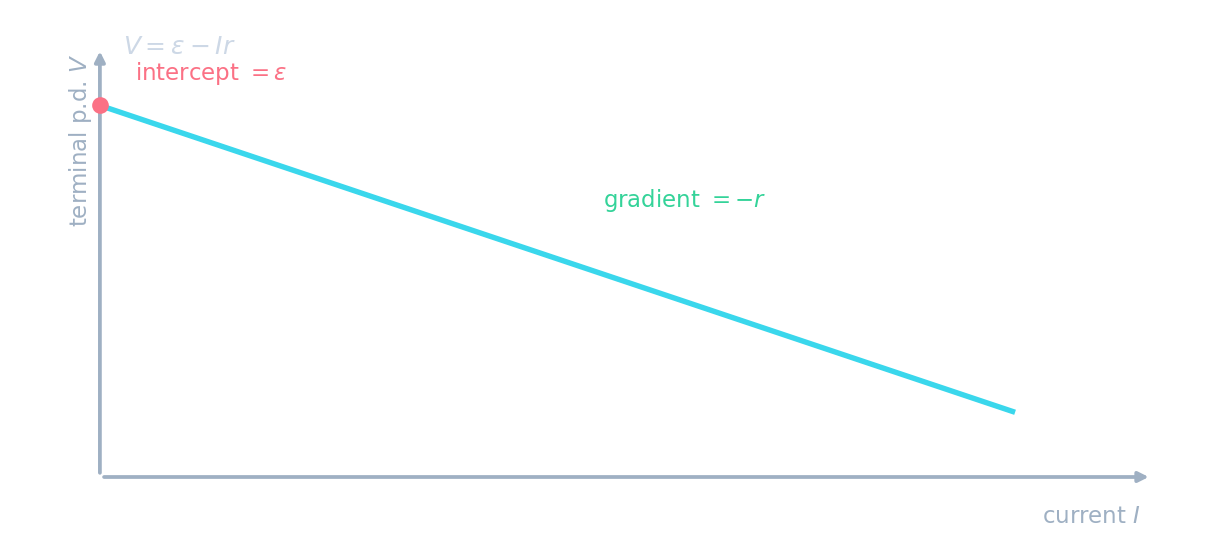
On a terminal-p.d.-against-current graph, match each feature. · Em um gráfico de p.d. terminal contra corrente, combine cada característica.
From $V = \varepsilon - Ir$: at $I = 0$, $V = \varepsilon$ (intercept); the slope is $-r$. · De $V = \varepsilon - Ir$: em $I = 0$, $V = \varepsilon$ (intercepto); a inclinação é $-r$.
Worked example: reading the graph
A $V$–$I$ graph for a cell is a straight line from $(0,\ 1.5\ \text{V})$ to $(3.0\ \text{A},\ 0)$. The external resistor is then made smaller.
- e.m.f.: the intercept, $\varepsilon = 1.5\ \text{V}$.
- Internal resistance: gradient $= \dfrac{0 - 1.5}{3.0 - 0} = -0.50\ \dfrac{\text{V}}{\text{A}}$, so $r = 0.50\ \Omega$.
- Short-circuit current: where the line meets the $I$ axis, $\dfrac{\varepsilon}{r} = 3.0\ \text{A}$.
- Smaller external resistor: the current increases, so the lost volts $Ir$ increase and the terminal p.d. falls — you move down the line to the right.
- Check: the gradient is negative but a resistance is positive; write $r = 0.50\ \Omega$, not $-0.50\ \Omega$.
Exemplo resolvido: lendo o gráfico
Um gráfico $V$–$I$ para uma célula é uma linha reta de $(0,\ 1.5\ \text{V})$ até $(3.0\ \text{A},\ 0)$. O resistor externo é então diminuído.
- f.e.m.: o intercepto, $\varepsilon = 1.5\ \text{V}$.
- Resistência interna: coeficiente angular $= \dfrac{0 - 1.5}{3.0 - 0} = -0.50\ \dfrac{\text{V}}{\text{A}}$, logo $r = 0.50\ \Omega$.
- Corrente de curto-circuito: onde a reta cruza o eixo $I$, $\dfrac{\varepsilon}{r} = 3.0\ \text{A}$.
- Resistor externo menor: a corrente aumenta, logo os volts perdidos $Ir$ aumentam e a tensão terminal cai — você se move para baixo à direita ao longo da linha.
- Verificação: o coeficiente angular é negativo mas uma resistência é positiva; escreva $r = 0.50\ \Omega$, não $-0.50\ \Omega$.
The external resistance connected to a real cell is decreased. What happens to the terminal p.d., and why? · A resistência externa conectada a uma pilha real é diminuída. O que acontece com a p.d. terminal e por quê?
Smaller external resistance → larger current → larger lost volts $Ir$ → smaller terminal p.d. $\varepsilon - Ir$. The e.m.f. is fixed, but the terminal p.d. is not. · Menor resistência externa → maior corrente → maiores voltagens perdidas $Ir$ → menor p.d. terminal $\varepsilon - Ir$. A f.e.m. é fixa, mas a p.d. terminal não é.
The e.m.f. is not "the voltage of the battery" read by any voltmeter. A voltmeter across the terminals reads the terminal p.d., which equals $\varepsilon$ only when no current flows — an ideal voltmeter alone across the cell. Once a load is connected the reading drops by $Ir$. And the gradient of the $V$–$I$ line is $-r$: quote the resistance as a positive number.
A f.e.m. não é "a tensão da bateria" lida por qualquer voltímetro. Um voltímetro nos terminais lê a tensão terminal, que equivale a $\varepsilon$ apenas quando nenhuma corrente flui — um voltímetro ideal sozinho ligado à célula. Assim que uma carga é conectada, a leitura cai em $Ir$. E o coeficiente angular da linha $V$–$I$ é $-r$: cite a resistência como um número positivo.
When does a voltmeter across a cell's terminals read the e.m.f.? Select all that apply. · Quando um voltímetro sobre os terminais de uma pilha lê a f.e.m.? Selecione todas as que se aplicam.
The reading is $\varepsilon - Ir$. It equals $\varepsilon$ if · se $r = 0$ or if $I = 0$. With a lamp connected, current flows and the reading drops; on a short circuit it falls to zero. · A leitura é $\varepsilon - Ir$. Ela iguala $\varepsilon$ se $r = 0$ ou se $I = 0$. Com uma lâmpada conectada, a corrente flui e a leitura cai; em um curto-circuito ela cai para zero.
Ammeters 电流表, voltmeters 电压表 and the diagram
- An ideal ammeter has zero resistance and goes in series 串联.
- An ideal voltmeter has infinite resistance and goes in parallel 并联.
- When asked to draw the circuit, use the standard symbols and show the internal resistance as a resistor next to the cell.
The standard circuit symbols you need to recognise and draw
Amperímetros 电流表, voltímetros 电压表 e o diagrama
- Um amperímetro ideal tem resistência zero e vai em série 串联.
- Um voltímetro ideal tem resistência infinita e vai em paralelo 并联.
- Quando solicitado a desenhar o circuito, use os símbolos padrão e mostre a resistência interna como um resistor ao lado da célula.

Os símbolos de circuito padrão que você precisa reconhecer e desenhar
An ideal ammeter has: · Um amperímetro ideal tem:
An ammeter goes in series and should add no resistance, so an ideal one has zero resistance. · Um amperímetro vai em série e não deve adicionar resistência, então um ideal tem resistência zero.
An ideal voltmeter has infinite resistance and is connected in parallel. · Um voltímetro ideal tem resistência infinita e é conectado em paralelo.
Yes — in parallel, with infinite resistance so it draws no current from the component it measures. · Sim — em paralelo, com resistência infinita para que não retire corrente do componente que mede.
You've got it
- terminal p.d. $V = \varepsilon - Ir$ (drops as current rises); $Ir$ is the lost volts
- a $V$–$I$ graph gives $\varepsilon$ (intercept) and $-r$ (gradient); short-circuit current $= \dfrac{\varepsilon}{r}$
- ideal ammeter: 0 Ω in series; ideal voltmeter: ∞ Ω in parallel — it reads $\varepsilon$ only with no current
Entendeu?
- tensão terminal $V = \varepsilon - Ir$ (diminui conforme a corrente aumenta); $Ir$ são os volts perdidos
- um gráfico $V$–$I$ fornece $\varepsilon$ (intercepto) e $-r$ (coeficiente angular); corrente de curto-circuito $= \dfrac{\varepsilon}{r}$
- amperímetro ideal: 0 Ω em série; voltímetro ideal: ∞ Ω em paralelo — ele lê $\varepsilon$ apenas sem corrente