Kirchhoff's laws · Leis de Kirchhoff
| English | Português |
|---|---|
| Kirchhoff's laws/ˈkɜːkhɒfs lɔːz/ | Leis de Kirchhoff |
| junctions/ˈdʒʌŋkʃnz/ | junctions |
| conservation of charge/ˌkɒnsəˈveɪʃn ɒv tʃɑːdʒ/ | conservação de carga |
| conservation of energy/ˌkɒnsəˈveɪʃn ɒv ˈenədʒi/ | conservação de energia |
| series/ˈsɪəriːz/ | série |
| parallel/ˈpærəlel/ | paralelo |
Two rules for any circuit
- A tangle of wires can look impossible to solve.
- But just two rules — Kirchhoff's laws 基尔霍夫定律 — crack any of them.
- Each is really a conservation law in disguise.
Duas regras para qualquer circuito
- Um emaranhado de fios pode parecer impossível de resolver.
- Mas apenas duas regras — as leis de Kirchhoff 基尔霍夫定律 — resolvem qualquer uma delas.
- Cada uma é realmente uma lei de conservação disfarçada.
First law: junctions 节点
- At any junction, current in = current out.
- It comes from conservation of charge 电荷守恒 — charge cannot pile up at a point.
Primeira lei: nós 节点
- Em qualquer nó, corrente que entra = corrente que sai.
- Ela vem da conservação de carga 电荷守恒 — a carga não pode acumular-se num ponto.
Series & parallel circuits · Circuitos série e paralelo
Switch between series and parallel and add bulbs. In series they share the voltage and one break kills them all; in parallel each gets the full voltage and a break only loses its branch. · Alterne entre série e paralelo e adicione lâmpadas. Em série, elas compartilham a tensão e uma interrupção as apaga todas; em paralelo, cada uma recebe a tensão total e uma interrupção perde apenas seu ramo.
$5.0\ \text{A}$ flows into a junction and splits into two branches; one carries $2.0\ \text{A}$. What does the other carry? · $5.0\ \text{A}$ entra em um nó e se divide em dois ramos; um carrega $2.0\ \text{A}$. O outro carrega o quê?
Current in = current out: $5.0 = 2.0 + I$, so $I = 3.0\ \text{A}$. · Corrente entrante = corrente saiente: $5.0 = 2.0 + I$, então $I = 3.0\ \text{A}$.
Second law: loops
- Around any closed loop, total e.m.f. = total p.d. across the components.
- It comes from conservation of energy 能量守恒 — each coulomb gives back what it gained.
- Go round the loop in one direction: an e.m.f. counts positive if you pass through the source from $-$ to $+$; a p.d. $IR$ counts positive if you go with the current.
Segunda lei: malhas
- Ao redor de qualquer malha fechada, soma das f.e.m. = soma das tensões sobre os componentes.
- Ela vem da conservação de energia 能量守恒 — cada coulomb devolve o que ganhou.
- Passe pela malha numa direção: uma f.e.m. conta positiva se você passar pela fonte de $-$ para $+$; uma tensão $IR$ conta positiva se você for no sentido da corrente.
Match each Kirchhoff law to the conservation law behind it. · Combine cada lei de Kirchhoff com a lei de conservação por trás dela.
Charge cannot build up at a junction; energy a charge gains from sources equals what it gives to components round a loop. · A carga não pode acumular-se em um nó; a energia que uma carga ganha das fontes iguala o que ela entrega aos componentes ao redor de uma malha.
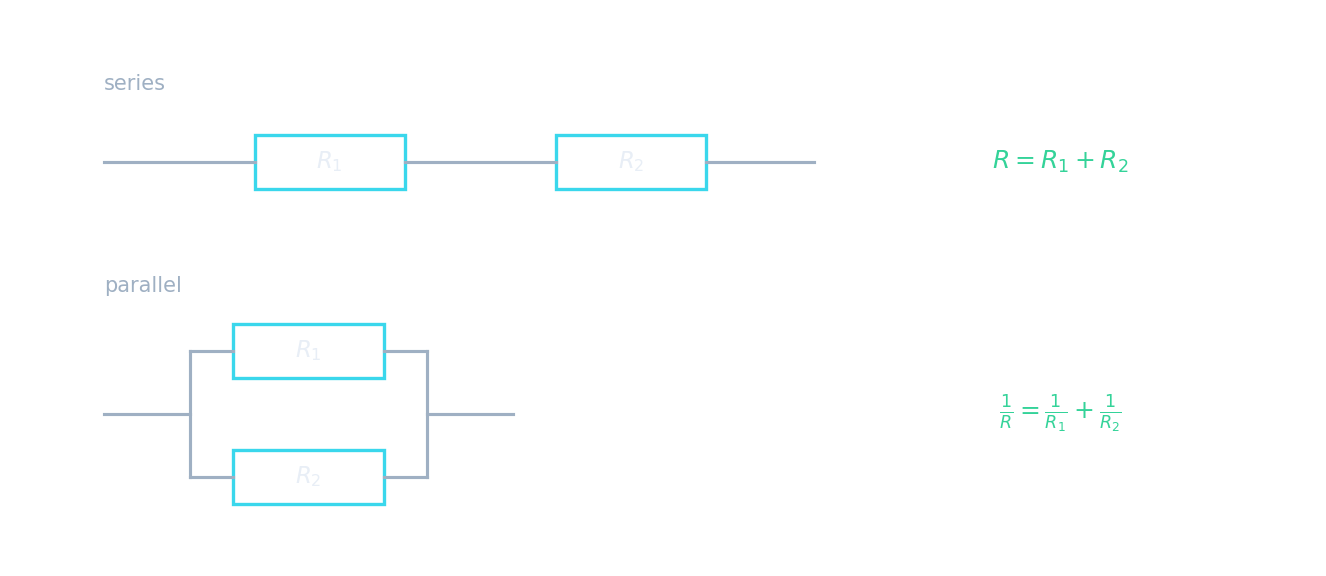
Resistors in series 串联
- Same current through each; the p.d.s add.
- $R_{\text{series}} = R_1 + R_2 + \ldots$ — always larger than each one.
Two resistors in series and their single equivalent resistor
Resistores em série 串联
- Mesma corrente em cada um; as tensões somam.
- $R_{\text{series}} = R_1 + R_2 + \ldots$ — sempre maior que cada um deles.

Dois resistores em série e seu único resistor equivalente
A $3.0\ \Omega$ and a $6.0\ \Omega$ resistor are in series. What is the total resistance? · Um resistor $3.0\ \Omega$ e um resistor $6.0\ \Omega$ estão em série. Qual é a resistência total?
$R = R_1 + R_2 = 3.0 + 6.0 = 9.0\ \Omega$.
Resistors in parallel 并联
- Same p.d. across each; the currents add.
- $\dfrac{1}{R_{\text{parallel}}} = \dfrac{1}{R_1} + \dfrac{1}{R_2} + \ldots$ — always smaller than the smallest one.
Two resistors in parallel and their single equivalent resistor
Resistores em paralelo 并联
- Mesma tensão em cada um; as correntes somam.
- $\dfrac{1}{R_{\text{parallel}}} = \dfrac{1}{R_1} + \dfrac{1}{R_2} + \ldots$ — sempre menor que o menor deles.

Dois resistores em paralelo e seu único resistor equivalente
A $3.0\ \Omega$ and a $6.0\ \Omega$ resistor are in parallel. What is the total resistance? · Um resistor $3.0\ \Omega$ e um resistor $6.0\ \Omega$ estão em paralelo. Qual é a resistência total?
$\dfrac{1}{R} = \dfrac{1}{3.0} + \dfrac{1}{6.0} = \dfrac{1}{2.0}$, so $R = 2.0\ \Omega$ — smaller than either. · $\dfrac{1}{R} = \dfrac{1}{3.0} + \dfrac{1}{6.0} = \dfrac{1}{2.0}$, então $R = 2.0\ \Omega$ — menor que qualquer um.
A parallel combination is always smaller than the smallest resistor in it. · Uma combinação em paralelo é sempre menor que o menor resistor nela.
Yes — adding a parallel path gives the current another route, lowering the overall resistance. · Sim — adicionar um caminho em paralelo dá à corrente outra rota, reduzindo a resistência total.
Worked example: a cell with a parallel pair
A cell of e.m.f. $6.0\ \text{V}$ and internal resistance $1.0\ \Omega$ is connected to a $4.0\ \Omega$ and a $6.0\ \Omega$ resistor in parallel. Find the current in the cell, the terminal p.d., and the current in each resistor.
- Parallel pair: $\dfrac{1}{R} = \dfrac{1}{4.0} + \dfrac{1}{6.0} = \dfrac{5}{12}$, so $R = 2.4\ \Omega$.
- Whole circuit: $R_{\text{total}} = 2.4 + 1.0 = 3.4\ \Omega$, so $I = \dfrac{6.0}{3.4} = 1.8\ \text{A}$ (second law: $\varepsilon = I(R + r)$).
- Terminal p.d.: $V = 6.0 - 1.8 \times 1.0 = 4.2\ \text{V}$ — the p.d. across both resistors.
- Branch currents: $\dfrac{4.2}{4.0} = 1.1\ \text{A}$ and $\dfrac{4.2}{6.0} = 0.70\ \text{A}$.
- Check (first law): $1.1 + 0.70 = 1.8\ \text{A}$, the current in the cell. The smaller resistor takes the larger share.
Exemplo resolvido: uma célula com um par em paralelo
Uma célula de f.e.m. $6.0\ \text{V}$ e resistência interna $1.0\ \Omega$ está conectada a um resistor $4.0\ \Omega$ e um resistor $6.0\ \Omega$ em paralelo. Encontre a corrente na célula, a tensão terminal e a corrente em cada resistor.
- Par em paralelo: $\dfrac{1}{R} = \dfrac{1}{4.0} + \dfrac{1}{6.0} = \dfrac{5}{12}$, logo $R = 2.4\ \Omega$.
- Circuito todo: $R_{\text{total}} = 2.4 + 1.0 = 3.4\ \Omega$, logo $I = \dfrac{6.0}{3.4} = 1.8\ \text{A}$ (segunda lei: $\varepsilon = I(R + r)$).
- Tensão terminal: $V = 6.0 - 1.8 \times 1.0 = 4.2\ \text{V}$ — a tensão sobre ambos os resistores.
- Correntes nos ramos: $\dfrac{4.2}{4.0} = 1.1\ \text{A}$ e $\dfrac{4.2}{6.0} = 0.70\ \text{A}$.
- Verificação (primeira lei): $1.1 + 0.70 = 1.8\ \text{A}$, a corrente na célula. O resistor menor leva a maior parte.
A cell of e.m.f. $12\ \text{V}$ and internal resistance $2.0\ \Omega$ is connected to two $8.0\ \Omega$ resistors in parallel. What is the terminal p.d., in V? · Uma pilha de f.e.m. $12\ \text{V}$ e resistência interna $2.0\ \Omega$ é conectada a dois resistores $8.0\ \Omega$ em paralelo. Qual é a p.d. terminal, em V?
Two equal $8.0\ \Omega$ resistors in parallel give $4.0\ \Omega$. $I = \dfrac{12}{4.0 + 2.0} = 2.0\ \text{A}$, so $V = 12 - 2.0 \times 2.0 = 8.0\ \text{V}$. · Dois resistores iguais $8.0\ \Omega$ em paralelo dão $4.0\ \Omega$. $I = \dfrac{12}{4.0 + 2.0} = 2.0\ \text{A}$, então $V = 12 - 2.0 \times 2.0 = 8.0\ \text{V}$.
Explaining a change with the laws
- A thermistor in parallel with a resistor R, across a real cell. Temperature rises — why does the current in R fall?
- Chain it: thermistor resistance ↓ → total circuit resistance ↓ → current in the cell ↑ → lost volts $Ir$ ↑ → terminal p.d. ↓ → current in R $= \dfrac{V}{R}$ ↓.
- Every arrow is a mark. The current in the cell goes up while the current in R goes down — both at once.
Explicando uma mudança com as leis
- Um termistor em paralelo com um resistor R, sobre uma célula real. Temperatura sobe — por que a corrente em R cai?
- Encadeie: resistência do termistor ↓ → resistência total do circuito ↓ → corrente na célula ↑ → volts perdidos $Ir$ ↑ → tensão terminal ↓ → corrente em R $= \dfrac{V}{R}$ ↓.
- Cada seta vale um ponto. A corrente na célula sobe enquanto a corrente em R desce — ambas ao mesmo tempo.
A thermistor is in parallel with a resistor R across a real cell, and the temperature rises. Put the chain of reasoning in order. · Um termistor está em paralelo com um resistor R sobre uma pilha real, e a temperatura aumenta. Coloque a cadeia de raciocínio em ordem.
Less resistance → more cell current → more lost volts → less terminal p.d. → less current in R. Note the cell current rises while the current in R falls. · Menos resistência → mais corrente da pilha → mais voltagens perdidas → menos p.d. terminal → menos corrente em R. Note que a corrente da pilha aumenta enquanto a corrente em R cai.
Solving a circuit
- Label every current with a direction.
- Apply the junction rule and the loop rule, plus $V = IR$, then solve together.
Resolvendo um circuito
- rotule cada corrente com uma direção.
- aplique a regra do nó e a regra da malha, além de $V = IR$, e resolva em conjunto.
Two equal resistors $R$ in parallel give a combined resistance of: · Dois resistores iguais $R$ em paralelo dão uma resistência combinada de:
$\dfrac{1}{R_{\text{tot}}} = \dfrac{1}{R} + \dfrac{1}{R} = \dfrac{2}{R}$, so $R_{\text{tot}} = \tfrac{1}{2}R$. · $\dfrac{1}{R_{\text{tot}}} = \dfrac{1}{R} + \dfrac{1}{R} = \dfrac{2}{R}$, logo $R_{\text{tot}} = \tfrac{1}{2}R$.
The parallel formula gives $\dfrac{1}{R}$ — invert at the end, or you will quote $0.42\ \Omega$ for a $2.4\ \Omega$ pair. Two equal resistors in parallel give exactly half. Adding any resistor in parallel always lowers the total. And all branches in parallel have the same p.d., so you never add p.d.s across parallel branches.
A fórmula do paralelo dá $\dfrac{1}{R}$ — inverta no final, ou você citará $0.42\ \Omega$ para um par de $2.4\ \Omega$. Dois resistores iguais em paralelo dão exatamente metade. Adicionar qualquer resistor em paralelo sempre reduz o total. E todos os ramos em paralelo têm a mesma tensão, logo você nunca soma tensões sobre ramos em paralelo.
Components connected in parallel always have the same ____ across them. · Componentes conectados em paralelo sempre têm a mesma ____ sobre eles.
Parallel branches share the same two junctions, so the p.d. across each is identical; the currents are what differ. · Ramos em paralelo compartilham os mesmos dois nós, então a p.d. sobre cada um é idêntica; as correntes são o que difere.
You've got it
- first law (junctions): current in = current out — conservation of charge
- second law (loops): total e.m.f. = total p.d. — conservation of energy; $\varepsilon = I(R + r)$
- series: $R = R_1 + R_2$; parallel: $\dfrac{1}{R} = \dfrac{1}{R_1} + \dfrac{1}{R_2}$ (then invert); a change anywhere alters the cell current and the terminal p.d.
Entendeu?
- primeira lei (nós): corrente que entra = corrente que sai — conservação de carga
- segunda lei (malhas): soma das f.e.m. = soma das tensões — conservação de energia; $\varepsilon = I(R + r)$
- série: $R = R_1 + R_2$; paralelo: $\dfrac{1}{R} = \dfrac{1}{R_1} + \dfrac{1}{R_2}$ (então inverta); uma mudança em qualquer lugar altera a corrente da célula e a tensão terminal.