The diffraction grating · A rede de difração
| English | Português |
|---|---|
| diffraction grating/dɪˈfrækʃn ˈɡreɪtɪŋ/ | rede de difração |
| slits/slɪts/ | fendas |
| coherent/kəʊˈhɪərənt/ | coerente |
| monochromatic/ˌmɒnəʊkrəʊˈmætɪk/ | monocromático |
| maxima/ˈmæksɪmə/ | máximos |
| order/ˈɔːdə/ | ordem |
| normal/ˈnɔːml/ | normal |
| spectrum/ˈspektrəm/ | espectro |
The rainbow on a CD
- Tilt a CD in the light and you see bright rainbow colours.
- The disc's fine tracks act as a diffraction grating 衍射光栅, splitting the light by wavelength.
- Gratings are how we measure wavelengths precisely.
O arco-íris num CD
- Incline um CD na luz e verá cores de arco-íris brilhantes.
- As finas faixas do disco atuam como uma grade de difração 衍射光栅, dividindo a luz pelo comprimento de onda.
- Grades são como medimos comprimentos de onda com precisão.
What a grating is
- A grating has many equally spaced slits 狭缝 — often hundreds per millimetre.
- Each slit is a coherent 相干 source, and they all interfere together.
A diffraction grating splits monochromatic 单色 light into sharp maxima on a screen
O que é uma grade
- Uma grade tem muitas fendas igualmente espaçadas 狭缝 — muitas vezes centenas por milímetro.
- Cada fenda é uma fonte coerente 相干 e todas interferem juntas.

Uma grade de difração divide a luz monocromática 单色 em máximos nítidos num ecrã
Why the grating gives sharp maxima · Por que a rede produz máximos nítidos
Two waves add when in phase and cancel when out of phase — change the phase and watch the resultant. A grating's many slits make the bright fringes razor-sharp. · Duas ondas se somam quando estão em fase e se cancelam quando estão fora de fase — altere a fase e observe o resultado. As muitas fendas de uma rede tornam as franjas brilhantes extremamente finas.
A diffraction grating is made of: · Uma rede de difração é feita de:
Hundreds or thousands of equally spaced slits, each acting as a coherent source. · Centenas ou milhares de fendas igualmente espaçadas, cada uma agindo como uma fonte coerente.
The grating equation
- Bright maxima 极大 appear at angles given by $d\sin\theta = n\lambda$.
- $d$ = slit spacing, $n = 0, 1, 2, \ldots$ is the order 级次, $\theta$ measured from the normal 法线 (the straight-through direction).
A equação da grade
- Máximos brilhantes 极大 aparecem em ângulos dados por $d\sin\theta = n\lambda$.
- $d$ = espaçamento de fendas, $n = 0, 1, 2, \ldots$ é a ordem 级次, $\theta$ medido a partir da normal 法线 (direção de passagem reta).
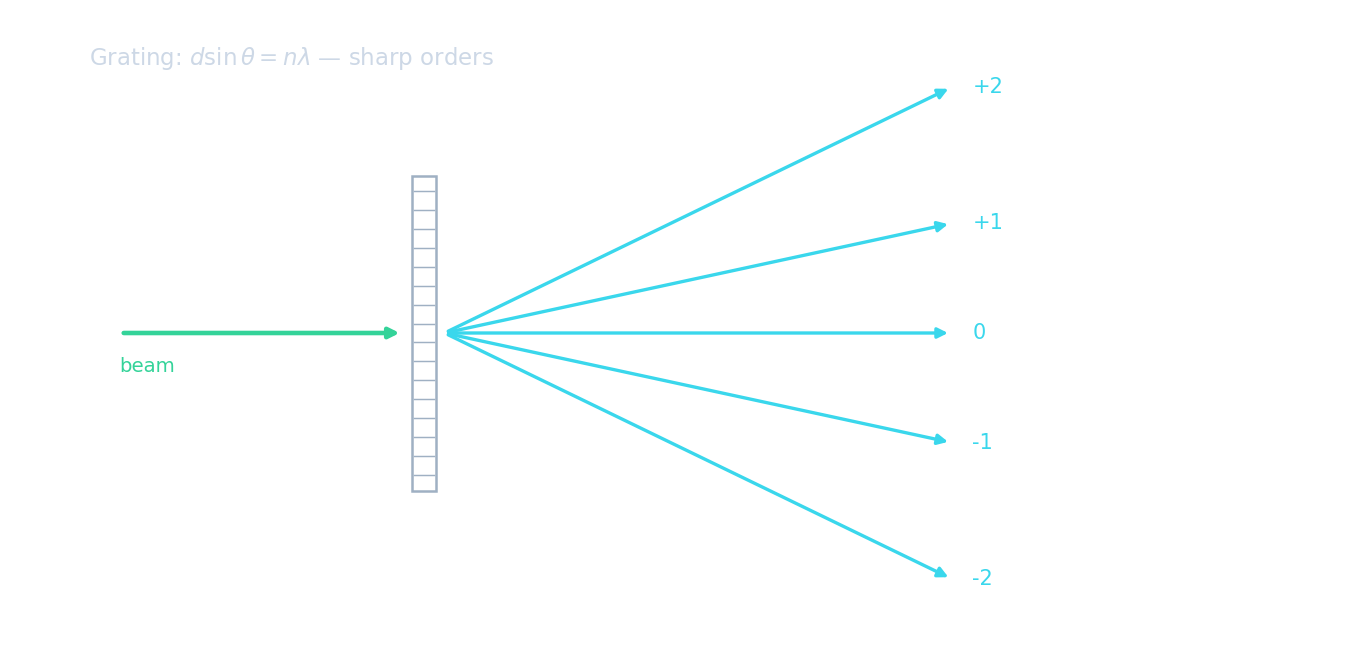
Light hits a grating of slit spacing $2.0\ \mu\text{m}$. The first-order ($n=1$) maximum is where $\sin\theta = 0.30$. Find the wavelength, in nm. · Luz atinge uma rede com espaçamento de fendas $2.0\ \mu\text{m}$. O máximo de primeira ordem ($n=1$) está onde $\sin\theta = 0.30$. Encontre o comprimento de onda, em nm.
$\lambda = \dfrac{d\sin\theta}{n} = \dfrac{2.0 \times 10^{-6} \times 0.30}{1} = 6.0 \times 10^{-7}\ \text{m} = 600\ \text{nm}$.
Sharper than two slits
- With many slits, every "wrong" direction is cancelled by lots of slits.
- So a grating gives much sharper maxima than a double slit.
Young's double-slit experiment — the single slit makes the two slits coherent sources
Mais nítido que duas fendas
- Com muitas fendas, toda direção "errada" é cancelada por muitas fendas.
- Logo uma grade dá máximos muito mais nítidos que uma dupla fenda.

Experimento de dupla fenda de Young — a fenda única torna as duas fendas fontes coerentes
A diffraction grating gives sharper maxima than a double slit. · Uma rede de difração produz máximos mais nítidos que uma fenda dupla.
Yes — many slits cancel every "wrong" direction, leaving narrow, bright maxima. · Sim — muitas fendas cancelam todas as direções "erradas", deixando máximos estreitos e brilhantes.
Slit spacing and highest order
- $N$ lines per mm → $d = \dfrac{1}{N}\ \text{mm}$.
- Since $\sin\theta \le 1$, the highest order is $n_{\text{max}} = \left\lfloor \dfrac{d}{\lambda} \right\rfloor$.
Espaçamento de fendas e maior ordem
- $N$ linhas por mm → $d = \dfrac{1}{N}\ \text{mm}$.
- Como $\sin\theta \le 1$, a maior ordem é $n_{\text{max}} = \left\lfloor \dfrac{d}{\lambda} \right\rfloor$.
A grating has $500$ lines per mm. What is the slit spacing $d$, in µm? · Uma rede tem $500$ linhas por mm. Qual é o espaçamento entre fendas $d$, em µm?
$d = \dfrac{1}{500}\ \text{mm} = 0.002\ \text{mm} = 2.0\ \mu\text{m}$.
For a grating and wavelength with $\dfrac{d}{\lambda} = 3.27$, the highest order seen is: · Para uma rede e comprimento de onda com $\dfrac{d}{\lambda} = 3.27$, a maior ordem observável é:
$n_{\text{max}} = \left\lfloor \dfrac{d}{\lambda} \right\rfloor = \lfloor 3.27 \rfloor = 3$. Order 4 would need $\sin\theta > 1$. · $n_{\text{max}} = \left\lfloor \dfrac{d}{\lambda} \right\rfloor = \lfloor 3.27 \rfloor = 3$. A ordem 4 exigiria $\sin\theta > 1$.
Finding a wavelength
- Shine the light straight at the grating and measure the angle of a maximum.
- Then $\lambda = d\sin\theta$ (use $n = 1$ for the first order); average over orders to reduce error.
Encontrando um comprimento de onda
- Incida a luz diretamente na grade e meça o ângulo de um máximo.
- Então $\lambda = d\sin\theta$ (use $n = 1$ para a primeira ordem); faça média sobre ordens para reduzir erro.
To find a wavelength with a grating, you measure the ____ of a maximum. · Para encontrar um comprimento de onda com uma rede, você mede a ____ de um máximo.
Measure $\theta$ for a known order, then $\lambda = \dfrac{d\sin\theta}{n}$. · Meça $\theta$ para uma ordem conhecida, depois $\lambda = \dfrac{d\sin\theta}{n}$.
Worked example: a grating with 500 lines per mm
Light of wavelength $720\ \text{nm}$ falls normally on a grating with $500$ lines per mm. Find the angle between the two second-order maxima, the highest order visible, and the wavelength that would put its third-order maxima at the same angle.
- Spacing: $d = \dfrac{1}{500}\ \text{mm} = 2.0 \times 10^{-6}\ \text{m}$.
- Second order: $\sin\theta = \dfrac{2 \times 720 \times 10^{-9}}{2.0 \times 10^{-6}} = 0.72$, so $\theta = 46^\circ$. The two second-order maxima sit either side of the centre, so the angle between them is $2 \times 46^\circ = 92^\circ$.
- Highest order: $\dfrac{d}{\lambda} = \dfrac{2.0 \times 10^{-6}}{720 \times 10^{-9}} = 2.8$, so $n_{\text{max}} = 2$ — the third order would need $\sin\theta > 1$.
- Same angle, third order: $3\lambda = 2 \times 720\ \text{nm}$, so $\lambda = 480\ \text{nm}$ (blue).
- Check: at the same angle $d\sin\theta$ is fixed, so $n\lambda$ is fixed: a higher order needs a proportionally shorter wavelength.
Exemplo resolvido: uma grade com 500 linhas por mm
Luz de comprimento de onda $720\ \text{nm}$ incide normalmente numa grade com $500$ linhas por mm. Encontre o ângulo entre os dois máximos de segunda ordem, a maior ordem visível, e o comprimento de onda que colocaria seus máximos de terceira ordem no mesmo ângulo.
- Espaçamento: $d = \dfrac{1}{500}\ \text{mm} = 2.0 \times 10^{-6}\ \text{m}$.
- Segunda ordem: $\sin\theta = \dfrac{2 \times 720 \times 10^{-9}}{2.0 \times 10^{-6}} = 0.72$, logo $\theta = 46^\circ$. Os dois máximos de segunda ordem ficam de cada lado do centro, logo o ângulo entre eles é $2 \times 46^\circ = 92^\circ$.
- Maior ordem: $\dfrac{d}{\lambda} = \dfrac{2.0 \times 10^{-6}}{720 \times 10^{-9}} = 2.8$, logo $n_{\text{max}} = 2$ — a terceira ordem precisaria de $\sin\theta > 1$.
- Mesmo ângulo, terceira ordem: $3\lambda = 2 \times 720\ \text{nm}$, logo $\lambda = 480\ \text{nm}$ (azul).
- Verifique: no mesmo ângulo $d\sin\theta$ é fixo, logo $n\lambda$ é fixo: uma ordem maior exige um comprimento de onda proporcionalmente menor.
Light of wavelength $600\ \text{nm}$ falls normally on a grating with $400$ lines per mm. What is the angle, in degrees, between the two first-order maxima? · Luz de comprimento de onda $600\ \text{nm}$ incide perpendicularmente sobre uma rede com $400$ linhas por mm. Qual é o ângulo, em graus, entre os dois máximos de primeira ordem?
$d = \dfrac{1}{400}\ \text{mm} = 2.5 \times 10^{-6}\ \text{m}$; $\sin\theta = \dfrac{600 \times 10^{-9}}{2.5 \times 10^{-6}} = 0.24$, so $\theta = 13.9^\circ$ and the angle between the two maxima is $2\theta = 27.8^\circ$. · $d = \dfrac{1}{400}\ \text{mm} = 2.5 \times 10^{-6}\ \text{m}$; $\sin\theta = \dfrac{600 \times 10^{-9}}{2.5 \times 10^{-6}} = 0.24$, então $\theta = 13.9^\circ$ e o ângulo entre os dois máximos é $2\theta = 27.8^\circ$.
$\theta$ is measured from the normal, not from the surface of the grating, and "the angle between the two first-order maxima" means $2\theta$. Round $\dfrac{d}{\lambda}$ down for the highest order — a $\sin\theta$ above $1$ has no angle, so that order simply does not exist. And convert "lines per mm" to a spacing in metres before you start.
$\theta$ é medida a partir da normal, não da superfície da rede, e "o ângulo entre os dois máximos de primeira ordem" significa $2\theta$. Arredonde $\dfrac{d}{\lambda}$ para baixo para a ordem mais alta — um $\sin\theta$ acima de $1$ não tem ângulo, então essa ordem simplesmente não existe. E converta "linhas por mm" para um espaçamento em metros antes de começar.
In the grating equation $d\sin\theta = n\lambda$, the angle $\theta$ is measured from the surface of the grating. · Na equação da rede $d\sin\theta = n\lambda$, o ângulo $\theta$ é medido a partir da superfície da rede.
$\theta$ is measured from the normal — the straight-through direction of the zero order. Measuring from the surface swaps sine for cosine and gives the wrong wavelength. · $\theta$ é medido a partir da normal — a direção direta do zero. Medir a partir da superfície troca seno por cosseno e dá o comprimento de onda errado.
White light through a grating
- The zero order is white: every wavelength has $\theta = 0$ there.
- Every other order is a spectrum 光谱, with violet nearest the centre (shortest $\lambda$, smallest $\theta$) and red furthest out.
- Higher orders are wider, and from the second order onwards they can overlap — red of order 2 can land on violet of order 3.
Luz branca através de uma grade
- A ordem zero é branca: todo comprimento de onda tem $\theta = 0$ lá.
- Cada outra ordem é um espectro 光谱, com violeta mais próximo do centro (menor $\lambda$, menor $\theta$) e vermelho mais afastado.
- Ordens superiores são mais largas, e a partir da segunda ordem podem sobrepor-se — vermelho da ordem 2 pode cair sobre violeta da ordem 3.
White light passes through a grating. Put these colours of the first-order spectrum in order, starting nearest the central maximum. · Luz branca passa por uma rede. Organize estas cores do espectro de primeira ordem, começando pela mais próxima do máximo central.
From $d\sin\theta = n\lambda$, a shorter wavelength gives a smaller angle, so violet is nearest the centre and red furthest out. · De $d\sin\theta = n\lambda$, um comprimento de onda mais curto dá um ângulo menor, então violeta está mais próximo do centro e vermelho mais afastado.
You've got it
- a grating is many equally spaced slits → sharp maxima
- grating equation $d\sin\theta = n\lambda$, with $\theta$ from the normal; $d = \dfrac{1}{N}$ from "$N$ lines per mm"
- highest order $n_{\text{max}} = \left\lfloor \dfrac{d}{\lambda} \right\rfloor$; white light gives a spectrum in each order with violet nearest the centre
Entendeu?
- uma grade é muitas fendas igualmente espaçadas → máximos nítidos
- equação da grade $d\sin\theta = n\lambda$, com $\theta$ a partir da normal; $d = \dfrac{1}{N}$ de "$N$ linhas por mm"
- maior ordem $n_{\text{max}} = \left\lfloor \dfrac{d}{\lambda} \right\rfloor$; luz branca dá um espectro em cada ordem com violeta mais próximo do centro