O fluxo circular e o multiplicador
Introduzido| English | Significado |
|---|---|
| injection/ɪnˈdʒekʃn/ | injeção |
| multiplier/ˌmʌltɪˈplaɪə/ | multiplicador |
| national income/ˈnæʃənl ˈɪŋkʌm/ | renda nacional |
| withdrawals/wɪθˈdrɔːlz/ | vazamentos |
| marginal propensity to consume/ˈmɑːdʒɪnl prəˈpensɪti tə kənˈsjuːm/ | propensão marginal a consumir |
How one dollar becomes many
- Spend a dollar at a shop; the shopkeeper spends part of it; the next person spends part of that. One injection 注入 ripples through the economy.
- This multiplier 乘数 effect means a change in spending raises national income 国民收入 by more than the original amount.
The circular flow, revisited
- Income circulates between households and firms: firms pay incomes, and households spend them on firms' output.
- Injections (investment, government spending, exports) add to the flow; withdrawals 漏出 (saving, taxes, imports) leak out of it.
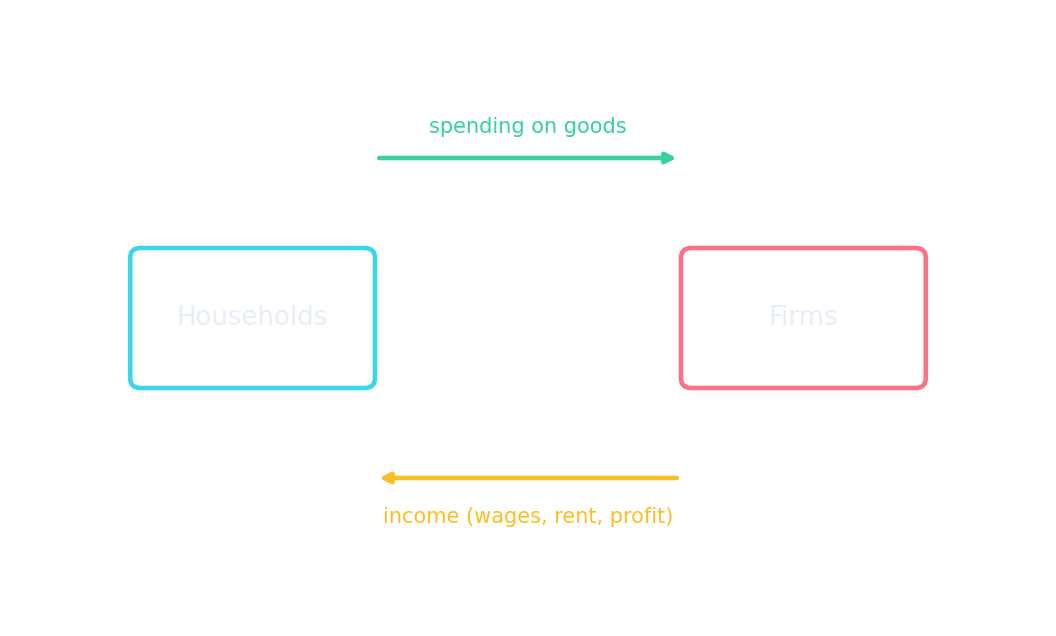
Injections (investment, government spending, exports) feed the loop; withdrawals (saving, taxes, imports) drain it.
O fluxo circular e o multiplicador
A renda circula entre famílias e empresas. Uma injeção (ex.: investimento) é reconvertida repetidamente — o efeito multiplicador.
Qual é uma injeção no fluxo circular?
Dificuldade 1/5 · Moedas 100 + pequeno bônus na primeira conclusão hoje
Injeções são I, G, X; poupança, impostos e importações são retiradas.
The multiplier
- Each round of re-spending depends on the marginal propensity to consume 边际消费倾向 (MPC):
Worked example. If MPC = 0.75, the multiplier $= \dfrac{1}{1 - 0.75} = \dfrac{1}{0.25} = 4$ — so £1bn of extra spending raises national income by £4bn.
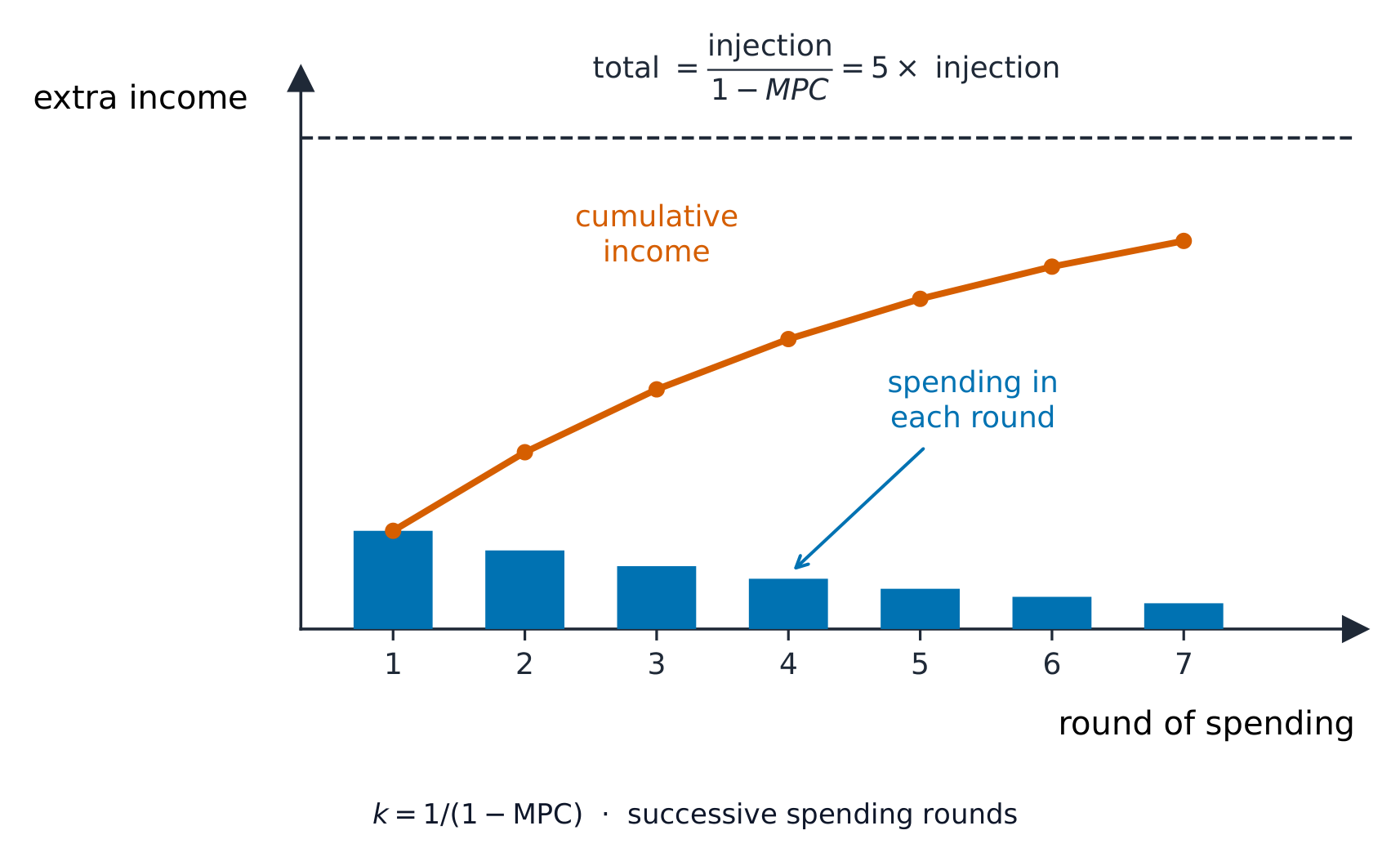
One injection multiplies into a larger rise in income
Income rounds and the multiplier’s assumptions
$\Delta Y=k\Delta J$
Compare the first few income rounds with the infinite model total. Domestic re-spending and total consumption must be distinguished when tax and imports are present.
Se a propensão marginal a consumir for 0,75, qual é o multiplicador = 1/(1 − MPC)?
Dificuldade 2/5 · Moedas 140 + pequeno bônus na primeira conclusão hoje
1 / (1 − 0.75) = 1 / 0.25 = 4.
Com um multiplicador de 4, em quanto a renda nacional aumenta se os gastos aumentarem em 2 bilhões?
Dificuldade 2/5 · Moedas 140 + pequeno bônus na primeira conclusão hoje
4 × 2 bilhões = 8 bilhões.
O multiplicador é igual a 1 / (1 − ______).
Dificuldade 1/5 · Moedas 100 + pequeno bônus na primeira conclusão hoje
Multiplicador = 1/(1 − MPC).
What weakens the multiplier
- The bigger the withdrawals (high saving, taxes, or import spending), the smaller the multiplier, because more leaks out each round.
- An open economy with high taxes may have a multiplier close to 1, so a stimulus raises income by little more than the injection itself.
Uma taxa maior de poupança ou importações aumenta a magnitude do multiplicador.
Dificuldade 1/5 · Moedas 100 + pequeno bônus na primeira conclusão hoje
Falso. Mais renda vaza do fluxo circular em cada rodada, então menos é reinvestido e o multiplicador é menor: k = 1 / (MPS + MPT + MPM).
You've got it
- an injection ripples through re-spending — the multiplier effect
- multiplier $= \dfrac{1}{1 - MPC}$ (MPC 0.75 → multiplier 4)
- bigger withdrawals (saving, tax, imports) → smaller multiplier
Write from the data: find the multiplier
- The marginal propensity to consume is 0.8 in a simple economy.
- An injection of 12 enters the circular flow.
Qual é o multiplicador e quanto a renda aumenta?
Um quinto da renda extra é retirado, então o multiplicador é 5.
Qual é o multiplicador quando a propensão marginal a consumir é 0.8?
Dificuldade 1/5 · Moedas 100 + pequeno bônus na primeira conclusão hoje
1 dividido por 0.2 resulta em 5.