Addressing income and wealth inequality
Introduzido| English | Significado |
|---|---|
| Lorenz curve/ˈlɒrənts kɜːv/ | curva de Lorenz |
| Gini coefficient/ˈdʒiːni ˌkəʊɪˈfɪʃənt/ | coeficiente de Gini |
| inheritance/ɪnˈherɪtəns/ | herança |
| progressive taxes/prəˈɡresɪv ˈtæksɪz/ | impostos progressivos |
| transfers/ˈtrænsfɜːz/ | transferências |
| redistribution/ˌriːˌdɪstrɪˈbjuːʃn/ | redistribuição |
Measuring the gap between rich and poor
- Two countries can have the same average income yet feel utterly different — one shares it evenly, the other hoards it at the top.
- Economists measure that spread with the Lorenz curve 洛伦兹曲线 and the Gini coefficient 基尼系数.
Inequality policy route
Follow how policy can change disposable income and opportunity.
On a Lorenz diagram, greater inequality is shown by the curve:
Dificuldade 1/5 · Moedas 100 + pequeno bônus na primeira conclusão hoje
The line of equality is the 45° line; the more the Lorenz curve bows below it, the more unequal.
The Lorenz curve
- The Lorenz curve plots the cumulative share of income against the cumulative share of population.
- Perfect equality is the 45° line; the more the curve sags below it, the more unequal the distribution.
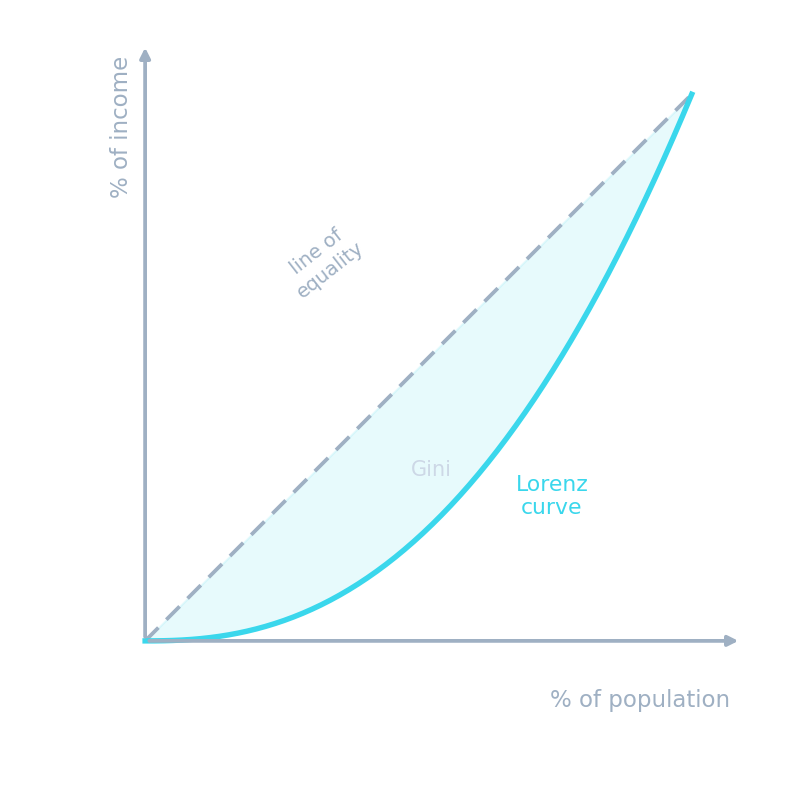
The further the Lorenz curve bows below the line of equality, the greater the inequality.
A Gini coefficient of 0 represents:
Dificuldade 1/5 · Moedas 100 + pequeno bônus na primeira conclusão hoje
Gini runs from 0 (perfect equality) to 1 (one person has all income).
The closer the Gini coefficient is to ______, the more equal the distribution.
Dificuldade 1/5 · Moedas 100 + pequeno bônus na primeira conclusão hoje
Gini = 0 is perfect equality; 1 is maximum inequality.
The Gini coefficient
- The Gini coefficient = the area between the line of equality and the Lorenz curve, as a fraction of the whole triangle.
- It runs from 0 (perfect equality) to 1 (one person has everything). Higher = more unequal.
A progressive tax takes the same percentage of income from every earner.
Dificuldade 1/5 · Moedas 100 + pequeno bônus na primeira conclusão hoje
False. That is a proportional (flat) tax. A progressive tax takes a larger percentage of income from higher earners, which is why it is used to reduce inequality.
Match each policy to how it reduces inequality.
Dificuldade 2/5 · Moedas 140 + pequeno bônus na primeira conclusão hoje
Taxes, transfers and human-capital spending all narrow the income gap.
Causes and policies
- Causes: differences in wages, wealth, inheritance 继承, education, and unemployment.
- Policies to reduce it: progressive taxes 累进税 (higher rates on higher incomes), benefits/transfers 转移支付, and spending on education and healthcare.
Equality vs efficiency trade-off. Heavy redistribution 再分配 can blunt incentives to work and invest. Governments weigh fairness against the efficiency cost.
Worked example: reading two Gini figures
Country A has a Gini coefficient of 0.25; Country B has 0.55. In A the poorest 20% receive 9% of income; in B they receive 3%. Compare the two and suggest policies for B.
- B is far more unequal: its Lorenz curve sags much further below the 45° line, and its poorest fifth receives a third of the share they get in A.
- B could use progressive income tax, means-tested benefits, and public spending on education and health that raises the earning power of the poor. A judgement: high taxes may weaken work incentives, so the size of the effect matters.
The area between the line of equality and the Lorenz curve is 0.15, and the whole triangle under the line of equality is 0.5. What is the Gini coefficient?
Dificuldade 2/5 · Moedas 140 + pequeno bônus na primeira conclusão hoje
0.15 ÷ 0.5 = 0.3.
If the Lorenz curve lies on the 45° line, the Gini coefficient is 0.
Dificuldade 1/5 · Moedas 100 + pequeno bônus na primeira conclusão hoje
There is no gap: perfect equality.
You've got it
- the Lorenz curve shows income share vs population share; sag below the 45° line = inequality
- the Gini coefficient runs 0 (equal) to 1 (one person has all)
- reduce inequality with progressive tax, benefits, and education/health spending
Write from this case
- Two households earn 20 and 80.
- Total income is 100.
What percentage of income does the richer household receive?
80 divided by 100 is 80 percent.
What is the richer household's income share?
Dificuldade 1/5 · Moedas 100 + pequeno bônus na primeira conclusão hoje
The richer household has 80 of the 100.