Acyl chlorides
Introduzido| English | Significado |
|---|---|
| acyl chloride/əˈkɪl ˈklɔːraɪd/ | cloreto de acila |
| nucleophile/ˈnjuːklɪɒfaɪl/ | nucleófilo |
| addition–elimination/əˈdɪʃn ɪˌlɪmɪˈneɪʃn/ | adição–eliminação |
| amide/əˈmaɪd/ | amida |
The most reactive derivatives
- Acyl chlorides 酰氯 are made from carboxylic acids and are very reactive.
- They react with many nucleophiles 亲核试剂, always releasing HCl.
- They follow an addition–elimination 加成消去 mechanism.
Acyl chloride reaction map
Follow why acyl chlorides are reactive acylating agents.
Acyl chlorides react vigorously with water to give a carboxylic acid and ______ chloride gas.
Dificuldade 1/5 · Moedas 100 + pequeno bônus na primeira conclusão hoje
Misty fumes of HCl form.
Reactions (all give HCl)
| Reactant | Product |
|---|---|
| water | the carboxylic acid |
| an alcohol | an ester |
| phenol | an ester |
| ammonia | an amide 酰胺 |
| a 1°/2° amine | an amide |

Addition-elimination mechanism of an acyl chloride
An acyl chloride reacting with ammonia gives:
Dificuldade 1/5 · Moedas 100 + pequeno bônus na primeira conclusão hoje
Ammonia (or a 1°/2° amine) reacts with an acyl chloride to give an amide.
An acyl chloride reacting with water gives:
Dificuldade 1/5 · Moedas 100 + pequeno bônus na primeira conclusão hoje
Hydrolysis of an acyl chloride regenerates the carboxylic acid (very vigorously).
Match each term to its meaning.
Dificuldade 2/5 · Moedas 140 + pequeno bônus na primeira conclusão hoje
Each item links the term to its correct meaning.
Addition–elimination
- A nucleophile adds to the slightly positive carbonyl carbon → a tetrahedral intermediate.
- Then the C=O reforms and $\text{Cl}^-$ leaves as HCl (elimination).
- Ease of hydrolysis: $\text{acyl chloride} \gg \text{alkyl chloride} \gg \text{aryl chloride}$ (the aryl C–Cl is strengthened by the ring).
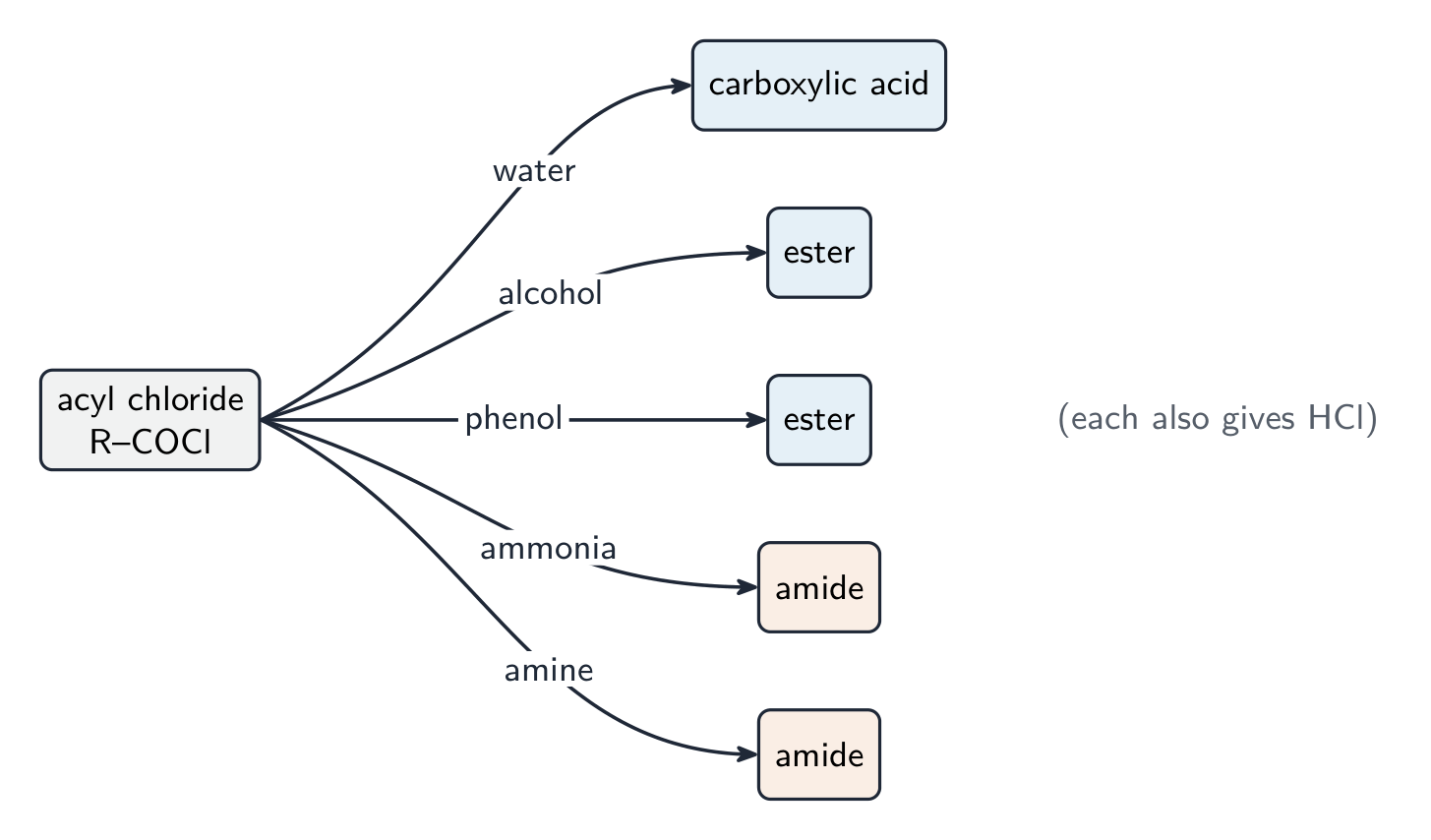
Acyl chlorides react with many nucleophiles
The reactions of acyl chlorides follow which mechanism?
Dificuldade 1/5 · Moedas 100 + pequeno bônus na primeira conclusão hoje
A nucleophile adds to the carbonyl carbon; the C=O reforms and Cl⁻ leaves as HCl.
The order of ease of hydrolysis is:
Dificuldade 1/5 · Moedas 100 + pequeno bônus na primeira conclusão hoje
Acyl chlorides hydrolyse violently, alkyl slowly, and aryl chlorides not at all (ring-strengthened C–Cl).
Worked example: predict and name the product
Give the organic product when ethanoyl chloride, $\text{CH}_3\text{COCl}$, reacts at room temperature with water, with ammonia and with methylamine.
- Water: $\text{CH}_3\text{COOH}$, ethanoic acid. Ammonia: $\text{CH}_3\text{CONH}_2$, ethanamide. In each the nucleophile replaces Cl, and HCl is lost.
- With methylamine, $\text{CH}_3\text{NH}_2$, the product is $\text{CH}_3\text{CONHCH}_3$, N-methylethanamide. The "N-" shows the methyl group is on the nitrogen. The HCl then reacts with more amine, so two moles of amine are used per mole of acyl chloride.
What forms when propanoyl chloride, $\text{CH}_3\text{CH}_2\text{COCl}$, reacts with ethylamine?
Dificuldade 1/5 · Moedas 100 + pequeno bônus na primeira conclusão hoje
The acyl group (propanoyl) gives the "-amide" part and the amine's ethyl group sits on N. An ester would need an alcohol.
You've got it
- acyl chlorides are very reactive; with water → acid, alcohol/phenol → ester, ammonia/amine → amide (all + HCl)
- mechanism = addition–elimination (nucleophile adds to the carbonyl carbon, then HCl is eliminated)
- hydrolysis ease: acyl ≫ alkyl ≫ aryl chloride