Aldehydes and ketones
Introduzido| English | Significado |
|---|---|
| carbonyl compound/ˈkɑːbənaɪl ˈkɒmpaʊnd/ | composto carbonila |
| aldehyde/ˈældɪhaɪd/ | aldeído |
| ketone/ˈketəʊn/ | cetona |
| reduction/rɪˈdʌkʃn/ | redução |
| hydroxynitrile/haɪˈdrɒksɪnaɪtraɪl/ | hidroxi-nitrila |
| nucleophilic addition/ˌnjuːklɪəˈfɪlɪk əˈdɪʃn/ | adição nucleofílica |
The carbonyl compounds 羰基化合物
- The smell of vanilla comes from vanillin, an aldehyde. Nail-polish remover is propanone, a ketone. Both contain the C=O (carbonyl) group.
- In an aldehyde 醛 the C=O is at the end of the chain (–CHO). In a ketone 酮 it is in the middle, between two carbons.
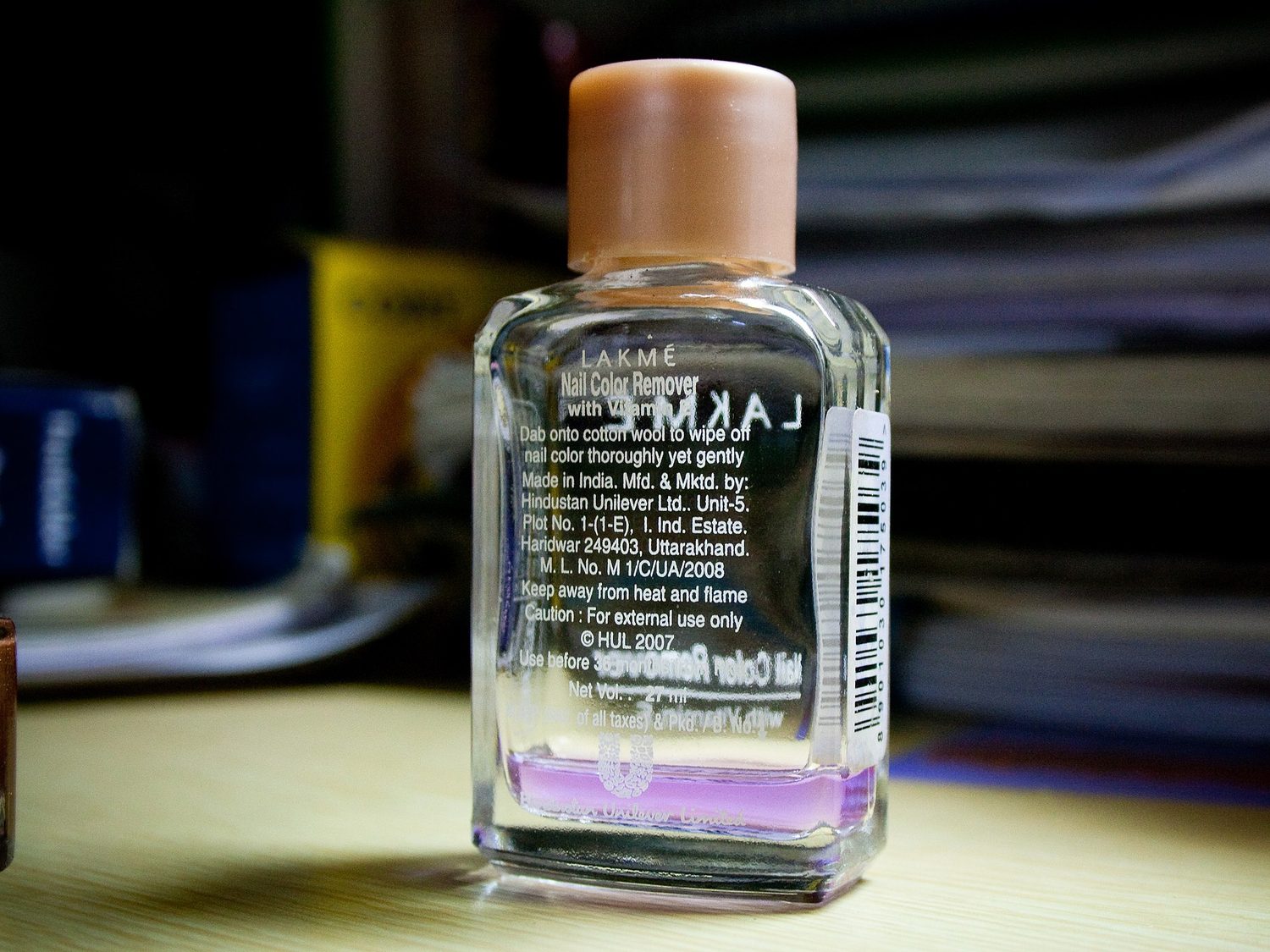
Propanone (acetone), the simplest ketone, is the solvent in nail-polish remover.
Names and boiling points
| Compound | Formula | Type | Boiling point / °C |
|---|---|---|---|
| methanal | HCHO | aldehyde | −19 |
| ethanal | CH₃CHO | aldehyde | 21 |
| propanal | CH₃CH₂CHO | aldehyde | 49 |
| propanone | CH₃COCH₃ | ketone | 56 |
| propan-1-ol (for comparison) | CH₃CH₂CH₂OH | alcohol | 97 |
- C=O is polar, so there are dipole–dipole forces, but no hydrogen bonds between carbonyl molecules. They boil lower than alcohols of similar size.
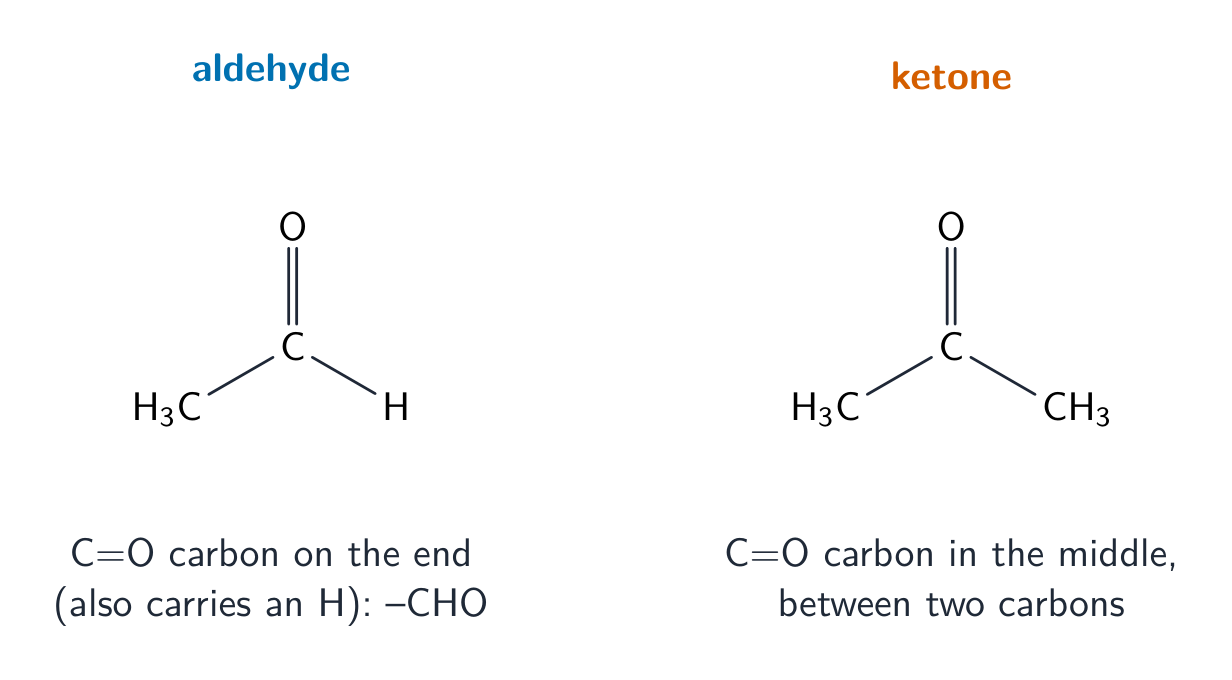
In an aldehyde the C=O is on the end; in a ketone it is in the middle
The difference between an aldehyde and a ketone is that:
Dificuldade 1/5 · Moedas 100 + pequeno bônus na primeira conclusão hoje
Both have the carbonyl C=O; in an aldehyde it is terminal (–CHO), in a ketone it is between two carbons.
Ketones have the carbonyl group at the end of the carbon chain.
Dificuldade 1/5 · Moedas 100 + pequeno bônus na primeira conclusão hoje
False. Aldehydes have the carbonyl group at the end of the chain; ketones have it in the middle, bonded to two carbons.
Propanal (bp 49 °C) boils much lower than propan-1-ol (bp 97 °C). Why?
Dificuldade 1/5 · Moedas 100 + pequeno bônus na primeira conclusão hoje
Propanal has no O–H, so only dipole–dipole and London forces act between its molecules. Its Mᵣ (58) is about the same as propan-1-ol (60).
Making them
- Oxidise an alcohol with acidified K₂Cr₂O₇: a primary alcohol, distilled at once, gives an aldehyde.
- A secondary alcohol, heated under reflux, gives a ketone.
Oxidising a secondary alcohol gives:
Dificuldade 1/5 · Moedas 100 + pequeno bônus na primeira conclusão hoje
Secondary alcohols oxidise to ketones; primary alcohols (with distillation) give aldehydes.
Reduction 还原
- NaBH₄ (in water or methanol, warm) or LiAlH₄ (in dry ether) supplies H⁻, written [H]. An aldehyde gives a primary alcohol; a ketone gives a secondary alcohol.
- $\text{CH}_3\text{CHO}+2[\text{H}]\rightarrow\text{CH}_3\text{CH}_2\text{OH}$. This is the reverse of the oxidation.
Reducing a carbonyl compound (with NaBH₄) gives:
Dificuldade 1/5 · Moedas 100 + pequeno bônus na primeira conclusão hoje
Reduction turns a carbonyl back into an alcohol (aldehyde → primary, ketone → secondary).
Match each carbonyl fact.
Dificuldade 2/5 · Moedas 140 + pequeno bônus na primeira conclusão hoje
Each item links the term to its correct meaning.
How many [H] are needed to reduce one molecule of propanone to propan-2-ol?
Dificuldade 2/5 · Moedas 140 + pequeno bônus na primeira conclusão hoje
CH₃COCH₃ + 2[H] → CH₃CH(OH)CH₃. One H goes to the carbon and one to the oxygen.
Adding HCN: nucleophilic addition 亲核加成
- HCN with a little KCN adds across the C=O to give a hydroxynitrile 羟基腈 with one more carbon. KCN supplies CN⁻, because HCN is a weak acid.
- Mechanism: CN⁻ attacks the δ+ carbon; the C=O π bond breaks, so O becomes O⁻; the O⁻ takes H⁺ (from HCN or water).
Carbonyl compound lab
Sort carbonyl reactions by what they reveal.
In the nucleophilic addition of HCN, the first step is:
Dificuldade 1/5 · Moedas 100 + pequeno bônus na primeira conclusão hoje
The cyanide nucleophile attacks the δ+ carbon, breaking the C=O; the O⁻ then takes an H⁺.
Name the product of each reaction: (a) butanal with $\text{NaBH}_4$; (b) butanone with $\text{NaBH}_4$; (c) propanone with HCN and a little KCN.
- (a) An aldehyde is reduced to a primary alcohol: butan-1-ol. (b) A ketone gives a secondary alcohol: butan-2-ol. $\text{NaBH}_4$ supplies $\text{H}^-$, written $[\text{H}]$:
- (c) $\text{CN}^-$ adds to the carbonyl carbon and $\text{H}^{+}$ to the O: $(\text{CH}_3)_2\text{C(OH)CN}$, 2-hydroxy-2-methylpropanenitrile. The chain grows from 3 to 4 carbons.
Butanal reacts with HCN (KCN catalyst). How many carbon atoms are in the hydroxynitrile formed?
Dificuldade 2/5 · Moedas 140 + pequeno bônus na primeira conclusão hoje
Butanal has 4 carbons and the CN group adds one: 2-hydroxypentanenitrile.
Propanal is reduced with $\text{NaBH}_4$. What forms?
Dificuldade 1/5 · Moedas 100 + pequeno bônus na primeira conclusão hoje
Reducing an aldehyde gives a primary alcohol, with the OH on the end carbon.
- The curly arrow goes from the lone pair on C of CN⁻ to the carbonyl carbon, and from the C=O bond to the O.
- HCN is very toxic: it is made in the flask from KCN and acid.
- NaBH₄ does not reduce C=C bonds; it only reduces C=O.
You've got it
- Carbonyl = C=O; aldehyde (–CHO, end) or ketone (middle). Polar, but no hydrogen bonds between molecules.
- Made by oxidising alcohols; reduced back by NaBH₄ or LiAlH₄ (aldehyde → primary, ketone → secondary).
- HCN/KCN → hydroxynitrile (+1 carbon) by nucleophilic addition: CN⁻ attacks δ+ C, O⁻ takes H⁺.