The nature of operations
Introduzido| English | Significado |
|---|---|
| inputs/ˈɪnpʊts/ | insumos |
| outputs/ˈaʊtpʊts/ | produtos |
| transformation/trænsfɔːˈmeɪʃn/ | transformação |
| operations/ˌɒpəˈreɪʃnz/ | operações |
| productivity/ˌprɒdəkˈtɪvɪti/ | produtividade |
| efficiency/ɪˈfɪʃənsi/ | eficiência |
| effectiveness/ɪˈfektɪvnəs/ | eficácia |
| sustainable/səˈsteɪnəbl/ | sustentável |
From 12 hours to 93 minutes, 1913
- In 1913, at Highland Park, Michigan, Ford introduced a moving assembly line for the Model T. Instead of workers walking around a fixed car, a rope pulled each chassis past them. The time to assemble one fell from about 12½ hours to about 93 minutes, and the car's price fell year after year.
- Ford changed how inputs 投入 became outputs 产出. That transformation 转化 is operations 运营.
What did Ford's 1913 moving assembly line change?
Dificuldade 1/5 · Moedas 100 + pequeno bônus na primeira conclusão hoje
Assembly time fell to about 93 minutes.
The transformation process
- Inputs: materials, labour, capital (machines, buildings) and enterprise. Process: making, assembling, serving. Outputs: goods or services.
- Operations add value: the output is worth more to customers than the inputs cost.
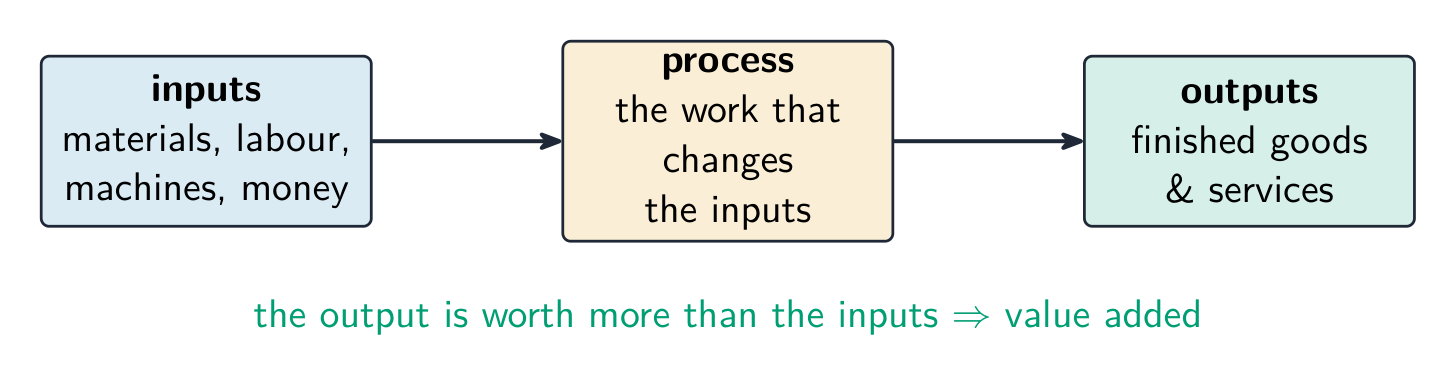
Operations: input → output
Operations management turns inputs into finished goods or services through a transformation process.
Which are inputs?
Dificuldade 2/5 · Moedas 140 + pequeno bônus na primeira conclusão hoje
Loaves are outputs.
Productivity
- Productivity 生产率 = output ÷ input over a period; labour productivity = output per worker (or per worker-hour).
- It rises with better training, better machines, better methods and motivated staff.
A factory makes 2,400 units a week with 30 workers. What is labour productivity (units per worker per week)?
Dificuldade 2/5 · Moedas 140 + pequeno bônus na primeira conclusão hoje
2,400 ÷ 30.
Efficiency and effectiveness
- Efficiency 效率: producing output with the least waste of resources (time, materials, money).
- Effectiveness 有效性: meeting the objective — the right quality, on time, what the customer wanted. An efficient process that makes the wrong product is not effective.
Match each term to its meaning.
Dificuldade 2/5 · Moedas 140 + pequeno bônus na primeira conclusão hoje
Doing things right versus doing the right thing.
Worked example: labour productivity
A bakery makes 600 loaves a day with 5 bakers. After buying a new oven it makes 750 loaves with the same 5 bakers.
- Before: $600 \div 5 = 120$ loaves per baker.
- After: $750 \div 5 = 150$ loaves per baker — a $\dfrac{150 - 120}{120} \times 100 = 25\%$ rise.
- Evaluation: worth it only if the extra loaves are sold and the oven's cost is covered; quality must not fall.
Productivity rises from 40 to 50 units per worker. What is the percentage increase?
Dificuldade 2/5 · Moedas 140 + pequeno bônus na primeira conclusão hoje
10 ÷ 40 × 100.
Operations objectives and sustainability
- Cost, quality, speed, dependability and flexibility — firms trade these off (Ford's early line was cheap but offered one model).
- Sustainable 可持续的 operations reduce waste, energy use and emissions, and can lower costs and attract customers.
Sustainable operations can reduce costs as well as emissions.
Dificuldade 1/5 · Moedas 100 + pequeno bônus na primeira conclusão hoje
Less waste and energy.
Higher productivity does not always mean lower unit cost. If wages or equipment costs rise faster than output, cost per unit can still go up.
Higher productivity always reduces cost per unit.
Dificuldade 1/5 · Moedas 100 + pequeno bônus na primeira conclusão hoje
Costs may rise faster.
Operations transform inputs into outputs and add value. Productivity is output per input; efficiency minimises waste; effectiveness meets the objective. Firms balance cost, quality, speed, flexibility and sustainability.
Evaluate whether a clothing factory should buy automated cutting machines to raise productivity.
Evaluation.