Meiosis and variation
Introduzido| English | Significado |
|---|---|
| diploid/ˈdɪplɔɪd/ | diploide |
| haploid/ˈhæplɔɪd/ | haploide |
| gamete/ˈɡæmiːt/ | gameta |
| meiosis/meɪˈəʊsɪs/ | meiose |
| homologous/həˈmɒləɡəs/ | homólogo |
| allele/əˈliːl/ | alelo |
| crossing over/ˈkrɒsɪŋ ˈəʊvə/ | crossing over |
| independent assortment/ˌɪndɪˈpendənt əˈsɔːtmənt/ | assortação independente |
| fertilisation/ˌfɜːtɪlaɪˈzeɪʃn/ | fertilização |
Shuffling the genetic deck
- A diploid 二倍体 cell (2n) has two sets of chromosomes; a haploid 单倍体 cell (n) has one.
- Gametes 配子 (sex cells) must be haploid — or the number would double each generation.
- They are made by meiosis 减数分裂, which also creates variation.
Why must gametes be haploid?
Dificuldade 1/5 · Moedas 100 + pequeno bônus na primeira conclusão hoje
If gametes were diploid, fertilisation would double the chromosome number each generation; meiosis halves it.
Meiosis halves the chromosome number, producing ______ gametes (one set of chromosomes each).
Dificuldade 1/5 · Moedas 100 + pequeno bônus na primeira conclusão hoje
Two haploid gametes fuse at fertilisation to restore the diploid number.
Homologous 同源 pairs and meiosis
- Chromosomes come in homologous pairs: same length, same genes — but the alleles 等位基因 (versions) may differ.
- Meiosis halves the chromosome number, in two divisions (eight stages: prophase I → telophase II).
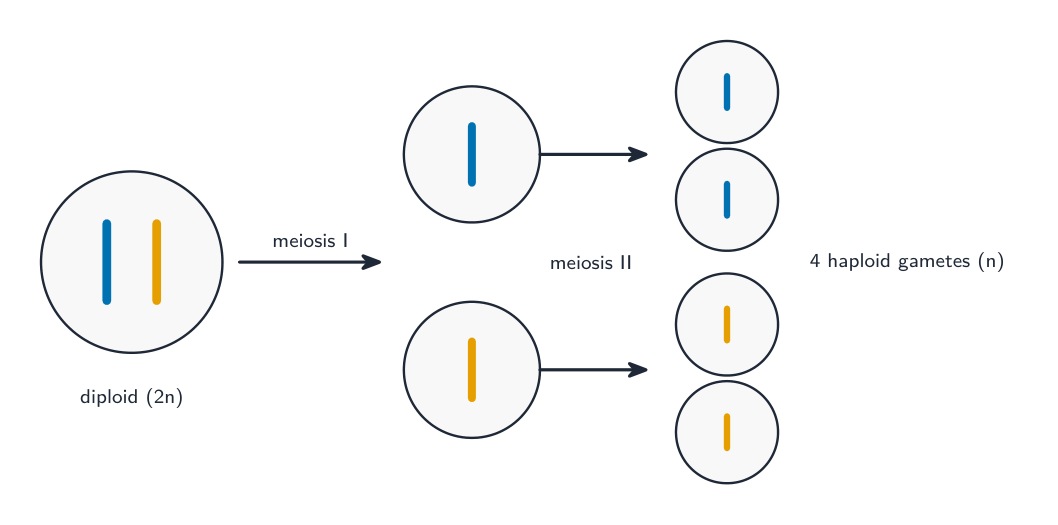
Meiosis runs two divisions, halving the chromosome number from a diploid cell to four haploid gametes
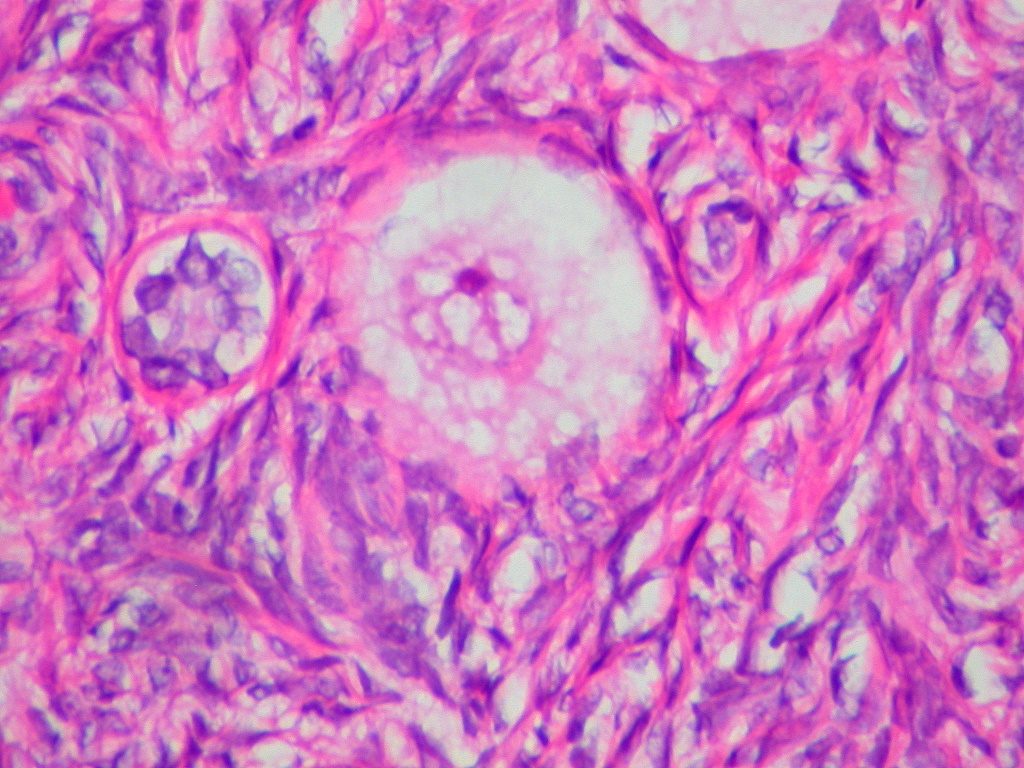
A human egg cell (ovum), one of the gametes produced by meiosis.
Mitose
Step through it. Two divisions halve the chromosome number and shuffle the alleles, giving four unique gametes.
A homologous pair of chromosomes:
Dificuldade 1/5 · Moedas 100 + pequeno bônus na primeira conclusão hoje
Homologous chromosomes match in length and gene positions, though they may carry different alleles.
Two sources of variation
- Crossing over 交叉互换: homologous chromosomes swap matching pieces, mixing alleles.
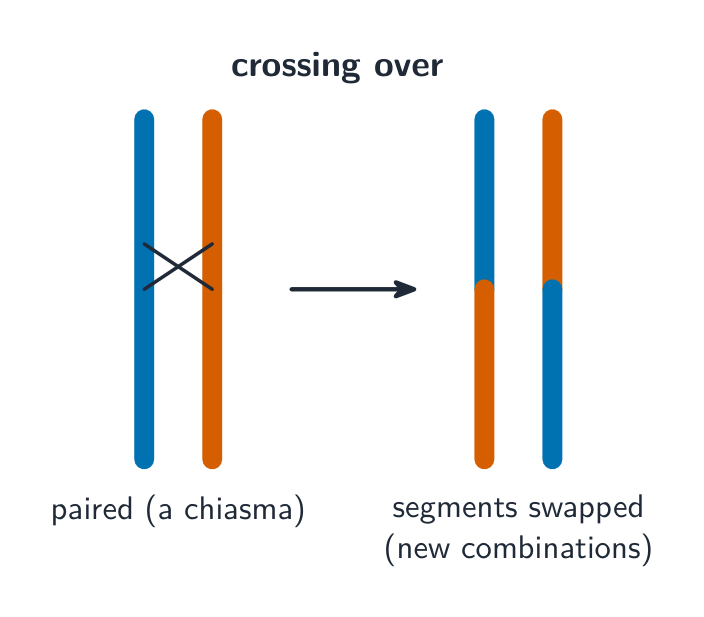
Crossing over swaps matching segments between homologous chromosomes, making new allele combinations
- Independent assortment 自由组合: the pairs line up in a random order, so each gamete gets a random mix.
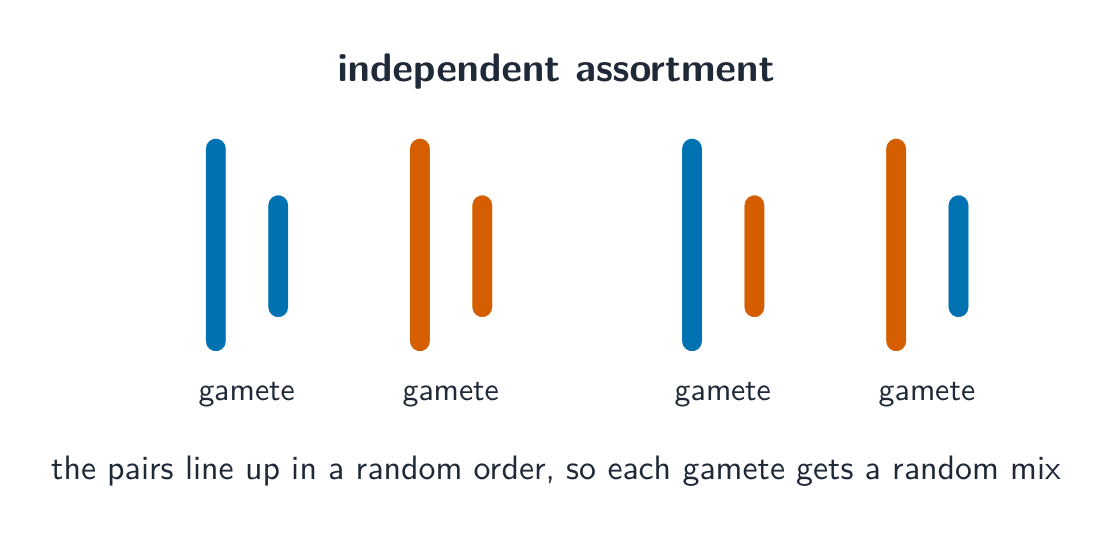
Independent assortment: each homologous pair lines up at random, so many different gamete types form
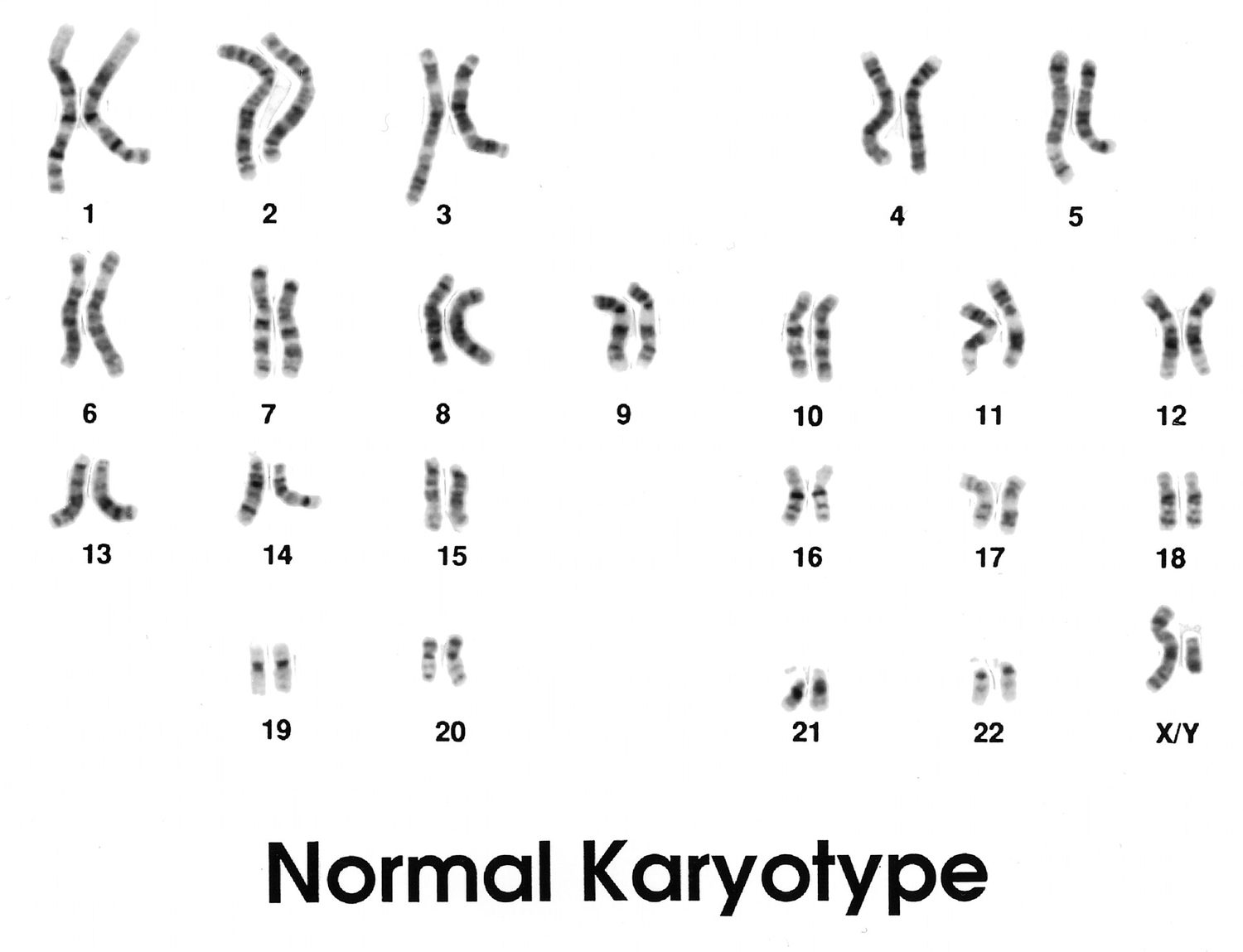
A human karyotype: 23 pairs of chromosomes, ending in XY (male)
Crossing over creates variation by:
Dificuldade 1/5 · Moedas 100 + pequeno bônus na primeira conclusão hoje
At a chiasma, homologous chromosomes exchange matching pieces, producing new allele combinations.
Independent assortment means each homologous pair lines up in a random order, so gametes get a random mix of chromosomes.
Dificuldade 1/5 · Moedas 100 + pequeno bônus na primeira conclusão hoje
The random orientation of each pair at metaphase I gives an enormous number of possible gamete combinations.
Match each source of variation to what it does.
Dificuldade 2/5 · Moedas 140 + pequeno bônus na primeira conclusão hoje
Meiosis (crossing over + independent assortment) and random fertilisation shuffle existing alleles; mutation creates new ones.
Random fertilisation 受精
- At fertilisation, any gamete can fuse with any other.
- This random fusion makes every new individual genetically different.
Random fertilisation adds to variation because:
Dificuldade 1/5 · Moedas 100 + pequeno bônus na primeira conclusão hoje
Which two gametes meet is random, so each new combination of alleles is unique.
Worked example: counting possible gametes
A human cell has 23 homologous pairs. How many different combinations of chromosomes can one person's gametes have by independent assortment alone? And how many zygotes can two parents produce?
- Each pair can line up two ways, so the number of combinations is $2^n$, here $2^{23}\approx$ 8.4 million different gametes.
- With random fertilisation, any one of one parent's 8.4 million combinations can meet any one of the other's: about $(8.4\times10^6)^2\approx7\times10^{13}$ zygotes. Crossing over adds even more variation, so no two children (except identical twins) are genetically the same.
A cell has 3 homologous pairs (2n = 6). How many different combinations of chromosomes can its gametes have by independent assortment?
Dificuldade 2/5 · Moedas 140 + pequeno bônus na primeira conclusão hoje
2³ = 8.
A body cell has 46 chromosomes. How many are in a human sperm cell?
Dificuldade 1/5 · Moedas 100 + pequeno bônus na primeira conclusão hoje
Gametes are haploid, so they carry half the number.
You've got it
- diploid (2n) = two sets; haploid (n) = one; gametes must be haploid
- homologous pairs: same genes, possibly different alleles; meiosis halves the number
- variation from crossing over + independent assortment
- plus random fertilisation → every individual is unique
Write from the data given
- A human body cell has 46 chromosomes.
- It divides by meiosis.
How many chromosomes are in each gamete?
Meiosis produces haploid gametes.
How many chromosomes are in a human gamete?
Dificuldade 1/5 · Moedas 100 + pequeno bônus na primeira conclusão hoje
Half of 46 is 23.