The circulatory system
Introduzido| English | Significado |
|---|---|
| closed double circulation/kləʊzd ˈdʌbl ˌsɜːkjʊˈleɪʃn/ | Circulação dupla fechada |
| pulmonary circulation/ˈpʌlmənəri ˌsɜːkjʊˈleɪʃn/ | Circulação pulmonar |
| systemic circulation/sɪˈstemɪk ˌsɜːkjʊˈleɪʃn/ | Circulação sistêmica |
| vein/veɪn/ | Veia |
| artery/ˈɑːtəri/ | Artéria |
| aorta/eɪˈɔːtə/ | Aorta |
| lumen/ˈluːmen/ | Lúmen |
| capillary/kəˈpɪləri/ | Capilar |
The body's transport network
- Mammals have a closed double circulation 闭锁双循环.
- Closed: blood stays inside vessels the whole time.
- Double: blood passes through the heart twice per full trip.
A "closed double circulation" means that:
Dificuldade 1/5 · Moedas 100 + pequeno bônus na primeira conclusão hoje
Closed = blood always in vessels; double = it passes through the heart twice (pulmonary then systemic).
Two loops
- The pulmonary circulation 肺循环 carries blood from the heart to the lungs and back.
- The systemic circulation 体循环 carries blood from the heart to the rest of the body and back.
- Blood flows: arteries → arterioles → capillaries → venules → veins 静脉.
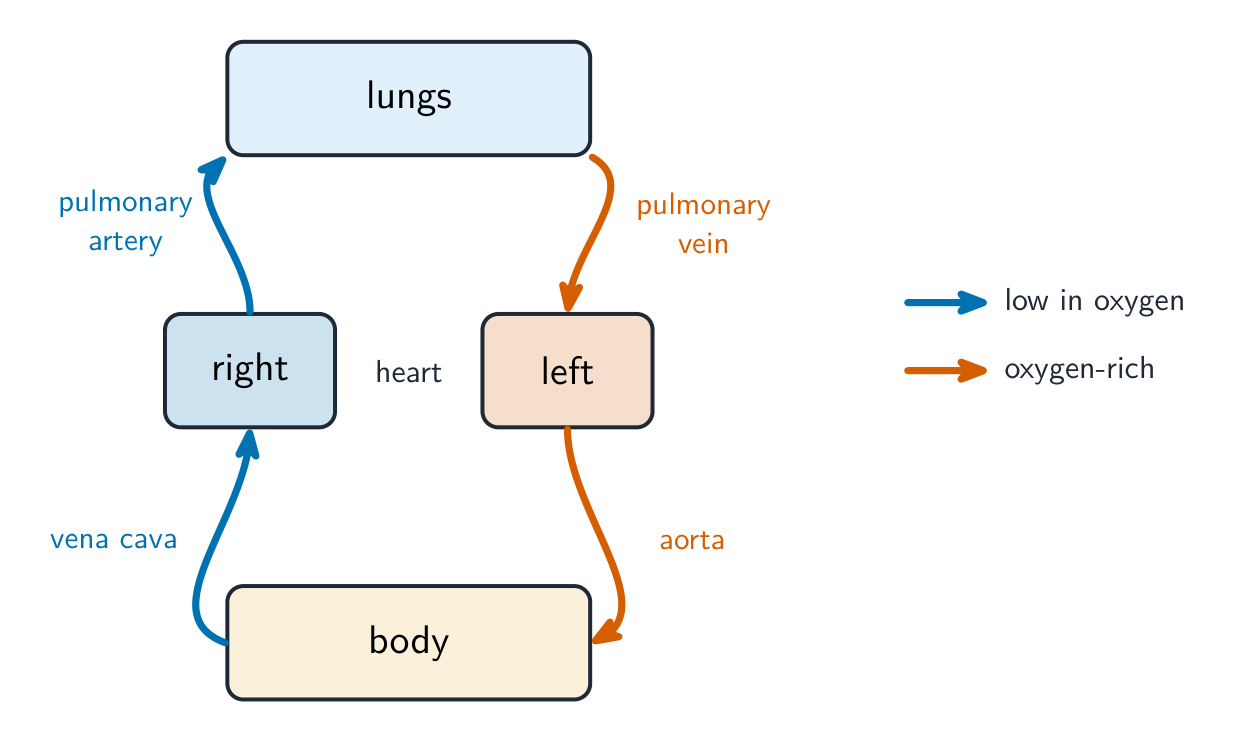
Closed double circulation through the heart, lungs and body
Double circulation
Follow one red blood cell around the loop. It passes through the heart twice each circuit — once to the lungs, once to the body.
The circulation that carries blood from the heart to the lungs and back is the ______ circulation.
Dificuldade 1/5 · Moedas 100 + pequeno bônus na primeira conclusão hoje
Pulmonary = to the lungs; systemic = to the rest of the body.
The main vessels
- pulmonary artery 动脉 — heart → lungs (low oxygen).
- pulmonary vein — lungs → heart (oxygen-rich).
- aorta 主动脉 — heart → body (oxygen-rich).
- vena cava — body → heart (oxygen-poor).
Vessels suited to their jobs
| Vessel | Structure | Function |
|---|---|---|
| artery | thick muscle + elastic wall, narrow lumen 管腔 | high-pressure flow away from heart; walls recoil to smooth flow |
| capillary 毛细血管 | wall just one cell thick | short distance for exchange with cells |
| vein | thin wall, wide lumen, valves | low-pressure return to heart; valves stop backflow |
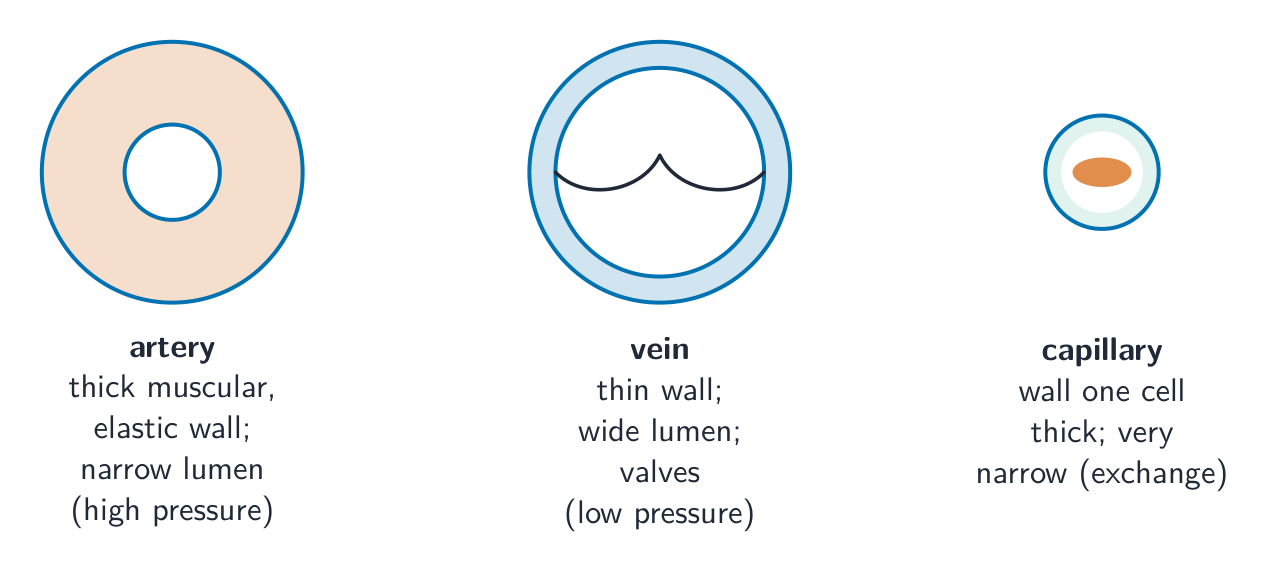
Cross-sections of an artery (thick wall), vein (wide lumen, valves) and capillary (one cell thick)
Match each vessel to its feature.
Dificuldade 2/5 · Moedas 140 + pequeno bônus na primeira conclusão hoje
Arteries carry high-pressure blood away; veins return it (valves stop backflow); capillaries are where exchange happens.
Arteries have thick, elastic, muscular walls because they:
Dificuldade 1/5 · Moedas 100 + pequeno bônus na primeira conclusão hoje
High-pressure blood leaving the heart needs strong walls that stretch and recoil to smooth the flow.
Arteries contain valves because their blood is at low pressure.
Dificuldade 1/5 · Moedas 100 + pequeno bônus na primeira conclusão hoje
False. Veins carry blood at low pressure and contain valves to stop backflow. Arteries carry high-pressure blood and have no valves along their length.
A capillary wall is just one cell thick because this:
Dificuldade 1/5 · Moedas 100 + pequeno bônus na primeira conclusão hoje
A one-cell-thick wall means a short diffusion distance, so substances exchange quickly.
Worked example: tracing a red blood cell
A red blood cell leaves a capillary in a muscle of the leg. Trace its route until it next returns to the leg, naming the vessels and heart chambers.
- Leg capillary → venule → vein → vena cava → right atrium → right ventricle → pulmonary artery → lung capillaries (picks up oxygen) → pulmonary vein → left atrium.
- → left ventricle → aorta → artery → arteriole → leg capillary. It passed through the heart twice, once in each loop: this is double circulation.
Which vessel carries oxygen-rich blood from the lungs to the heart?
Dificuldade 1/5 · Moedas 100 + pequeno bônus na primeira conclusão hoje
Veins carry blood to the heart; this one comes from the lungs.
Every artery carries oxygen-rich blood.
Dificuldade 1/5 · Moedas 100 + pequeno bônus na primeira conclusão hoje
The pulmonary artery carries oxygen-poor blood to the lungs.
You've got it
- closed double circulation: blood in vessels, through the heart twice
- pulmonary loop = lungs; systemic loop = body
- artery: thick wall, high pressure, away from heart; vein: valves, low pressure, back to heart
- capillary: one cell thick → fast exchange
Write from this case
- Blood leaves the heart under pressure.
- It later returns at lower pressure.
Which vessels carry blood away from the heart?
Artery means away from the heart in this course.
Which vessels leave the heart?
Dificuldade 1/5 · Moedas 100 + pequeno bônus na primeira conclusão hoje
Arteries carry blood away. Veins bring it back.