Pular para o conteúdo
Matérias

Pearson Edexcel · International GCSE · Chemistry

  • 1

    1 · Principles of chemistry

    Programa de aprendizado em breve

    Material de apoio

    English

    The language of chemistry

    Everything in this course is written in one language: particles, formulae and equations. Section 1 teaches it — how particles arrange themselves in solids, liquids and gases; how atoms are built and lined up in the Periodic Table; how to turn a sentence about a reaction into a balanced equation and a mass calculation; and how the three kinds of bonding give every substance its properties.

    Edexcel International GCSE Chemistry 4CH1, Section 1 (statements 1.1–1.60C) is the largest section and the foundation for the other three. C-suffixed statements are the separate-science (Chemistry-only) extension.

    States of matter and solutions
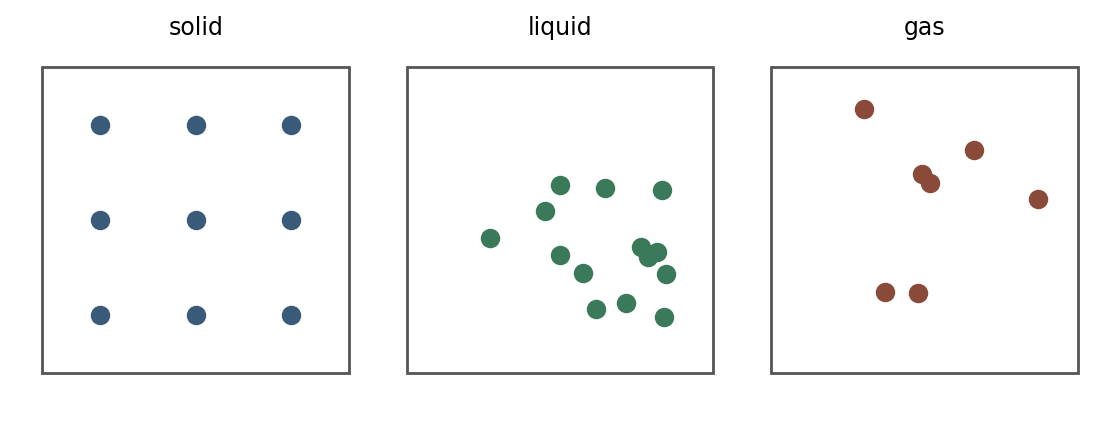
    Particle arrangements in the three states: fixed rows in solids, touching but disordered in liquids, far apart and fast in gases.

    Solid: particles vibrate about fixed positions in a regular pattern. Liquid: particles touch but move past each other at random. Gas: particles far apart, fast, random. Interconversions: melting 熔化 / freezing 凝固, boiling 沸腾 / condensation 凝结, evaporation 蒸发 (surface only, below boiling), sublimation 升华 (solid → gas directly). Energy is absorbed to separate particles and released as they bond again.

    A solvent 溶剂 dissolves the solute 溶质 to make a solution 溶液; a saturated solution 饱和溶液 holds all the solute it can at that temperature. (C) Solubility is the mass dissolved per 100 g of solvent at a stated temperature, read from a solubility curve 溶解度曲线 — points on the line are saturated; below it, unsaturated.
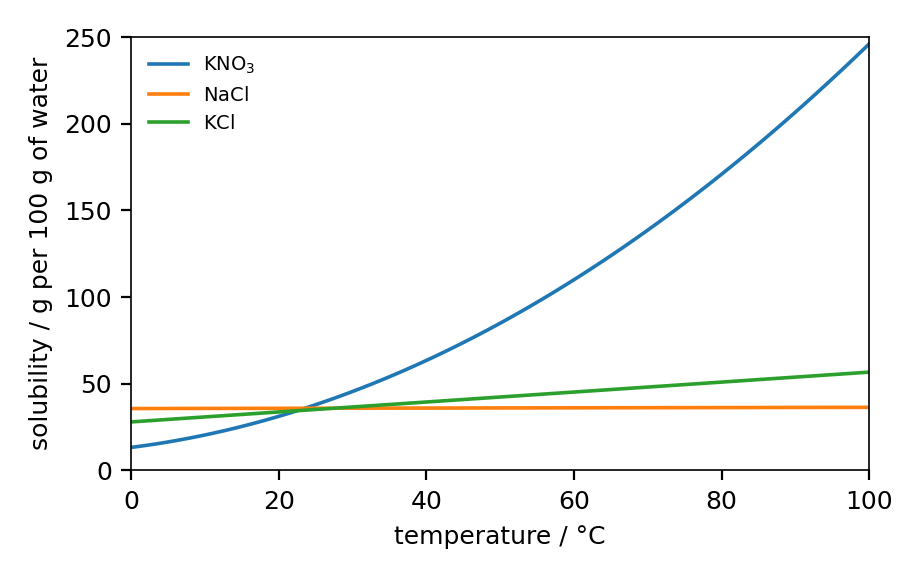
    Solubility curves rise with temperature for most solids; read the saturated mass at a stated temperature.

    Dilution of coloured solutions and gas diffusion (bromine spreading through air) both show particles moving from where they are many to where they are few.

    Elements, compounds, mixtures and separation

    An element 元素 contains one type of atom; a compound 化合物 holds different atoms chemically joined; a mixture 混合物 is not chemically joined. A pure substance has a sharp melting/boiling point; mixtures melt and boil over a range — the test for purity.

    Separation techniques, matched to the job: filtration 过滤 (insoluble solid from liquid); crystallisation 结晶 (evaporate a solution to leave crystals); simple distillation 蒸馏 (liquid from dissolved solid — evaporate then condense); fractional distillation 分馏 (liquids with close boiling points, using a fractionating column); paper chromatography 纸层析 (solutes that dissolve differently in a solvent).
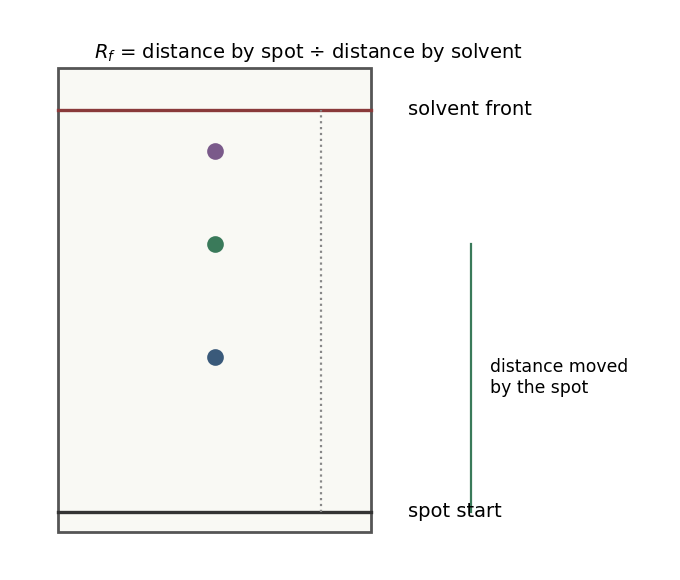
    A chromatogram: the solvent front and spot distances give Rf values that identify each component.

    Rf = distance moved by the spot ÷ distance moved by the solvent. The same substance always has the same Rf in the same solvent — comparing with known values identifies the components of the mixture.

    Atoms and the Periodic Table
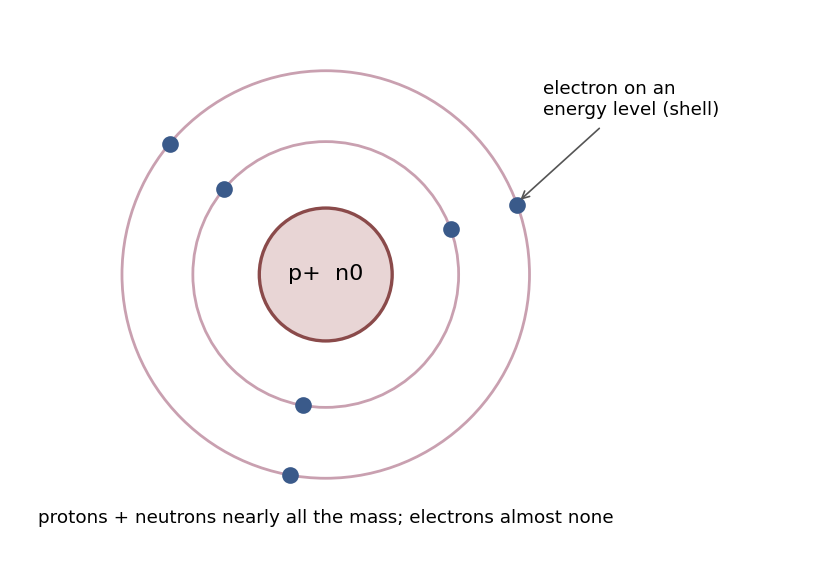
    The nuclear atom: protons and neutrons in the nucleus, electrons in shells.
    Particle Relative mass Relative charge
    proton 1 +1
    neutron 1 0
    electron 1/1835 (≈0) −1

    Atomic number 质子数 = protons; mass number 质量数 = protons + neutrons. Isotopes 同位素 have the same protons but different neutrons. Relative atomic mass ($A_r$) is the weighted mean over the isotopes.

    Worked check. Chlorine: 75 % Cl-35, 25 % Cl-37 → $A_r = (75 \times 35 + 25 \times 37)/100 = 35.5$.

    The Periodic Table lists elements by atomic number into groups 族 (columns, same outer electrons) and periods 周期 (rows). The first 20 electronic configurations follow 2,8,8,2 shells (e.g. sodium 2.8.1). Metals sit left/centre: their oxides are basic and they conduct; non-metal oxides are acidic. Group members behave alike because they have the same number of outer electrons; Group 0 noble gases have full outer shells and do not readily react.

    Formulae, equations and calculations

    Balance equations with state symbols 状态符号: (s), (l), (g), (aq). $M_r$ sums the $A_r$ values. The mole 摩尔 is the amount of substance: $n = m/M_r$ (mass in grams).

    Worked check (reacting masses). What mass of magnesium oxide forms from 6.0 g of magnesium? $2\mathrm{Mg} + \mathrm{O_2} \rightarrow 2\mathrm{MgO}$: $n(\mathrm{Mg}) = 6.0/24 = 0.25$ mol → $n(\mathrm{MgO}) = 0.25$ mol → mass $= 0.25 \times 40 = 10$ g.

    Percentage yield 产率 $=$ actual ÷ theoretical × 100 %. Empirical formula 实验式 is the simplest whole-number ratio (divide each mass by its $A_r$, scale to integers); the molecular formula is the true count ($M_r$ ÷ empirical mass gives the multiplier).

    Worked check. A hydrocarbon is 85.7 % C, 14.3 % H: C 85.7/12 = 7.14, H 14.3/1 = 14.3 → ratio 1:2 → empirical CH₂. With $M_r = 56$: 56/14 = 4 → molecular C₄H₈.

    (C) Solutions: $n = c \times V$ with $c$ in mol/dm³ and $V$ in dm³ (cm³ ÷ 1000). Gases: molar volume 24 dm³ at rtp, so $n = V/24$. (C-practical) A metal oxide's formula comes from combustion (weigh magnesium, burn, weigh the oxide) or reduction (weigh copper(II) oxide, reduce with hydrogen, weigh the copper).

    Bonding

    Ionic bonding 离子键: metals lose electrons to non-metals; the charged ions attract electrostatically in a giant lattice — dot-and-cross diagrams show the transfer (Groups 1–3 with 5–7). High melting points (strong attractions); conduct only when molten or dissolved (ions free to move). Learn the charges: Groups 1/2/3 → 1+/2+/3+; Groups 5/6/7 → 3−/2−/1−; Ag⁺, Cu²⁺, Fe²⁺, Fe³⁺, Pb²⁺, Zn²⁺; OH⁻, NH₄⁺, CO₃²⁻, NO₃⁻, SO₄²⁻. Formulae balance the charges: calcium nitrate Ca(NO₃)₂, ammonium sulfate (NH₄)₂SO₄.

    Covalent bonding 共价键: shared pairs of electrons (dot-and-cross for H₂, O₂, N₂, halogens, HCl, H₂O, NH₃, CO₂ and small organics). Simple molecular substances have weak intermolecular forces — low melting points, rising with $M_r$; they do not conduct (no ions, no free electrons). Giant covalent: diamond (each C bonded to 4 — very hard, non-conductor), graphite (3 bonds + one free electron per C, layers with weak forces — soft, conducts, slippery), C₆₀ fullerene (simple molecular cage).
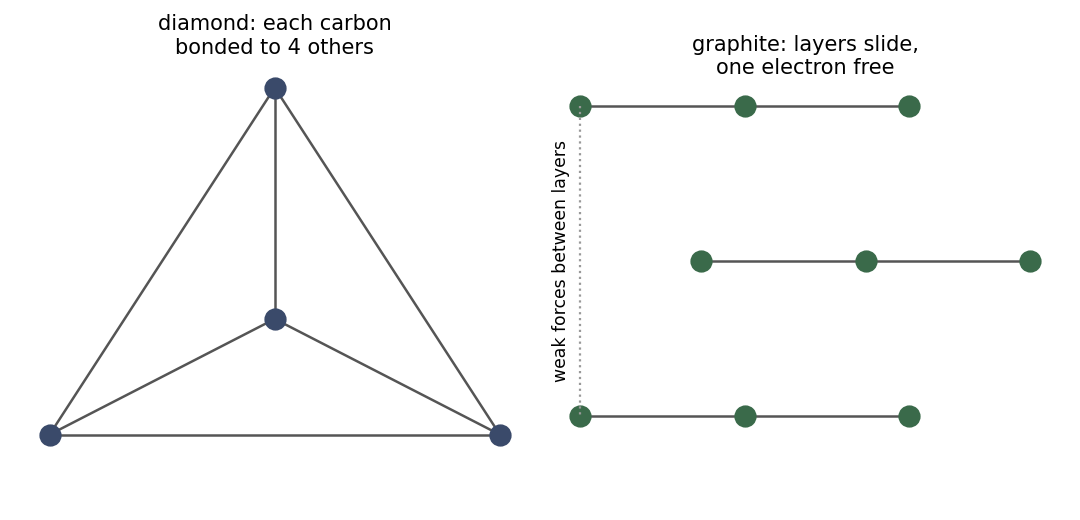
    Diamond bonds every carbon to four others; graphite bonds three and keeps one electron free between weak layers.

    (C) Metallic: a lattice of positive ions in a sea of delocalised electrons — electrostatic attraction; the free electrons conduct electricity, and layers slide (malleable).

    Electrolysis (C)
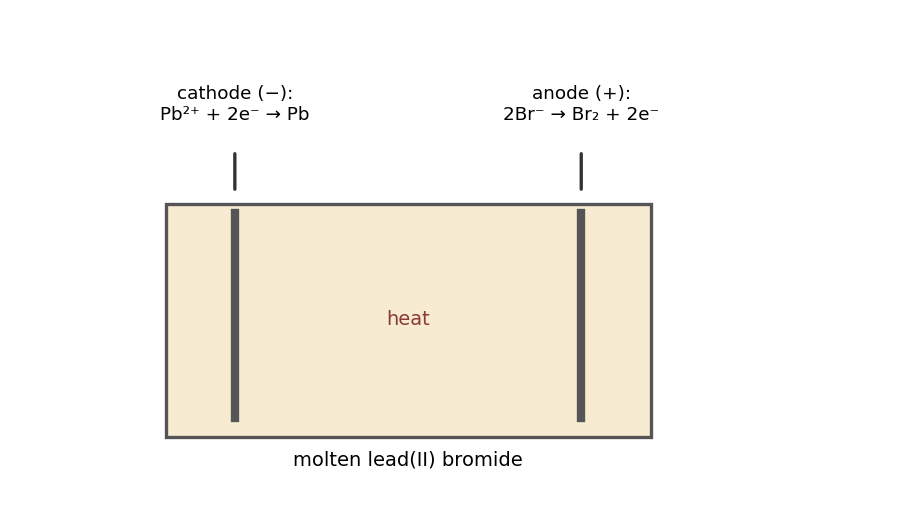
    Electrolysis of molten lead(II) bromide: lead forms at the cathode, bromine at the anode.

    Electrolysis 电解 uses electricity to split molten or dissolved ionic compounds: the cathode 阴极 (negative) attracts cations 阳离子; the anode 阳极 (positive) attracts anions 阴离子. Molten PbBr₂ gives Pb at the cathode (Pb²⁺ + 2e⁻ → Pb) and Br₂ at the anode (2Br⁻ → Br₂ + 2e⁻). In aqueous solution, hydrogen forms at the cathode if the metal is more reactive than hydrogen; at the anode, halide ions give the halogen, otherwise oxygen (4OH⁻ → O₂ + 2H₂O + 4e⁻). Loss of electrons is oxidation 氧化, gain is reduction 还原.

    Check yourself

    1. Describe the particle arrangement and movement in a liquid.
    2. Define saturated solution, and state the units of solubility.
    3. Which technique separates two miscible liquids with close boiling points?
    4. An isotope has 17 protons and 20 neutrons. Give its mass number and the numbers of each particle.
    5. Calculate $A_r$ of an element with 80 % of mass 20 and 20 % of mass 22.
    6. Balance with state symbols: magnesium + oxygen → magnesium oxide.
    7. 8.4 g of the oxide of calcium forms from 6.0 g of calcium. Show the empirical formula of the oxide.
    8. Write the formula of ammonium carbonate.
    9. Explain why graphite conducts but diamond does not.
    10. (C) What forms at each electrode in the electrolysis of molten potassium chloride?

    Answers: 1 particles touch but are disordered, moving randomly past each other; 2 a solution containing the maximum mass of dissolved solute at that temperature; g per 100 g of solvent; 3 fractional distillation; 4 mass number 37; 17 protons, 20 neutrons, 17 electrons; 5 $(80 \times 20 + 20 \times 22)/100 = 20.4$; 6 2Mg(s) + O₂(g) → 2MgO(s); 7 Ca 6.0/40 = 0.15 mol; O mass 8.4 − 6.0 = 2.4 g → 2.4/16 = 0.15 mol; ratio 1:1 → empirical formula CaO; 8 (NH₄)₂CO₃; 9 graphite uses three bonds per carbon, leaving one delocalised electron per carbon free to move between layers — diamond uses all four in fixed bonds; 10 (C) potassium at the cathode (K⁺ + e⁻ → K) and chlorine at the anode (2Cl⁻ → Cl₂ + 2e⁻).
    Vocabulário
    English Português
    melting/ˈmeltɪŋ/ fusão
    freezing/ˈfriːzɪŋ/ solidificação
    boiling/ˈbɔɪlɪŋ/ ebulição
    evaporation/ɪˌvæpəˈreɪʃn/ evaporação
    condensation/kɒndenˈseɪʃn/ condensação
    sublimation/ˌsʌblɪˈmeɪʃn/ sublimação
    solvent/ˈsɒlvənt/ solvente
    solute/ˈsɒljuːt/ soluto
    solution/səˈluːʃn/ solução
    saturated solution/ˈsætʃəreɪtɪd səˈluːʃn/ solução saturada
    solubility curve curva de solubilidade
    element/ˈelɪmənt/ elemento
    compound/ˈkɒmpaʊnd/ composto
    mixture/ˈmɪkstʃə/ mistura
    filtration/fɪlˈtreɪʃn/ filtração
    crystallisation/ˌkrɪstəlaɪˈzeɪʃn/ cristalização
    simple distillation/ˈsɪmpl dɪstɪˈleɪʃn/ destilação simples
    fractional distillation/ˈfrækʃənl dɪstɪˈleɪʃn/ destilação fracionada
    paper chromatography/ˈpeɪpə krəʊməˈtɒɡrəfi/ cromatografia em papel
    Atomic number/əˈtɒmɪk ˈnʌmbə/ número atômico
    mass number/mæs ˈnʌmbə/ número de massa
    Isotope/ˈaɪsətəʊp/ isótopo
    group/ɡruːp/ grupo
    period/ˈpɪərɪəd/ período
    state symbol/steɪt ˈsɪmbl/ símbolo de estado
    mole/məʊl/ mol
    Percentage yield/pəˈsentɪdʒ jiːld/ rendimento percentual
    Empirical formula/emˈpɪrɪkl ˈfɔːmjʊlə/ fórmula empírica
    Ionic bonding/aɪˈɒnɪk ˈbɒndɪŋ/ ligação iônica
    cation/ˈkætaɪən/ cátion
    anion/ˈænaɪən/ ânion
    Covalent bonding/ˈkəʊvələnt ˈbɒndɪŋ/ ligação covalente
    Electrolysis/ɪlekˈtrɒləsɪs/ eletrólise
    cathode/ˈkæθəʊd/ cátodo
    anode/ˈænəʊd/ ânodo
    oxidation/ˌɒksɪˈdeɪʃn/ oxidação
    reduction/rɪˈdʌkʃn/ redução
  • 2

    2 · Inorganic chemistry

    Programa de aprendizado em breve

    Material de apoio

    O mundo reativo da química inorgânica

    Adicionar lítio à água faz efervescer suavemente; adicionar potássio inflama. Esta seção segue os padrões dessas observações — as famílias da Tabela Periódica, o ar que respiramos, a escala de reatividade que determina como cada metal é extraído e por que o ferro enferruja — e depois o enorme centro prático do curso: ácidos, bases, preparação de sais e testes de identificação.

    Edexcel International GCSE Chemistry 4CH1, Section 2 (enunciados 2.1–2.50) fornece a maioria das questões de memorização e práticas em ambas as provas. Os enunciados sufixados com C são exclusivos de Química.

    Grupo 1 e Grupo 7

    Grupo 1 (Li, Na, K) reagem com água para formar hidróxido e hidrogênio — efervescência, flutuação, fusão (Na), chama lilás (K). As reações tornam-se mais rápidas e vigorosas descendo no grupo: uma família com tendência. (C) A reatividade aumenta porque o elétron externo está mais longe do núcleo e é perdido com mais facilidade.

    Grupo 7 (Cl₂ gás verde-claro, Br₂ líquido laranja-acastanhado, I₂ sólido cinza-negro) escurecem ao descer no grupo. Um halogênio mais reativo desloca a sal de um menos reativo: cloro desloca bromo do brometo de potássio (a solução fica laranja). (C) A reatividade diminui ao descer no grupo — a camada externa está mais distante, então ganhar um elétron é mais difícil.

    Ar e gases

    Ar seco: cerca de 78 % nitrogênio, 21 % oxigênio, 0.96 % argônio, 0.04 % dióxido de carbono (os quatro mais abundantes). A porcentagem de oxigênio pode ser medida consumindo-o — ferrugem de ferro em ar úmido sobre água, ou fósforo queimando, fazendo a água subir cerca de um quinto. Elementos queimam em oxigênio: magnésio produz chama branca intensa e MgO branco; hidrogênio queima com estalido formando vapor; enxofre produz chama azul e SO₂ sufocante. Carbonato de cobre(II) decompondo-se com aquecimento: CuCO₃ → CuO + CO₂ (a água de cal fica turva). CO₂ é um gaso estufa cujos níveis crescentes contribuem para as mudanças climáticas.

    Série de reatividade e metais

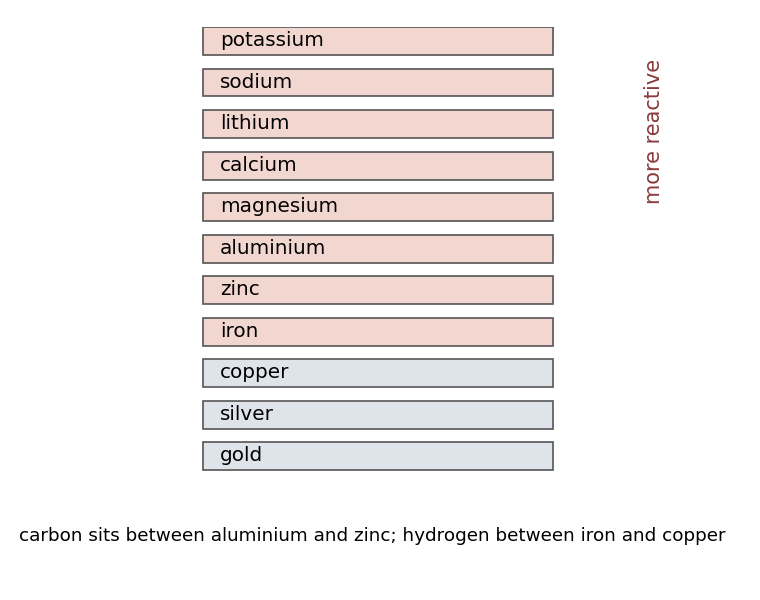
    Ordem para memorizar: potássio, sódio, lítio, cálcio, magnésio, alumínio, (carbono), zinco, ferro, (hidrogênio), cobre, prata, ouro. Metais acima do hidrogênio — tudo até o ferro — reagem com HCl/H₂SO₄ diluídos liberando hidrogênio; quanto mais reativo, mais rápida a efervescência. Um metal desloca qualquer metal menos reativo de sua solução salina ou óxido.

    Escada da série de reatividade: potássio no topo, ouro na base, com carbono e hidrogênio entre os metais.

    Ferrugem exige oxigênio e água; evitada por métodos de barreira (tinta, óleo, plástico), galvanização (revestimento de zinco) e proteção sacrificial (um metal mais reativo como zinco ou magnésio corrói em seu lugar). Oxidação é perda de elétrons ou ganho de oxigênio; redução o oposto; uma reação redox possui ambas; o agente oxidante é reduzido, o agente redutor é oxidado.

    (C) Extração corresponde à reatividade: metais pouco reativos (ouro, prata) ocorrem nativos; aqueles abaixo do carbono (ferro) são reduzidos pelo carbono em alto-forno; os acima (alumínio) necessitam de eletrólise de minério fundido. Alumínio (baixa densidade, resistente à corrosão), cobre (condutor), ferro e aços (resistentes; inoxidável resiste à ferrugem) são escolhidos por suas propriedades. Ligas misturam um metal com outros elementos e são mais duras porque átomos de tamanhos diferentes perturbam o deslizamento das camadas.

    Ácidos, bases e sais

    Ácidos fornecem H⁺(aq); bases solúveis fornecem OH⁻(aq). Indicadores: litmus (vermelho em ácido, azul em base), fenolftaleína (incolor → rosa), laranja de metila (vermelho → amarelo). A escala de pH pH 0–14 classifica soluções (0–3 fortemente ácidas … 11–14 fortemente alcalinas); indicador universal mede pH aproximado. Neutralização: ácido + base → sal + água. (C) Ácidos são doadores de prótons, bases aceptoras de prótons; bases solúveis são bases. (C) Titulação: volume fixo de base com indicador em balão, ácido da bureta gota a gota até a mudança de cor, repetir para resultados concordantes.

    Regras de solubilidade: sais de sódio, potássio e amônio — solúveis; todos os nitratos — solúveis; cloretos — solúveis exceto AgCl e PbCl₂; sulfatos — solúveis exceto BaSO₄, CaSO₄ e PbSO₄; carbonatos — insolúveis exceto Na⁺, K⁺, NH₄⁺; hidróxidos — insolúveis exceto Na⁺, K⁺ (Ca(OH)₂ levemente solúvel).

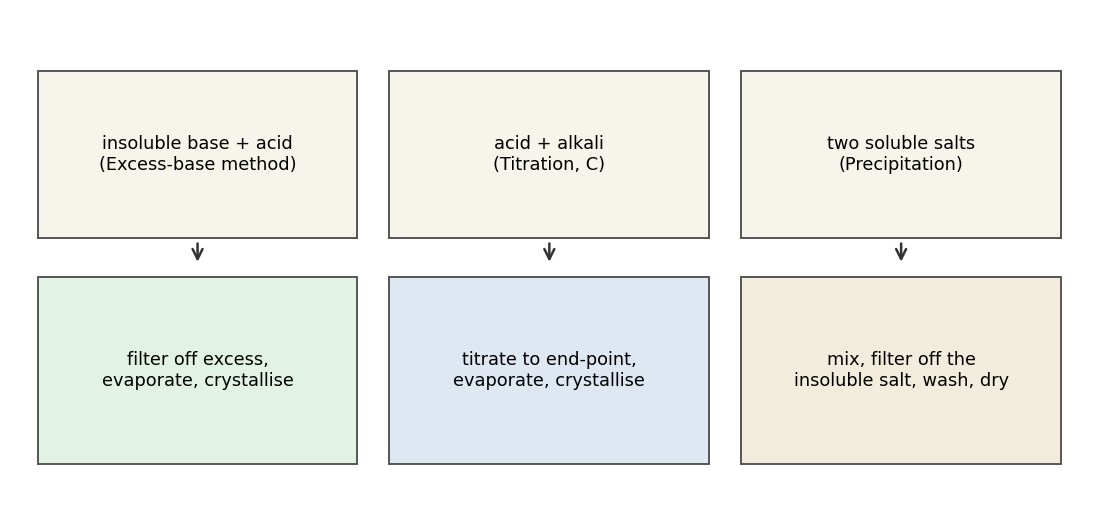
    Três rotas de preparação de sais correspondentes aos reagentes disponíveis.

    Ácido + metal / base / carbonato forma um sal: ex. Zn + H₂SO₄ → ZnSO₄ + H₂; CuO + 2HNO₃ → Cu(NO₃)₂ + H₂O. Sal solúvel a partir de reagente insolúvel (CuO + H₂SO₄ diluído morno): adicionar base em excesso, filtrar, evaporar, cristalizar. (C) De ácido + base: titular, depois evaporar. (C) Sal insolúvel: misturar duas soluções para formar um precipitado (Pb(NO₃)₂ + Na₂SO₄ → PbSO₄↓ + 2NaNO₃), filtrar, lavar, secar.

    Testes químicos

    Cores de teste de chama para cinco cátions.

    Gases: hidrogênio — palito aceso faz estalido; oxigênio — reacende palito incandescente; dióxido de carbono — torna a água de cal turva; amônia — torna litmo úmido vermelho azul; cloro — decolora papel de litmo úmido branco. Cátions: testes de chama (Li⁺ vermelho, Na⁺ amarelo, K⁺ lilás, Ca²⁺ laranja-vermelho, Cu²⁺ azul-esverdeado); NH₄⁺ aquece com NaOH(aq) liberando amônia; Cu²⁺/Fe²⁺/Fe³⁺ formam precipitados azul/esverdeado/marron-ferrugem com NaOH(aq). Ânions: Cl⁻/Br⁻/I⁻ formam precipitados branco/creme/amarelo-pálido com nitrato de prata acidificado; SO₄²⁻ forma precipitado branco com cloreto de bário acidificado; CO₃²⁻ efervesce com HCl diluído liberando CO₂. Água: transforma sulfato de cobre(II) anidro branco → azul; amostra pura de água ferve exatamente a 100 °C.

    Verifique você mesmo

    1. Descreva a tendência de reatividade no Grupo 1 e dê a razão (C) eletrônica.
    2. O que se observa ao adicionar água clorada ao brometo de potássio e por quê?
    3. Cite os quatro gases mais abundantes no ar seco com porcentagens aproximadas.
    4. Cite as duas condições necessárias para a ferrugem do ferro e dois métodos de prevenção.
    5. Defina oxidação e redução em termos de elétrons.
    6. (C) Por que o alumínio é extraído por eletrólise, mas o ferro por redução com carbono?
    7. Quais cloretos são insolúveis e quais sulfatos?
    8. Escreva a equação da reação do óxido de cobre(II) com ácido sulfúrico.
    9. Descreva as cores da prova de chama para sódio, potássio e cobre.
    10. Descreva o teste para íons sulfato e o resultado positivo.

    Respostas: 1 reatividade aumenta ao longo do grupo (B1); (C) o elétron externo está em uma camada mais distante do núcleo, logo é perdido mais facilmente; 2 a solução fica laranja — o cloro desloca o bromo porque é um halogênio mais reativo; 3 nitrogênio ≈78 %, oxigênio ≈21 %, argônio ≈0.96 %, dióxido de carbono ≈0.04 %; 4 oxigênio e água; métodos de barreira (tinta/graxa/plástico) e galvanização ou zinco sacrificial; 5 oxidação é perda de elétrons, redução é ganho; 6 (C) o alumínio está acima do carbono na série de reatividade, então o carbono não pode reduzir seu óxido — é necessária eletrólise da alumina fundida; o ferro está abaixo do carbono, então o carbono o desloca do seu óxido; 7 AgCl e PbCl₂; BaSO₄, CaSO₄ e PbSO₄; 8 CuO(s) + H₂SO₄(aq) → CuSO₄(aq) + H₂O(l); 9 sódio amarelo, potássio lilás, cobre azul-esverdeado; 10 acidificar com ácido clorídrico diluído, adicionar solução de cloreto de bário — um precipitado branco de BaSO₄ confirma o sulfato.

    Vocabulário
    English Português
    greenhouse gas/ˈɡriːnhaʊs ɡæs/ gás de efeito estufa
    rusting/ˈrʌstɪŋ/ oxidação (ferrugem)
    galvanising/ˈɡælvənaɪzɪŋ/ zincoamento
    sacrificial protection/ˌsækrɪˈfɪʃl prəˈtekʃn/ proteção sacrificial
    oxidation/ˌɒksɪˈdeɪʃn/ oxidação
    reduction/rɪˈdʌkʃn/ redução
    oxidising agent/ˈɒksɪdaɪzɪŋ ˈeɪdʒənt/ agente oxidante
    reducing agent/rɪˈdjuːsɪŋ ˈeɪdʒənt/ agente redutor
    alloy/ˈælɔɪ/ liga metálica
    titration/taɪˈtreɪʃn/ titulação
    pH scale/piː eɪtʃ skeɪl/ escala de pH
    flame test/fleɪm test/ ensaio de chama
    precipitate/prɪˈsɪpɪteɪt/ precipitado
  • 3

    3 · Physical chemistry

    Programa de aprendizado em breve

    Material de apoio

    Energia, velocidade e equilíbrio

    Três questões determinam se uma reação é útil: se aquece ou esfria, quão rápida é e se termina? A química física responde a elas — calorimetria e Q = mcΔT, teoria das colisões com suas quatro alavancas e o equilíbrio dinâmico que uma reação reversível atinge em um recipiente fechado.

    Edexcel International GCSE Química 4CH1, Seção 3 (enunciados 3.1–3.22C) é curto, mas cheio de cálculos. Os enunciados sufixados com C são apenas de Química.

    Energetica

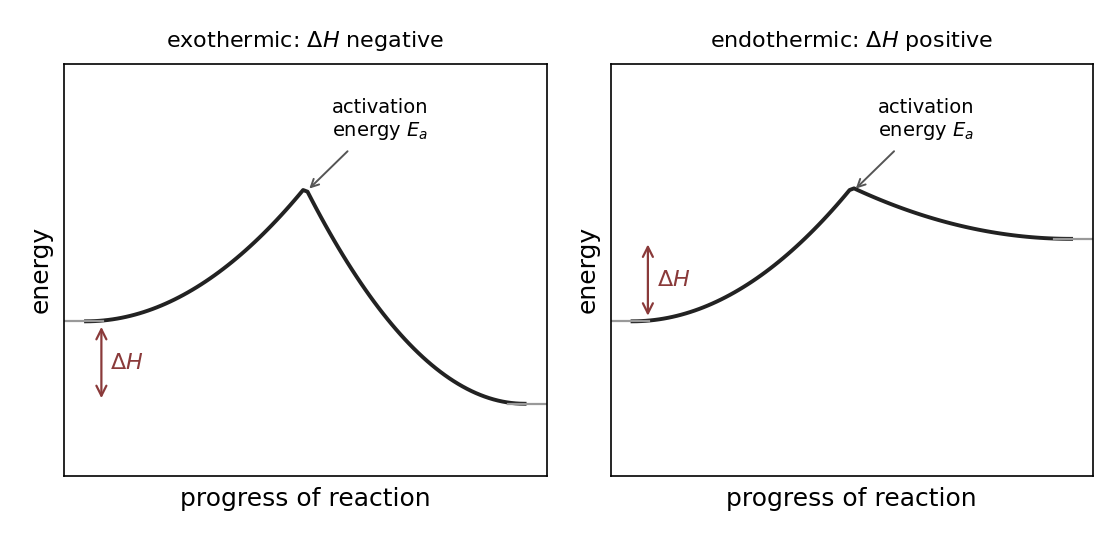
    Reações exotérmicas liberam calor (combustão, neutralização, maioria dos deslocamentos) — a mistura esquenta, ΔH é negativo. Reações endotérmicas absorvem calor (decomposição térmica, algumas dissoluções) — a mistura esfria. Calorimetria simples: medir a variação de temperatura de uma massa conhecida (copo de poliestireno para soluções; queimador de álcool sob béquer de água para combustão).

    $$Q = mc\Delta T$$

    Exemplo resolvido. 50 g de água eleva 24 °C em um ensaio com queimador de álcool: $Q = 50 \times 4.2 \times 24 = 5040$ J. Se 0.010 mol de combustível foram queimados: $\Delta H = -5040/0.010 = -504\,000\ \mathrm{J\,mol^{-1}} = -504\ \mathrm{kJ\,mol^{-1}}$.

    Perfis de energia: exotérmico (produtos abaixo dos reagentes) e endotérmico (produtos acima), cada um com sua energia de ativação.

    (C) Quebra de ligações é endotérmica; formação de ligações é exotérmica. ΔH = ligações quebradas − ligações formadas. Exemplo resolvido. H₂ + Cl₂ → 2HCl: quebradas 436 + 242 = 678; formadas 2 × 431 = 862; ΔH = 678 − 862 = −184 kJ/mol (exotérmica).

    Velocidade de reação

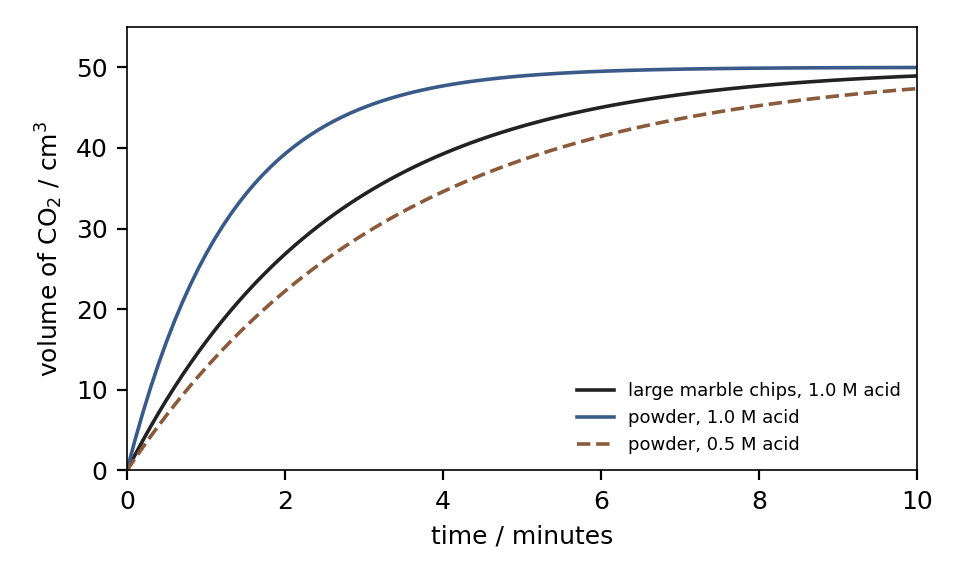
    Experimentos seguem uma reação visível: volume de gás (mármore + ácido), perda de massa em balança ou cruzada desaparecendo (tiossulfato de sódio + ácido). Quatro alavancas: área superficial de um sólido, concentração (ou pressão gasosa), temperatura e um catalisador.

    Curvas de velocidade para fragmentos de mármore e ácido: pó reage mais rápido que fragmentos; ácido mais diluído desacelera a reação.

    Teoria das colisões explica tudo: reações exigem colisões com pelo menos a energia de ativação. O pó oferece maior superfície exposta → mais colisões por segundo; concentração ou pressão maior aproxima as partículas → colisões mais frequentes; temperatura mais alta aumenta a velocidade das partículas → colisões tanto mais frequentes quanto mais energéticas — o único fator que eleva a fração de colisões bem-sucedidas. Um catalisador fornece um caminho alternativo com menor energia de ativação → mais colisões são bem-sucedidas — e permanece quimicamente inalterado ao final; não altera a quantidade de produto, apenas a velocidade com que ele se forma.

    Reações reversíveis e equilíbrios

    Uma reação reversível (⇌) ocorre em ambos os sentidos: sulfato de cobre(II) hidratado ⇌ sal anidro + água (calor favorece a reação direta, água a inversa); cloreto de amônio ⇌ amônia + cloreto de hidrogênio ao aquecer. (C) Em um recipiente fechado, atinge-se o equilíbrio dinâmico: as velocidades das reações direta e inversa são iguais e todas as concentrações permanecem constantes — ambas as reações continuam ocorrendo.

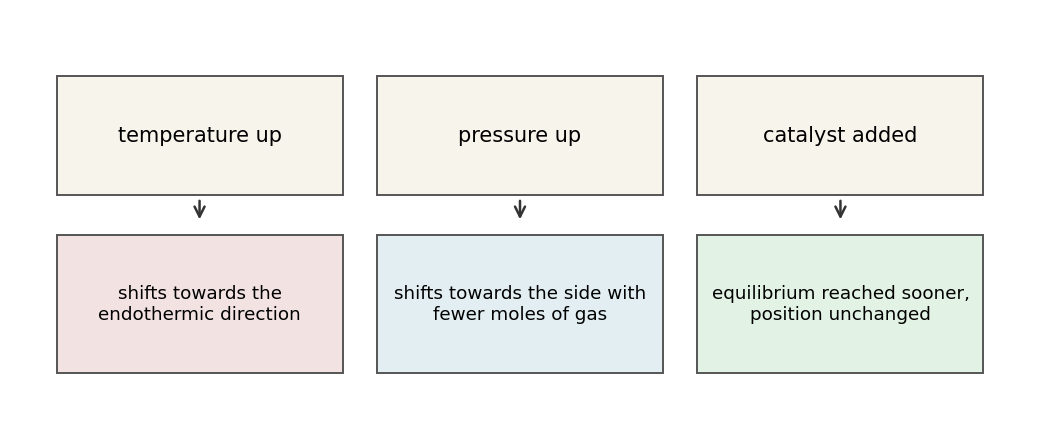
    O que cada alteração faz na posição do equilíbrio.

    (C) Aumento de temperatura → o equilíbrio desloca-se no sentido endotérmico; aumento de pressão → desloca-se para o lado com menor número de mols de gás; um catalisador acelera ambas as direções igualmente e não altera a posição do equilíbrio.

    Verifique você mesmo

    1. Classifique como exotérmica ou endotérmica: combustão, decomposição térmica, neutralização.
    2. 100 g de água esfria em 8.0 °C em um experimento de dissolução. Calcule Q.
    3. (C) Indique o sinal de ΔH para ruptura e formação de ligações.
    4. Use energias de ligação para encontrar ΔH para 2H₂ + O₂ → 2H₂O (H–H 436, O=O 498, O–H 463 kJ/mol).
    5. Por que o mármore em pó reage mais rapidamente com ácido do que um único pedaço grande?
    6. Qual alavanca de velocidade aumenta a fração de colisões bem-sucedidas, e por quê?
    7. Defina um catalisador.
    8. (C) Enuncie as duas características do equilíbrio dinâmico.
    9. (C) N₂ + 3H₂ ⇌ 2NH₃: o que o aumento da pressão provoca e por quê?
    10. (C) Por que um catalisador não altera a posição do equilíbrio?

    Respostas: 1 exotérmica (combustão), endotérmica (decomposição térmica), exotérmica (neutralização); 2 $Q = 100 \times 4.2 \times 8.0 = 3360$ J absorvidos — a água esfria, logo a dissolução é endotérmica; 3 (C) ruptura positiva (endotérmica), formação negativa (exotérmica); 4 quebradas: 2(436) + 498 = 1370; formadas: 4(463) = 1852; ΔH = 1370 − 1852 = −482 kJ/mol (por 2 mol H₂O); 5 o pó expõe muito mais superfície, permitindo mais colisões com o ácido por segundo; 6 temperatura — partículas mais rápidas colidem com mais frequência E mais colisões superam a energia de ativação; 7 uma substância que aumenta a velocidade, mas permanece quimicamente inalterada ao final; 8 (C) velocidades direta e inversa iguais; concentrações de todas as substâncias constantes; 9 (C) desloca-se para a direita — 4 mols de gás à esquerda, 2 à direita, então maior pressão favorece o lado com menor número de mols.

    Respostas continuadas: 10 (C) reduz a energia de ativação das reações direta e inversa igualmente, acelerando ambas sem alterar seu equilíbrio.

    Vocabulário
    English Português
    exothermic/eɡzəˈðɜːmɪk/ exotérmico
    endothermic/ˌendəʊˈθɜːmɪk/ endotérmico
    calorimetry/ˌkælɔːˈrɪmətri/ calorimetria
    catalyst/ˈkætəlɪst/ catalisador
    collision theory/kəˈlɪʒn ˈθɪəri/ teoria das colisões
    activation energy/ˌæktɪˈveɪʃn ˈenədʒi/ energia de ativação
    reversible reaction/rɪˈvɜːsɪbl rɪˈækʃn/ reação reversível
    dynamic equilibrium/daɪˈnæmɪk ˌiːkwɪˈlɪbrɪəm/ equilíbrio dinâmico
  • 4

    4 · Organic chemistry

    Programa de aprendizado em breve

    Material de apoio

    English

    Carbon's family tree

    Crude oil is a mixture of hydrocarbons — compounds of carbon and hydrogen only — built from the smallest molecules in the gas fraction to the tars of bitumen. This section organises them into families, follows crude oil from well to fraction, and then meets each family in turn: the unreactive alkanes, the double-bonded alkenes, and (C) the alcohols, acids, esters and polymers that come after.

    Edexcel International GCSE Chemistry 4CH1, Section 4 (statements 4.1–4.50C) closes the course. C-suffixed statements are Chemistry-only.

    Introduction and crude oil

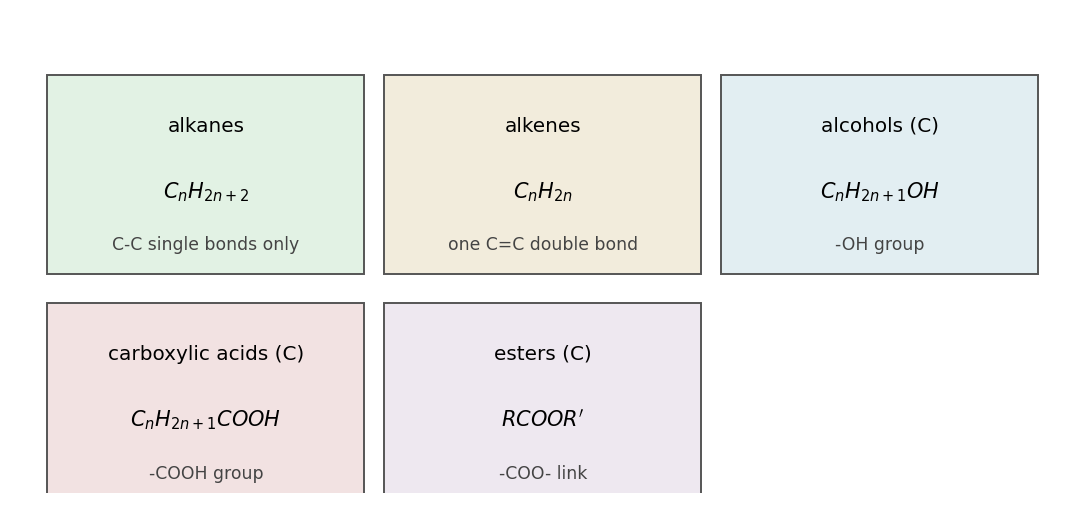
    A hydrocarbon 烃 holds hydrogen and carbon only. Molecules are drawn as empirical, molecular, general, structural and displayed formulae 结构式. A homologous series 同系列 shares a general formula and functional group 官能团, members differing by CH₂; isomerism 同分异构现象 — isomers 同分异构体 share a molecular formula with different structures. IUPAC naming runs to six carbons.

    The homologous series of this specification with general formulae and functional groups.

    Crude oil separates by fractional distillation 分馏: the furnace vaporises the oil, and vapours rise up the column, cooling as they go — small molecules with low boiling points collect at the top, large viscous molecules at the bottom.

    The fractionating column with its six fractions and their uses, small molecules at the top.

    Fractions darken and thicken down the column (rising boiling point and viscosity). Complete combustion gives CO₂ + H₂O; incomplete combustion 不完全燃烧 also gives carbon monoxide — poisonous because it reduces the blood's oxygen-carrying capacity — and soot. In engines, hot air makes nitrogen and oxygen combine into oxides of nitrogen; sulfur impurities burn to SO₂; both gases dissolve in rain making it acidic (acid rain damages leaves, lakes and buildings). Cracking 裂解 converts long-chain alkanes to alkenes + shorter alkanes over silica/alumina at 600–700 °C — because the refinery's supply of long fractions outstrips demand while short fractions are wanted.

    Alkanes and alkenes

    Alkanes 烷烃 ($C_nH_{2n+2}$) are saturated 饱和 — only single C–C bonds. Methane, ethane, propane, butane, pentane. With halogens in ultraviolet light they substitute one hydrogen: CH₄ + Cl₂ → CH₃Cl + HCl (substitution 取代).

    Alkenes 烯烃 ($C_nH_{2n}$) carry C=C — unsaturated 不饱和. With bromine they add across the double bond to a dibromoalkane (addition 加成): C₂H₄ + Br₂ → C₂H₄Br₂. Bromine water distinguishes them: decolourised (orange → colourless) by an alkene, unchanged by an alkane.

    Alcohols, acids and esters (C)

    Alcohols 醇 carry –OH: methanol, ethanol, propan-1-ol, butan-1-ol. Ethanol oxidises to ethanoic acid by complete combustion, by microbial oxidation in air, or by warming with potassium dichromate(VI) in dilute sulfuric acid. Ethanol is made by ethene + steam over a phosphoric acid catalyst (≈300 °C, 60–70 atm) or by fermentation 发酵 of glucose with yeast enzymes in the absence of air at ≈30 °C — the optimum for the enzymes, and no oxygen so the yeast produces ethanol not water.

    Carboxylic acids 羧酸 carry –COOH: methanoic, ethanoic, propanoic, butanoic. Their solutions react with metals (giving H₂) and carbonates (giving CO₂) like other acids; vinegar is dilute ethanoic acid.

    Esters 酯 carry –COO–: ethanol + ethanoic acid, with an acid catalyst, give ethyl ethanoate 乙酸乙酯 and water (esterification). Given an alcohol and an acid, join the acid's –COOH to the alcohol's –O–. Esters are volatile, sweet-smelling, used as flavourings and perfumes.

    Synthetic polymers

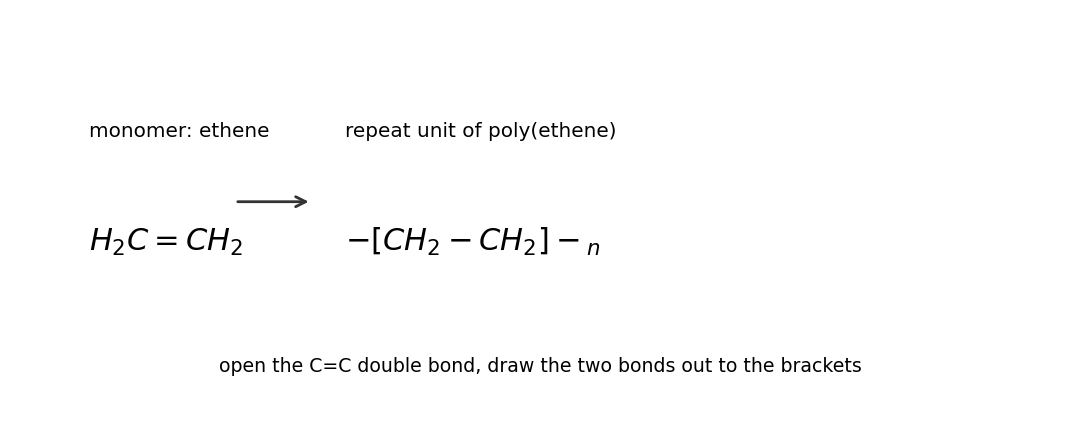
    Addition polymers 加成聚合物 form when many alkene monomers 单体 join, opening their C=C bonds.

    From ethene to poly(ethene): open the double bond and draw the repeat unit between brackets with n.

    Draw the repeat unit of poly(ethene), poly(propene), poly(chloroethene), PTFE; from a repeat unit, close the two bonds back into a C=C to recover the monomer. Disposal problems: polymers are inert and do not biodegrade, and burning can release toxic gases. (C) Condensation polymerisation: a dicarboxylic acid + a diol link ester bonds, releasing water — a polyester 聚酯; some (biopolyesters) biodegrade.

    Check yourself

    1. Define hydrocarbon, homologous series and isomerism.
    2. Name the six main fractions of crude oil in boiling-point order.
    3. Write the products of complete and incomplete combustion of a hydrocarbon.
    4. Give two pollutant gases from burning fuels and one source of each.
    5. Why is cracking necessary?
    6. Write the equation for methane reacting with chlorine in UV light, naming the reaction type.
    7. How does bromine water distinguish an alkene from an alkane?
    8. (C) Name the two methods of manufacturing ethanol with one condition for each.
    9. (C) Which alcohol and acid make ethyl ethanoate, and what else forms?
    10. (C) What monomers make a polyester, and what small molecule is released?

    Answers: 1 a compound of hydrogen and carbon only; a family with the same general formula and functional group, differing by CH₂; molecules with the same molecular formula but different structures; 2 refinery gases, gasoline, kerosene, diesel, fuel oil, bitumen; 3 complete: carbon dioxide + water; incomplete adds carbon monoxide (and soot); 4 carbon monoxide — incomplete combustion; sulfur dioxide — burning sulfur impurities; oxides of nitrogen — hot engine air; 5 supply of long-chain fractions exceeds demand while short fractions and alkenes are in short supply; 6 CH₄ + Cl₂ → CH₃Cl + HCl — substitution (photo, UV); 7 the alkene decolourises orange bromine water; the alkane leaves it orange; 8 (C) ethene + steam, phosphoric acid catalyst, ~300 °C, 60–70 atm; fermentation of glucose with yeast, no air, ~30 °C; 9 (C) ethanol + ethanoic acid — water also forms (acid catalyst); 10 (C) a dicarboxylic acid and a diol; water is released at each ester link.

    Vocabulário
    English Português
    hydrocarbon/ˈhaɪdrəkɑːbən/ hidrocarboneto
    homologous series/həˈmɒləɡəs ˈsɪəriːz/ série homóloga
    functional group/ˈfʌŋkʃənl ɡruːp/ grupo funcional
    isomerism/ˈaɪsəmərɪzəm/ isomeria
    isomer/ˈaɪsəmə/ isômero
    displayed formula/dɪˈspleɪd ˈfɔːmjʊlə/ fórmula expandida
    fractional distillation/ˈfrækʃənl dɪstɪˈleɪʃn/ destilação fracionada
    incomplete combustion/ɪŋkəmˈpliːt kəmˈbʌstʃn/ combustão incompleta
    cracking/ˈkrækɪŋ/ fragmentação
    alkane/ˈælkeɪn/ alcano
    alkene/ˈælkiːn/ alceno
    saturated/ˈsætʃəreɪtɪd/ saturado
    unsaturated/ʌnˈsætʃəreɪtɪd/ insaturado
    substitution/ˌsʌbstɪˈtjuːʃn/ substituição
    addition/əˈdɪʃn/ adição
    alcohol/ˈælkəhɒl/ álcool
    fermentation/fɜːmənˈteɪʃn/ fermentação
    carboxylic acid/ˌkɑːbəkˈsɪlɪk ˈæsɪd/ ácido carboxílico
    ester/ˈestə/ éster
    ethyl ethanoate etanoato de etila
    addition polymer polímero de adição
    monomer/ˈmɒnəʊmə/ monômero
    polyester/ˌpɒlɪˈestə/ poliéster

Entrar ou criar conta

IGCSE, A-Level & AP