Excitable cells and muscle
Introduced| English | Meaning |
|---|---|
| action potential/ˈækʃn pəˈtenʃl/ | action potential |
| threshold/ˈθreʃəʊld/ | A boundary value at which a specified effect begins or a decision changes. |
| absolute refractory period | absolute refractory period |
| saltatory conduction/ˈsɒltətəri kənˈdʌkʃn/ | saltatory conduction |
| tetanus | tetanus |
One electrical language
- Nerve and muscle speak one electrical language, and the action potential is its sentence.
- Every rhythm you will reason about, heartbeat, breathing, the gut's movements, is built from it.
The action potential
- At rest the membrane sits near −70 mV, set mainly by K⁺. In an action potential 动作电位, voltage-gated Na⁺ channels open and the membrane overshoots to about +30 mV.
- Then Na⁺ channels close (inactivate), K⁺ flows out and repolarises the membrane, with a brief dip below rest (hyperpolarisation) before it settles.
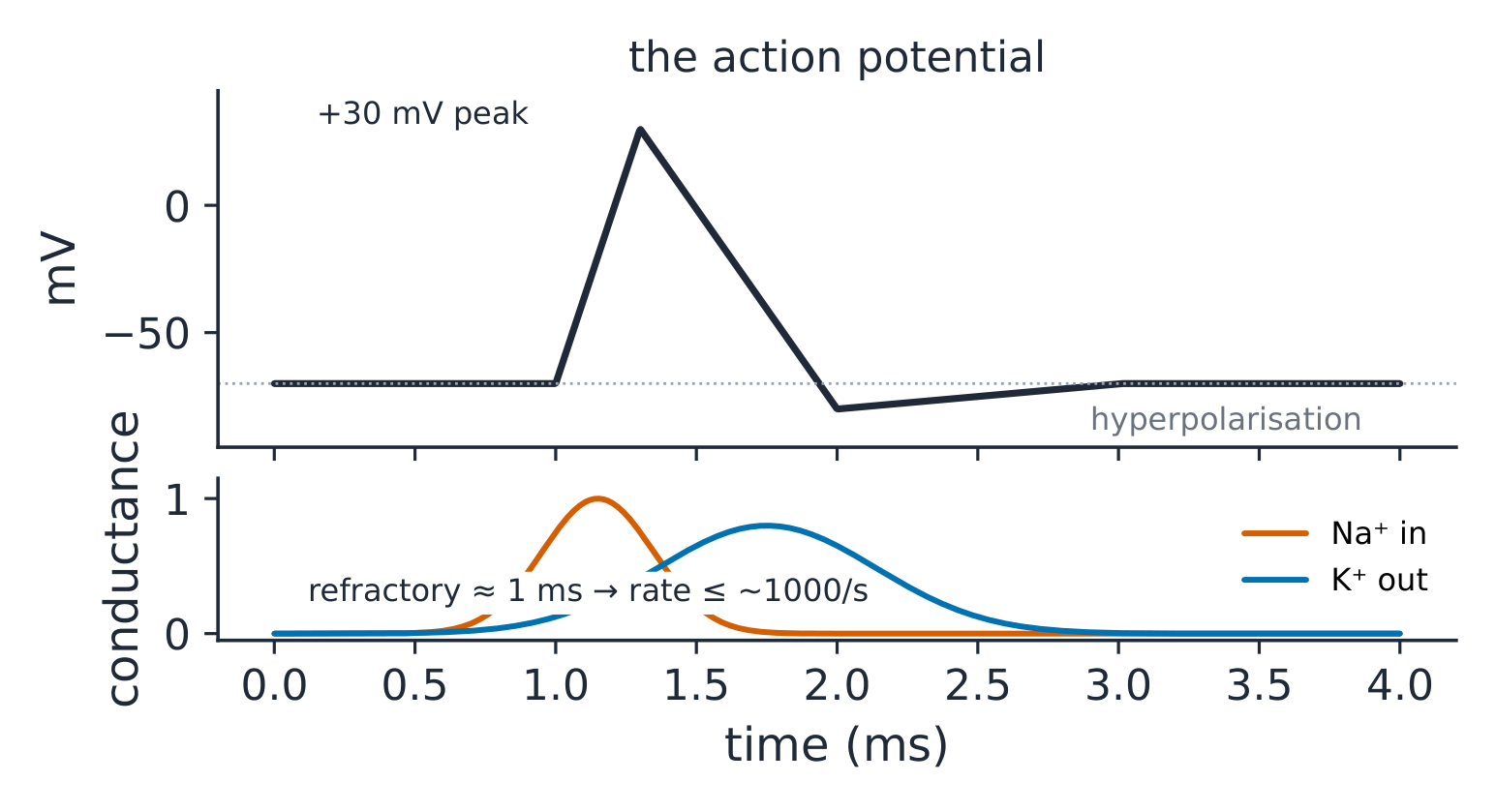
Put the phases of an action potential in order.
Difficulty 3/5 · 200 coins + a small bonus on first completion today
The upstroke is Na⁺ entry; repolarisation is K⁺ exit; the dip below rest comes from K⁺ channels closing slowly.
Threshold: all or none
- The upstroke feeds itself: depolarisation opens Na⁺ channels, Na⁺ enters and depolarises further. That is positive feedback.
- Below threshold 阈值, K⁺ outflow wins and nothing happens; above it, Na⁺ wins and a full spike always follows.
A stimulus twice as strong as threshold makes an action potential twice as tall.
Difficulty 1/5 · 100 coins + a small bonus on first completion today
Above threshold the spike is all or none; stronger stimuli raise the firing rate, not the height.
The refractory period
- For about 1 ms after a spike, Na⁺ channels are inactivated and no stimulus can fire another: the absolute refractory period 绝对不应期.
- That sets a ceiling on firing: about 1/(1 ms) = 1000 spikes per second.
A fibre's absolute refractory period is 2 ms. What is its maximum firing rate, in spikes per second?
Difficulty 2/5 · 140 coins + a small bonus on first completion today
1 / 0.002 s = 500 spikes per second.
Jumping along the axon
- A spike regenerates itself along the membrane. Myelin lets it jump from gap to gap: saltatory conduction 跳跃传导.
- Speed rises from about 1 m/s in thin unmyelinated fibres to as much as 100 m/s in thick myelinated ones.
Why does myelin make conduction faster?
Difficulty 1/5 · 100 coins + a small bonus on first completion today
Myelin insulates the axon, so current spreads quickly to the next gap where the spike regenerates (saltatory conduction).
A signal travels 1 m from spinal cord to foot at 50 m/s. How many milliseconds does it take?
Difficulty 2/5 · 140 coins + a small bonus on first completion today
1 / 50 = 0.02 s = 20 ms. At 1 m/s in an unmyelinated fibre it would take a full second.
Worked example: from spike to force
- In skeletal muscle a spike releases Ca²⁺ from the sarcoplasmic reticulum; Ca²⁺ moves troponin, actin is freed, and the sarcomere contracts. A twitch lasts about 100 ms, but the refractory period only about 2 ms.
- So twitches can add up. At about 20 stimuli per second they fuse partly; at about 50 per second and above they fuse into tetanus 强直收缩, a smooth maximal pull.
Why can skeletal muscle be tetanised but the heart cannot?
Difficulty 1/5 · 100 coins + a small bonus on first completion today
A skeletal twitch (~100 ms) far outlasts its refractory period (~2 ms), so twitches add; the heart's long refractory period blocks that.
Worked example: paralysis after a meal
- (Fictional patient) Weakness after a large carbohydrate meal. Insulin drives K⁺ into cells and blood K⁺ falls.
- In fibres with a faulty channel, the membrane depolarises instead of hyperpolarising; Na⁺ channels sit inactivated and cannot fire. A few millivolts in the wrong direction silence the muscle.
Three common slips
- Refractory = hyperpolarised. Refractory means it cannot fire at all; hyperpolarised means it is harder to fire.
- Local anaesthetics block pain last. Small pain fibres are blocked first.
- Tetanus in the heart. Heart cells have a long refractory period, so the heart cannot be tetanised.
Match each term to its meaning.
Difficulty 2/5 · 140 coins + a small bonus on first completion today
Keeping these three apart explains firing limits, all-or-none spikes and why some drugs block conduction.
Recap
- Rest −70 mV; Na⁺ upstroke (positive feedback), K⁺ repolarisation.
- The refractory period caps firing at about 1000 per second; myelin gives saltatory conduction up to about 100 m/s.
- Ca²⁺ links the spike to the sarcomere; fast trains fuse into tetanus, but not in the heart.