Policy: the multiplier and the clock
Introduced| English | Meaning |
|---|---|
| marginal propensity to consume/ˈmɑːdʒɪnl prəˈpensɪti tə kənˈsjuːm/ | The proportion of an additional unit of disposable income that is spent on consumption. |
| multiplier/ˌmʌltɪˈplaɪə/ | A number by which another quantity is multiplied. |
| crowding out/ˈkraʊdɪŋ aʊt/ | A reduction in private spending or investment caused by increased government activity, often through higher interest rates. |
When the recession hits, somebody decides
- Aurora's output gap is −£60bn. The arithmetic of the response is one fraction. The judgement — what to buy, whose taxes to cut, and WHEN — is everything else.
- This lesson carries the marginal propensity to consume 边际消费倾向 from lesson 0401's loop into the policy room.
The multiplier fraction
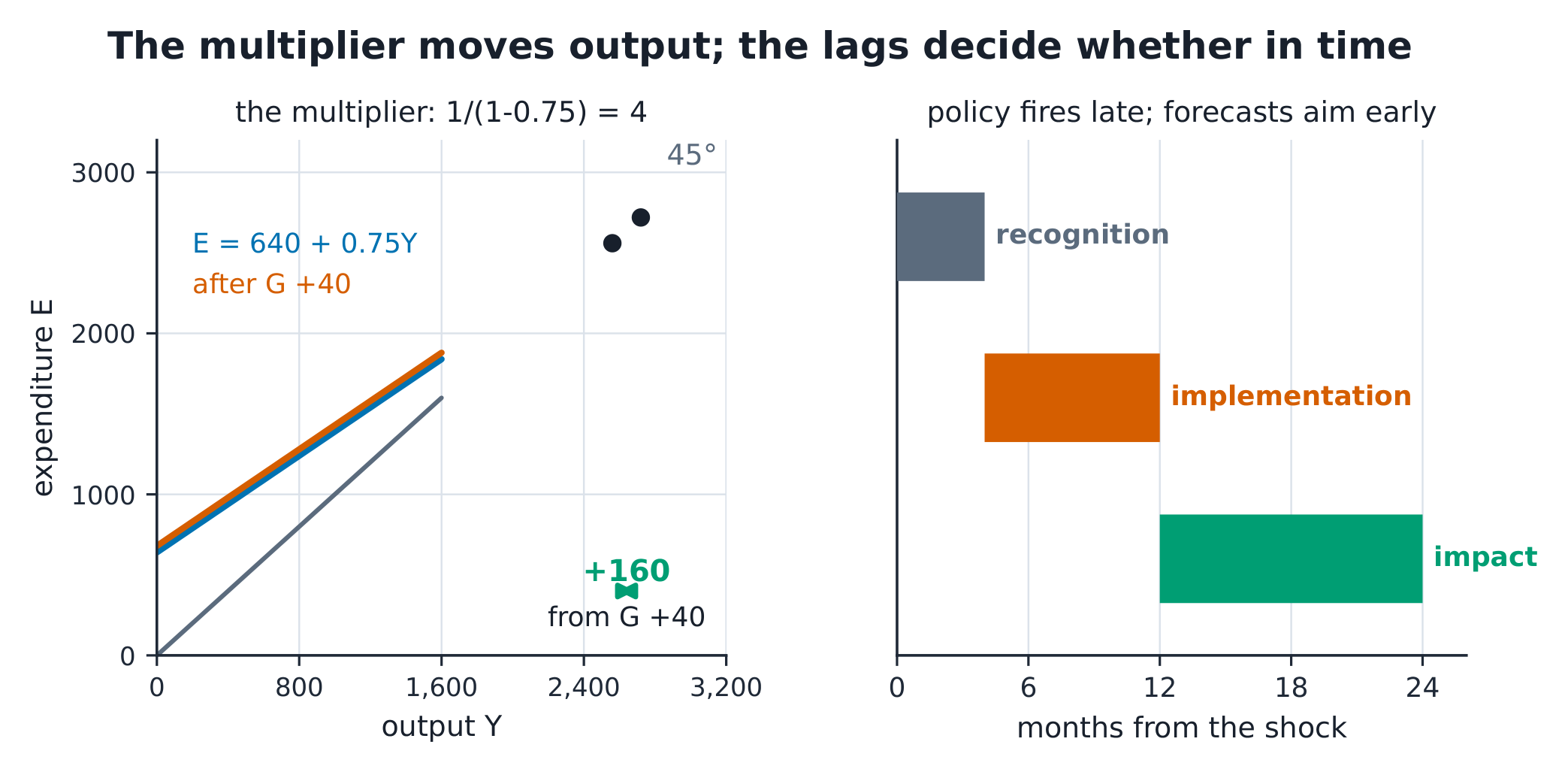
- With $MPC = 0.75$, the multiplier 乘数 is $1/(1-0.75) = 4$: a £40bn spending rise lifts income by £160bn ✓, because each round of spending becomes income and three quarters of it is spent again.
- The tax multiplier is $-MPC/(1-MPC) = -3$: a £40bn tax cut first round spends only $40 \times 0.75 = 30$, so output rises £120bn ✓.
MPC 0.75. The spending multiplier?
Difficulty 2/5 · 140 coins + a small bonus on first completion today
$1/(1-0.75) = 4$. A 40 rise in G lifts Y by 160.
MPC 0.75. A tax CUT of 40 raises output by how much?
Difficulty 2/5 · 140 coins + a small bonus on first completion today
First round only $40 \times 0.75 = 30$ is spent, then the multiplier: $30 \times 4 = 120$. The tax multiplier is -3.
The balanced-budget theorem
- Raise G by 50 AND taxes by 50: output rises $50 \times 4 - 50 \times 3 = \mathbf{+50}$ ✓.
- The balanced-budget multiplier is exactly 1 — a one-line theorem you can prove from the two fractions above.
G and T both rise by 50 (MPC 0.75). What happens to output?
Difficulty 2/5 · 140 coins + a small bonus on first completion today
$50 \times 4 - 50 \times 3 = +50$ - the balanced-budget multiplier of exactly 1.
The gap is -60. Which package closes it under the simple model?
Difficulty 1/5 · 100 coins + a small bonus on first completion today
$15 \times 4 = 60$ and $20 \times 3 = 60$. The arithmetic offers choices; the judgement is debt, composition and speed.
The fine print: crowding out and leakages
- Government borrowing can raise interest rates and displace private investment — crowding out 挤出效应. Imports and taxes leak rounds out of the chain.
- Real-world multipliers sit well below 4. The fraction is a model result, and the model's limits belong IN the answer.
Crowding out means the fiscal multiplier is exactly zero in practice.
Difficulty 1/5 · 100 coins + a small bonus on first completion today
It means borrowing-fuelled spending raises rates and displaces some private investment, so the multiplier falls BELOW the simple 4 - not to zero. State the direction and the model.
The lags
- Recognition (is this a shock or noise?), implementation (budgets are not written overnight), impact (the multiplier takes quarters to round out).
- Monetary policy fires quickly and lands slowly; fiscal is the reverse. A policy that arrives after the patient recovers is not neutral — it is pro-cyclical.
Which clock does each delay belong to?
Sort the policy room's delays into recognition, implementation and impact lags, and match instruments to speed.
Match each lag to its question.
Difficulty 2/5 · 140 coins + a small bonus on first completion today
Three delays, one risk - late policy amplifies the cycle it meant to smooth.
Monetary policy is slower to announce than fiscal policy but lands sooner.
Difficulty 1/5 · 100 coins + a small bonus on first completion today
The reverse: a rate decision is announced in weeks (fast fire) but transmits over quarters (slow landing); fiscal takes calendars to pass but its spending lands as it is spent.
The dated episode: 2021–23
- Supply shocks (energy, shipping) met stimulus-fortified demand; UK CPI peaked at 11.1% in October 2022 (ONS), unemployment sat near historic lows, and policy rates went from near zero to 4–5% through 2023.
- Read it with this course: a negative supply shock moves inflation and output the WRONG way together (the Phillips trade-off fails), the tightening landed a year later (lags, exactly as above), and energy-bill support worked through prices, not around them.
In 2022 the UK faced 11.1% CPI inflation with low unemployment. What does the Phillips framework say about that combination?
Difficulty 1/5 · 100 coins + a small bonus on first completion today
A negative supply shock raises inflation while lowering output - both move the wrong way for the simple curve. The 2023 tightening then landed with the usual lags.
Three policy slips
- Quoting "the multiplier" as a fact. It is $1/(1-MPC)$ under leakages, borrowing costs and supply slack — state the model.
- Comparing a tax cut and spending pound-for-pound. The first round differs: 0.75 of the tax cut is spent, all of the spending is.
- Grading policy by announcement, not arrival. The question is always when the effect landed.
Recap
- Spending multiplier $1/(1-MPC)$; tax multiplier $-MPC/(1-MPC)$; balanced budget exactly 1.
- Lags are why policy targets forecasts; crowding out and leakages are why the arithmetic is a ceiling.