Your learning plan · Continue · Review →
Speaking: Read Aloud and Picture Narration
IntroducedYour saved position stays in this browser. Resuming does not complete the lesson or answer its questions.
 5:06
TOEFL Junior · Speaking
The Speaking test has four tasks in about eighteen minutes, and you speak into a microphone. Task one, read a short passage aloud. Task two, tell the story in…
English narration · English and 中文 subtitles you can switch
In this lesson
| English | 中文 |
|---|---|
| stress/stres/ | 重音 |
| intonation/ˌɪntəˈneɪʃn/ | 语调 |
| narrate/nəˈreɪt/ | 讲述 |
"Let's eat, Grandma"
- Read it with a pause after eat: you are inviting Grandma to dinner. Without the pause, Grandma is dinner.
- Pauses, stress and a steady speed carry meaning. The Speaking test listens for them.
Why does "Let's eat, Grandma" need a pause after "eat"?
Difficulty 1/5 · 100 coins + a small bonus on first completion today
The pause carries the meaning of the comma.
The Speaking test
- 4 tasks in about 18 minutes, recorded on a computer: Read Aloud, Picture Narration, Non-academic Listen-Speak and Academic Listen-Speak.
- ETS-trained raters score each recording; the total is 0–16. This lesson covers Tasks 1 and 2; the next lesson covers the Listen-Speak tasks.
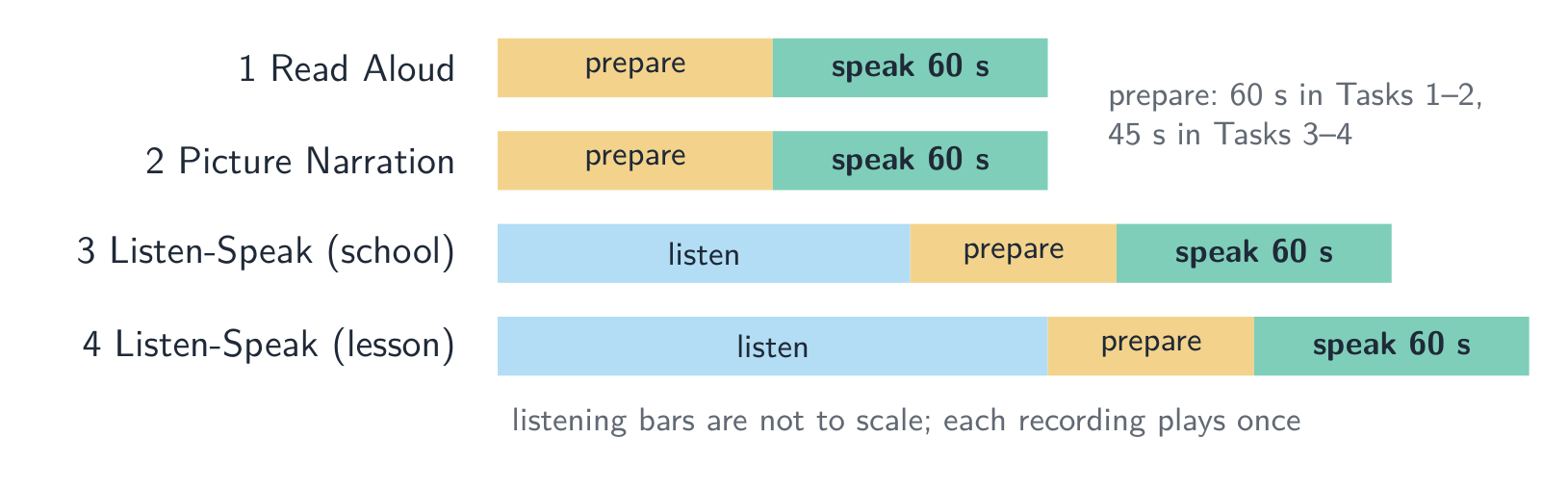
Put the four Speaking tasks in test order.
Difficulty 3/5 · 200 coins + a small bonus on first completion today
Tasks 1–4 in this order, about 18 minutes in total.
How many tasks are in the Speaking test?
Difficulty 2/5 · 140 coins + a small bonus on first completion today
Read Aloud, Picture Narration and two Listen-Speak tasks.
What is the score range of TOEFL Junior Speaking?
Difficulty 1/5 · 100 coins + a small bonus on first completion today
Speaking is scored 0–16 by ETS-trained raters.
About how many minutes does the Speaking test take?
Difficulty 2/5 · 140 coins + a small bonus on first completion today
About 18 minutes.
Task 1: Read Aloud
- You have one minute to read a short passage silently, then one minute to read it aloud into the microphone.
- Use the silent minute well: find the hard words, mark where to pause, and decide which words to stress 重音.
- Pause at commas and full stops: "The library is open from eight in the morning | until five in the afternoon, || Monday to Friday."
- Stress the important information: up to four books, within two weeks. Let your intonation 语调 rise a little in a friendly ending: "We hope you enjoy reading with us!"
Listen to a model Read Aloud. Notice the pauses and the stressed numbers.
Match each part with its time.
Difficulty 2/5 · 140 coins + a small bonus on first completion today
Both tasks give one minute to prepare and one minute to record.
Where is the best place to pause? "Students may borrow up to four books at a time ___ books must be returned within two weeks."
Difficulty 1/5 · 100 coins + a small bonus on first completion today
Pause at the end of a sentence. Pausing inside a phrase like up to four books breaks the meaning.
Listen to the model, then record yourself reading the same passage. Use one minute to read it silently first.
Compare your recording with the model: the pauses after each sentence and the stressed numbers carry the meaning.
What should you do in the silent minute of Read Aloud? Choose all that apply.
Difficulty 2/5 · 140 coins + a small bonus on first completion today
Prepare the reading; no summary is needed.
In "Students may borrow up to four books", which word carries the most stress?
Difficulty 1/5 · 100 coins + a small bonus on first completion today
Numbers are important information; stress them.
Task 2: Picture Narration
- You see six pictures that tell a story. You have one minute to prepare and one minute to narrate 讲述 the story.
- Say something about every picture, in order. Use past tenses and time links: first, then, after that, suddenly, finally.
Six pictures:
- Mei misses the school bus. 2. She walks to school in the rain. 3. She arrives in class very wet. 4. The teacher gives her a towel. 5. Her classmates laugh kindly. 6. Mei dries off and smiles.
Story start: "One morning, Mei got to the bus stop just as the bus was leaving, so she had to walk to school in the rain. When she arrived, she was completely wet…"
Which is the best first sentence for the Mei picture story?
Difficulty 1/5 · 100 coins + a small bonus on first completion today
It starts a story with a time, a character, a problem and a reason (so).
In Picture Narration, you should say something about every picture.
Difficulty 1/5 · 100 coins + a small bonus on first completion today
All six pictures, in order.
Which are good time links for a picture story? Choose all that apply.
Difficulty 2/5 · 140 coins + a small bonus on first completion today
"In picture two" describes the test, not the story.
Turn pictures into a story
- Don't describe pictures one by one ("In picture one there is a girl"). Tell a connected story with reasons: so, because, when.
- Give the character a name, add a feeling (she felt embarrassed) and finish with the ending in picture 6.
Story or list?
Tell the story with past simple, past continuous and linking words
Which sentence keeps the story in the past tense?
Difficulty 1/5 · 100 coins + a small bonus on first completion today
Both verbs (arrived, gave) are past simple.
Tell the Mei story from the six pictures in one minute. Prepare for one minute first, then record. Pictures: 1 misses the bus · 2 walks in the rain · 3 arrives wet · 4 teacher gives a towel · 5 classmates laugh kindly · 6 Mei dries off and smiles.
A strong one-minute story covers all six pictures in order, stays in the past tense and links each step with a reason.
Which sentence tells a connected story?
Difficulty 1/5 · 100 coins + a small bonus on first completion today
"So" links cause and result.
Which feeling fits Mei when her classmates laugh at her wet clothes?
Difficulty 1/5 · 100 coins + a small bonus on first completion today
Arriving wet in front of the class is embarrassing, and they laugh kindly.
Check yourself
- Record yourself and listen back. Did you include all six pictures? Were your sentences complete? Could a listener follow the story without seeing the pictures?
- For Read Aloud: did you pause at full stops, say the numbers clearly and keep a steady speed?
A good picture story can be followed by a listener who cannot see the pictures.
Difficulty 1/5 · 100 coins + a small bonus on first completion today
That is a useful self-check when you listen back.
Common mistakes
- Reading aloud as fast as possible. Clear pauses and stress matter more than speed.
- Stopping after four pictures because time runs out. Practise with a timer so you reach picture 6.
- Changing tense in the middle of the story (she walks … she arrived).
In Read Aloud, the fastest reading gets the best result.
Difficulty 1/5 · 100 coins + a small bonus on first completion today
Raters listen for clear pauses, stress and intonation, not speed.
How can you stop running out of time before picture 6?
Difficulty 1/5 · 100 coins + a small bonus on first completion today
Timed practice teaches you to reach the ending.
Recap
- Read Aloud: 1 minute silent + 1 minute aloud; pause, stress, steady speed.
- Picture Narration: 1 minute to prepare + 1 minute to speak; all six pictures, past tense, linked with reasons.
- Practice here is self-checked; only ETS raters give a Speaking score.
Official sources
- Task timings checked on 15 November 2026 in the TOEFL Junior Test Taker Handbook (ETS, PDF).
- Official samples with scored responses: Read Aloud (ETS) and Picture Narration (ETS). The texts and the model recording here are original.
What went wrong? Only the site team sees this.