Your learning plan · Continue · Review →
Reading: notices, emails, schedules and menus
IntroducedYour saved position stays in this browser. Resuming does not complete the lesson or answer its questions.
 5:03
TOEFL Junior · Reading Comprehension
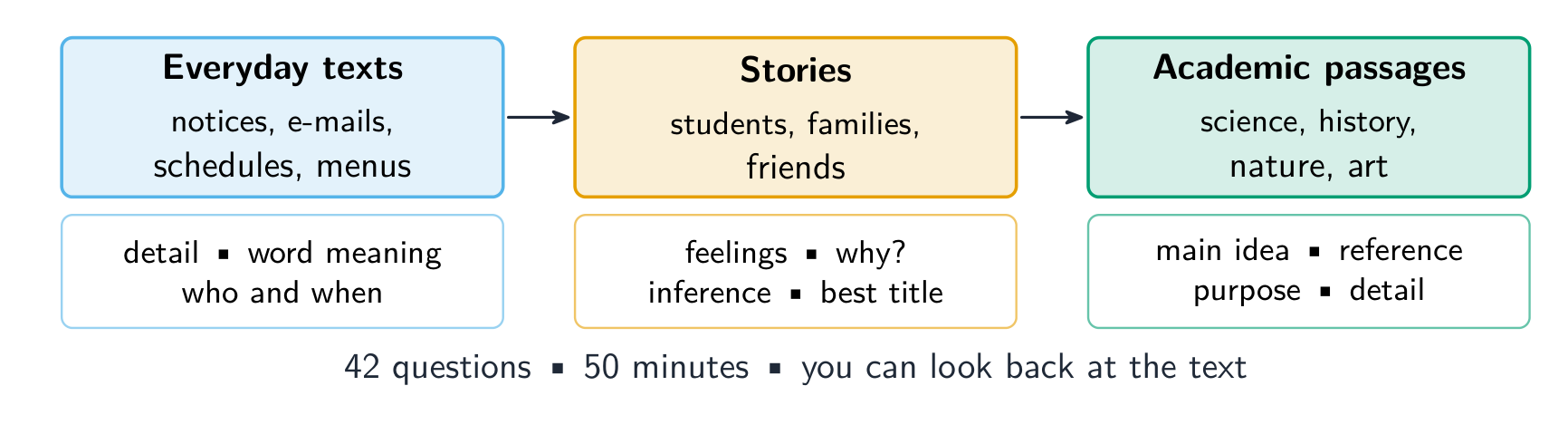
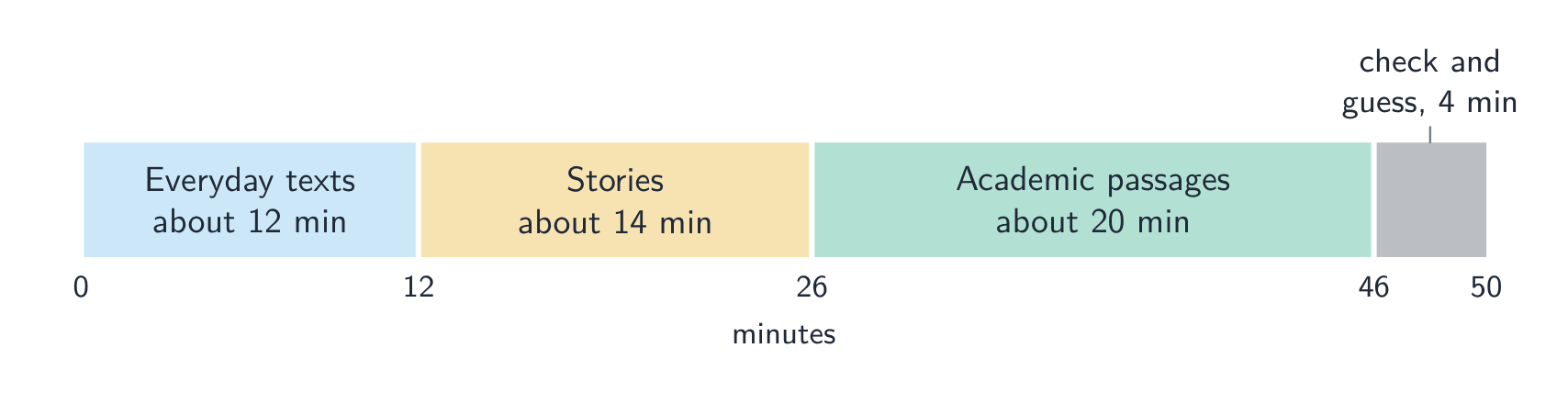
Reading is the last Standard section, forty-two questions in fifty minutes, about seventy seconds a question including the reading. The texts move from…
English narration · English and 中文 subtitles you can switch
In this lesson
| English | 中文 |
|---|---|
| schedule/ˈʃedjuːl/ | 时间表 |
| scan/skæn/ | 扫读 |
| context/ˈkɒntekst/ | 上下文 |
Thursday or Friday?
- A notice says: "Volunteers set up the hall on Thursday. The show is on Friday at 6." The question asks what happens on Thursday.
- Everyday texts are full of times, names and places. The skill is matching the right detail to the question.
"Volunteers set up the hall on Thursday. The show is on Friday at 6." What happens on Thursday?
Difficulty 1/5 · 100 coins + a small bonus on first completion today
Thursday is the set-up day.
What the Reading section contains
- 42 questions in 50 minutes: about 70 seconds per question, including reading time.
- It starts with everyday (non-academic) texts: notices, emails, schedules 时间表, menus, posters. Later come stories and academic passages.
Reading has 42 questions in 50 minutes. About how many seconds is that per question? (Nearest whole number.)
Difficulty 2/5 · 140 coins + a small bonus on first completion today
50 × 60 = 3,000 seconds; 3,000 ÷ 42 ≈ 71 seconds, including reading time.
Which everyday texts can appear at the start of Reading? Choose all that apply.
Difficulty 2/5 · 140 coins + a small bonus on first completion today
Everyday texts include all of these, before stories and academic passages.
Read the question, then scan
- Read the question first and pick its key word: a time, a name, a place, a price.
- Then scan 扫读 the text for that word and read the sentences around it carefully before you choose.
Notice: "The book sale opens at 10 a.m. Teachers may enter at 9:30 to choose books early." Question: When can students enter? → 10 a.m. The 9:30 time is for teachers.
Email: "The bus leaves at 8:00 sharp. Please be at the front gate by 7:45 so we can check names." When should students arrive?
Difficulty 1/5 · 100 coins + a small bonus on first completion today
The bus leaves at 8:00, but students must be at the gate by 7:45.
What should you do first with an everyday-text question?
Difficulty 1/5 · 100 coins + a small bonus on first completion today
The key word tells you what to scan for.
"The book sale opens at 10 a.m. Teachers may enter at 9:30 to choose books early." When can students enter?
Difficulty 1/5 · 100 coins + a small bonus on first completion today
9:30 is for teachers.
Reading quickly to find one key word is called ___. (one word: s…)
Difficulty 1/5 · 100 coins + a small bonus on first completion today
Scan for the key word, then read around it carefully.
Tables, schedules and menus
- In a schedule, read across the row and down the column. Check headings like Day, Room, Cost.
- Look for small notes below a table (* Saturday only, Closed on holidays). Questions love them.
| Club | Day | Room |
|---|---|---|
| Chess | Monday | 12 |
| Drama | Wednesday | Hall* |
| Robotics | Friday | Lab 2 |
* Drama meets in Room 12 when the hall is used for exams.
Look at the club table. Where does Drama meet during exam week?
Difficulty 1/5 · 100 coins + a small bonus on first completion today
The note under the table says Drama moves to Room 12 when the hall is used for exams.
From the table: Robotics meets on ____.
Difficulty 1/5 · 100 coins + a small bonus on first completion today
Read across the Robotics row to the Day column.
From the club table, in which room number does Chess meet?
Difficulty 2/5 · 140 coins + a small bonus on first completion today
Chess · Monday · Room 12.
Small notes below a table (marked with *) are often tested.
Difficulty 1/5 · 100 coins + a small bonus on first completion today
Questions love footnotes and exceptions.
Menu: "Noodle soup ¥18 · Rice set ¥22 · Drinks ¥6 (free with any rice set)". Lily orders a rice set and a drink. How much does she pay?
Difficulty 1/5 · 100 coins + a small bonus on first completion today
The drink is free with a rice set.
Who, what and when
- Everyday texts have several people and times. Keep them apart: who does what, and when.
- A wrong option often takes a real detail from the text and gives it to the wrong person or day.
Thursday or Friday?
Answer questions about times, people and actions without mixing them up
Notice: "Volunteers set up the hall on Thursday. Parents arrive at 5:30 on Friday; the show begins at 6." What will volunteers do on Thursday?
Difficulty 1/5 · 100 coins + a small bonus on first completion today
Setting up the hall on Thursday means preparing it. The show and parents belong to Friday.
Email: "Ms Wu will collect the forms on Monday. Mr Hart will hand out the T-shirts on Tuesday." Which option is the wrong-person trap for "What does Mr Hart do?"
Difficulty 1/5 · 100 coins + a small bonus on first completion today
Collecting forms is a real detail, but Ms Wu does it.
Words in context
- "In line 3, the word offer is closest in meaning to ___." The question asks what the word means in this text: the context 上下文.
- Put each option into the sentence. Keep the one that keeps the meaning: The café will offer two new soups → provide, not suggest.
"Visitors to this year's fair can watch a robot draw portraits in under a minute." In this sentence, watch is closest in meaning to:
Difficulty 1/5 · 100 coins + a small bonus on first completion today
Here watch means see something happen. Look after is another meaning of watch (watch a baby), but it does not fit this sentence.
"The café will offer two new soups this winter." Offer is closest in meaning to
Difficulty 1/5 · 100 coins + a small bonus on first completion today
The café will provide (serve) the soups.
Common mistakes
- Answering from your own experience (school trips usually leave at 8) instead of the text.
- Missing an exception: except, only, not, a footnote with *.
- Choosing the first word meaning you know instead of the meaning in the sentence.
If a notice does not give a time, you should choose the time that schools usually use.
Difficulty 1/5 · 100 coins + a small bonus on first completion today
Answer only from the text. If the text gives no time, an option with a time is probably wrong.
"The pool is open every day except Monday." Can you swim on Monday?
Difficulty 1/5 · 100 coins + a small bonus on first completion today
"Except" removes Monday.
Which words often mark an exception you must notice? Choose all that apply.
Difficulty 2/5 · 140 coins + a small bonus on first completion today
"Also" adds; the others limit.
Recap
- Question first, then scan for its key word; read around it.
- Match each detail to its person and time; check notes and exceptions.
- Word questions: test each option in the sentence.
Put the steps for an everyday-text question in order.
Difficulty 3/5 · 200 coins + a small bonus on first completion today
Question first saves time; reading around the key word avoids traps.
Official sources
- Checked on 15 November 2026: Reading Comprehension sample questions (ETS) and the Test Taker Handbook (ETS, PDF). The texts here are original.