Agreement, verb forms, modifiers and logical parallelism
Introduced| English | Meaning |
|---|---|
| agreement/əˈɡriːmənt/ | Matching a verb or pronoun in number with its subject or noun. |
| modifier/ˈmɒdɪfaɪə/ | A word, phrase or clause that adds information about another part of a sentence. |
| parallel structure/ˈpærəlel ˈstrʌktʃə/ | Using the same grammatical form for items in a list or comparison. |
The verb that doesn't match
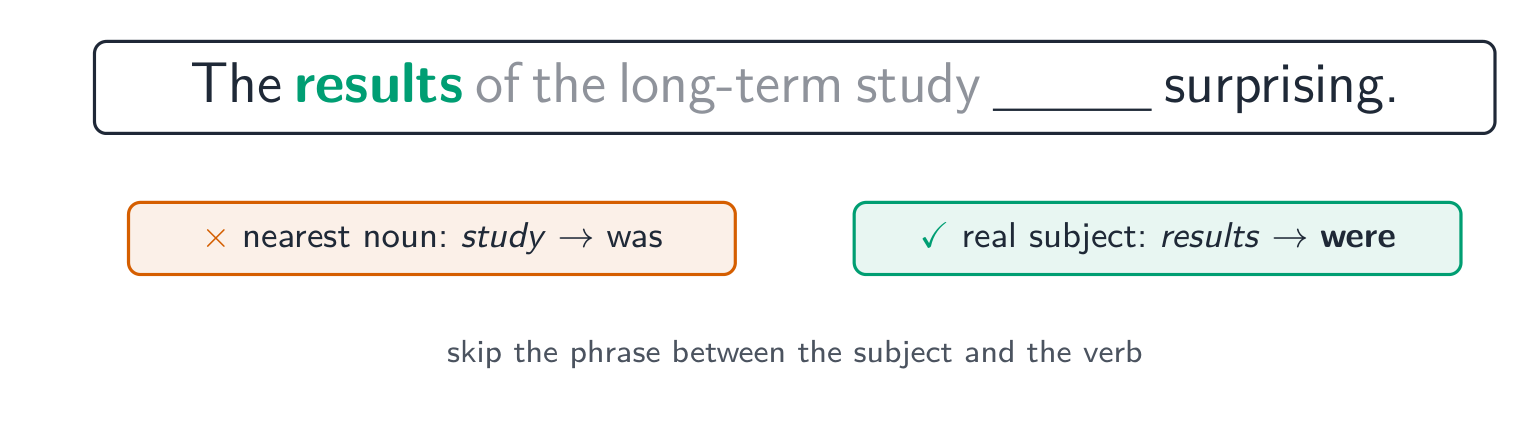
- "The results of the long-term study ___ surprising." The nearest noun is study, but the subject is results, so the verb is were.
- Form, structure and sense questions test agreement 一致, pronouns, verb tense and form, modifiers 修饰语 and parallel structure 平行结构.
Agreement with the real subject
- Skip phrases between subject and verb: "The box (of old letters) was found." "Neither the teacher nor the students were ready" — with or / nor, the verb agrees with the nearer subject.
- Pronouns must match their noun in number: "The companies released their reports"; "The company released its report."
“The list of approved items ___ posted on the door.” Which choice is correct?
Difficulty 1/5 · 100 coins + a small bonus on first completion today
The subject is list (singular).
“Neither the manager nor the employees ___ aware of the change.” (is / are)
Difficulty 1/5 · 100 coins + a small bonus on first completion today
With neither … nor, the verb agrees with the nearer subject, employees.
Tense from the time frame
- Keep the tense consistent with the passage: a text in the past ("In 1905, Einstein published…") needs past verbs unless a sentence states a general truth.
- Use the past perfect for an earlier past: "By the time the rescuers arrived, the storm had passed."
"In 1928, Fleming noticed that mould ___ the bacteria in his dish." The killing happened before he noticed it: had killed.
“By the time the guests arrived, the chef ___ the main course.” Which choice is correct?
Difficulty 1/5 · 100 coins + a small bonus on first completion today
The preparing happened before the past event (arrived): past perfect.
Modifiers and parallelism
- A modifier at the start of a sentence describes the subject that follows: "Walking to school, I saw a fox" — not "Walking to school, a fox crossed the road" (the fox was not walking to school).
- Parallel lists keep the same form: "She likes hiking, swimming and cycling" — not "hiking, to swim and cycling".
Which rule is broken?
Diagnose the grammar error in a sentence.
Which sentence has no dangling modifier?
Difficulty 1/5 · 100 coins + a small bonus on first completion today
The person running must be the subject after the comma.
“The job requires planning, organising and communicating clearly.” is correctly parallel.
Difficulty 1/5 · 100 coins + a small bonus on first completion today
True. All three items use the same -ing form, so the list is parallel.
Traps
- The nearest noun: the verb agrees with the head noun, not the noun just before it.
- Dangling modifiers: the subject after the comma must be the one doing the action in the opening phrase.
Recap
- Find the real subject for agreement; match pronouns to their noun's number.
- Keep tense consistent with the time frame; place modifiers next to what they describe; keep lists parallel.
- agreement: Matching a verb or pronoun in number with its subject or noun.
- parallel structure: Using the same grammatical form for items in a list or comparison.