Words in context: meaning, polarity and collocation
Introduced| English | Meaning |
|---|---|
| ambivalent/æmˈbɪvələnt/ | Having mixed feelings about something. |
| collocation/ˌkɒləˈkeɪʃn/ | Words that naturally go together in English, such as "make a decision" rather than "do a decision". |
The word that fits
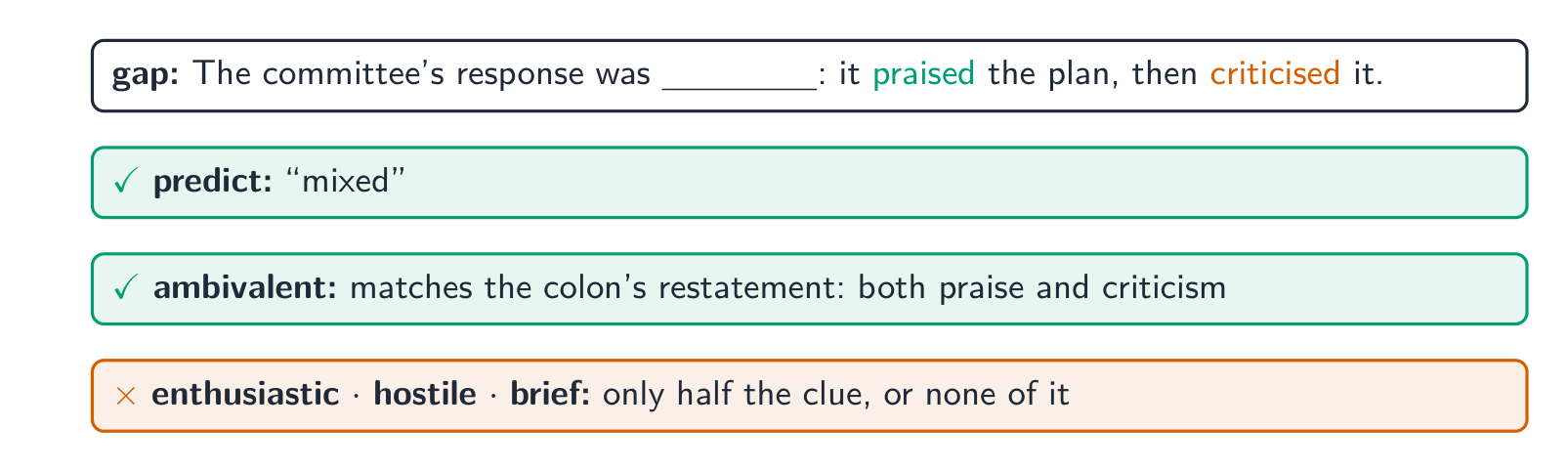
- "The committee's response was ___: it praised the plan in one sentence and criticised it in the next." Choices: ambivalent 矛盾的, enthusiastic, hostile, brief.
- Words in context asks for the word whose meaning, strength and usage fit the sentence. The sentence always contains the clue.
Use the clues
- Look for restatement (a colon or dash), contrast (although, but, despite), and cause (because, so). Here the colon explains: praised and criticised → mixed feelings → ambivalent.
- Predict a simple word first ("mixed"), then find the choice that means that.
Which clue is in the sentence?
Identify the type of context clue that decides the missing word.
“The new policy was ___ by residents: hundreds attended the meeting to oppose it.” Which word best fits?
Difficulty 1/5 · 100 coins + a small bonus on first completion today
Attending to oppose it shows resistance.
A colon or dash often signals that the next part ____ or explains the gap.
Difficulty 1/5 · 100 coins + a small bonus on first completion today
Use what follows the colon to work out the missing word.
Degree and direction
- Positive or negative? Strong or mild? "The results were ___ promising" might need "somewhat" if the next sentence lists problems.
- "Unprecedented" is stronger than "unusual"; "dismissed" is stronger than "questioned". Match the strength the context shows.
"Although the medication reduced symptoms, its effect was ___ — most patients still needed a second treatment." The contrast with "reduced symptoms" and the need for a second treatment point to a weak effect: modest, limited. Not dramatic.
“The improvement was ___: test scores rose by only two points.” Which word best fits?
Difficulty 1/5 · 100 coins + a small bonus on first completion today
“Only two points” shows a small change.
Collocation 词语搭配 and grammar
- The word must also fit the sentence grammatically and sound natural with its neighbours: "to conduct an experiment", "to pose a question", "a heavy rain" (not "a strong rain").
- Check the part of speech: a gap before a noun needs an adjective; after "to" it needs a verb.
Which word completes the phrase naturally: “to ___ a survey”?
Difficulty 1/5 · 100 coins + a small bonus on first completion today
“Conduct a survey” is the standard collocation.
Traps
- The familiar meaning: "the novel's arresting opening" means striking, not related to police.
- Right direction, wrong strength: "devastating" for a result the text calls a small setback.
In “an arresting photograph”, arresting means “striking or eye-catching”.
Difficulty 1/5 · 100 coins + a small bonus on first completion today
True. In this context arresting describes something that catches attention, not anything connected with the police.
Recap
- Find the clue (restatement, contrast, cause), predict a simple word, then match meaning and strength.
- Check grammar and natural collocation; beware familiar but wrong meanings.
- ambivalent: Having mixed feelings about something.