Cumulative frequency diagrams
Introduced| English | Meaning |
|---|---|
| cumulative frequency/ˈkjuːmjʊlətɪv ˈfriːkwənsi/ | The running total of frequencies up to a specified value or class boundary. |
| median/ˈmiːdiːən/ | The middle value when data are arranged in order, or the mean of the two middle values for an even number of observations. |
| quartile/ˈkwɔːtaɪl/ | One of the three boundary values that divide ordered data into four parts of approximately equal size. |
The running total
- In a marathon, you don't just count runners per age group — you want to know "how many runners have finished by time $t$?"
- That's a cumulative frequency 累积频数: a running total that builds up from the lowest class to the highest.
Cumulative frequency route
Follow raw data into a cumulative frequency curve and percentile reading.
Drawing the curve
- Plot cumulative frequency against the upper end of each class.
- Join the points with a smooth curve (or straight lines).
- The curve always goes up (or stays flat) — it never goes down, because you're adding.
Classes $0$–$10$ (freq $5$), $10$–$20$ (freq $8$), $20$–$30$ (freq $12$): cumulative frequencies are $5, 13, 25$. Plot at $10, 20, 30$.
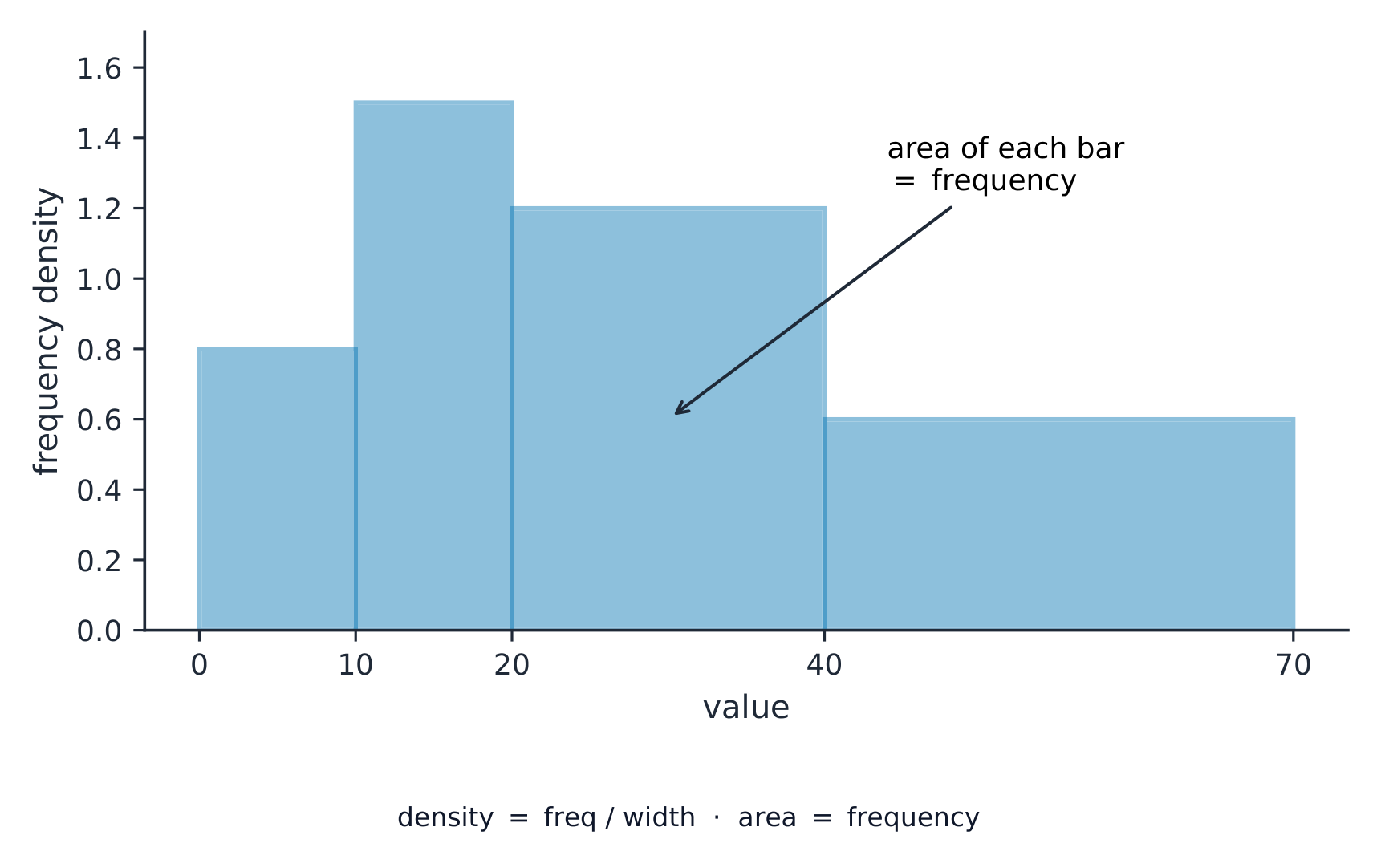
On a histogram with unequal class widths the bar AREA (not height) is the frequency, so the axis is frequency density
Cumulative frequency is:
Difficulty 1/5 · 100 coins + a small bonus on first completion today
Each point adds the next class frequency to the total so far.
Cumulative frequency is plotted against the upper end of each class.
Difficulty 1/5 · 100 coins + a small bonus on first completion today
Always plot the running total at the top boundary of the class.
A cumulative frequency curve can go down.
Difficulty 1/5 · 100 coins + a small bonus on first completion today
Cumulative frequency is a running total — it always increases or stays flat, never decreases.
Reading the curve
- Median 中位数: go across at half the total cumulative frequency, then down to the $x$-axis.
- Lower quartile 四分位数 (LQ): at $\dfrac{1}{4}$ of the total.
- Upper quartile (UQ): at $\dfrac{3}{4}$ of the total.
- IQR $=$ UQ $-$ LQ.
Across then down. To read a value from a cumulative frequency curve: go across from the $y$-axis to the curve, then down to the $x$-axis. Going the wrong way gives the wrong answer.
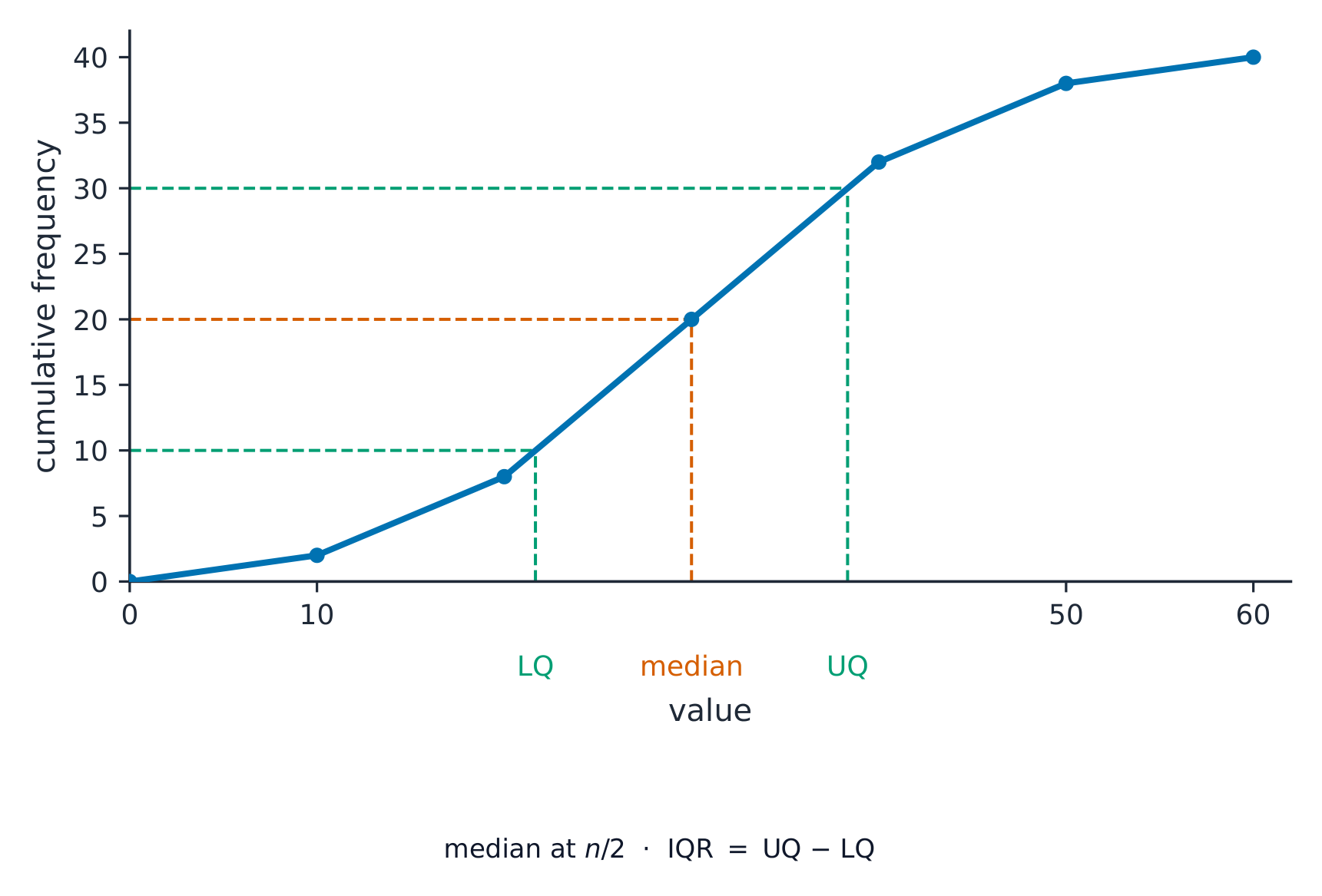
Read the median at half the total and the quartiles at one quarter and three quarters: go across to the curve, then down
A cumulative frequency curve has total 80. At what cumulative frequency do you read the median?
Difficulty 2/5 · 140 coins + a small bonus on first completion today
The median is at half the total: 80 ÷ 2 = 40.
Total cumulative frequency is 120. At what cumulative frequency do you read the upper quartile?
Difficulty 2/5 · 140 coins + a small bonus on first completion today
UQ is at 3/4 of the total: (3/4) × 120 = 90.
To read the median from a cumulative frequency curve, go ______ from the y-axis to the curve, then down to the x-axis.
Difficulty 1/5 · 100 coins + a small bonus on first completion today
Go across (horizontally) from the y-value to the curve, then down to read the x-value.
Worked example
- Total cumulative frequency $= 80$. Median at $80 \div 2 = 40$. Read across at $40$ on the $y$-axis, then down — suppose it reads $24$. The median is $24$.

A cumulative frequency curve always rises — the shape is like an elongated S, steep where data is concentrated.
There are 25 observations and cumulative frequency 13 at 20. How many are at least 20?
Difficulty 2/5 · 140 coins + a small bonus on first completion today
Subtract the count below 20: 25 − 13 = 12.
Include the start and read a count
- For classes $0\le t<10,10\le t<20,20\le t<30$ with frequencies 5,8,12, plot $(0,0),(10,5),(20,13),(30,25)$. The first point states that none are below the lower starting boundary.
- At 20, cumulative frequency is 13, so $25-13=12$ observations are at least 20. Quartile positions are $25/4=6.25$ and $3(25)/4=18.75$ on the cumulative axis; read values from the drawn curve.
You've got it
- cumulative frequency $=$ running total, plotted at each class's upper end
- read the median at half the total; quartiles at $\dfrac{1}{4}$ and $\dfrac{3}{4}$
- across to the curve, then straight down to the value
Write from a median position of 30
- A cumulative frequency curve has total 60.
- The median is at half the total.
A cumulative frequency curve has total 60. At what cumulative frequency do you read the median?
Half of 60 is 30.
At what cumulative frequency is the median?
Difficulty 1/5 · 100 coins + a small bonus on first completion today
The median sits halfway up the curve. Other options — 40 (the lesson median position); 60 (the total).