Bearings
Introduced| English | Meaning |
|---|---|
| bearing/ˈbeərɪŋ/ | A direction measured as an angle clockwise from north, usually written with three digits. |
| back bearing/bæk ˈbeərɪŋ/ | back bearing |
Lost at sea — saved by a bearing 方位角
- Before GPS, sailors navigated using bearings — a precise angle from north.
- A single mistake (reading anticlockwise instead of clockwise, or writing "45" instead of "045") could put a ship miles off course.
Bearings route
Follow how to measure a bearing correctly from north.
What is a bearing?
- A bearing gives a direction as a three-figure angle, measured clockwise from north.
- Due north $= 000^{\circ}$ (or $360^{\circ}$); due east $= 090^{\circ}$; due south $= 180^{\circ}$; due west $= 270^{\circ}$.
- Always write three figures: $5^{\circ}$ becomes $005^{\circ}$, $45^{\circ}$ becomes $045^{\circ}$.
Bearings are always measured clockwise from north, and always written as three figures.
Three figures, always. A bearing of $45^{\circ}$ is written $045^{\circ}$. Writing just "45" loses marks — the leading zero shows it's a bearing, not an ordinary angle.
What three-figure bearing points due east?
Difficulty 2/5 · 140 coins + a small bonus on first completion today
Clockwise from north, east is 090°.
Bearings are measured clockwise from north.
Difficulty 1/5 · 100 coins + a small bonus on first completion today
Always clockwise from north, written as three figures.
A bearing of 45° should be written as ______°.
Difficulty 1/5 · 100 coins + a small bonus on first completion today
Bearings are always written as three figures: 045°, not 45°.
Back bearings 反方位角
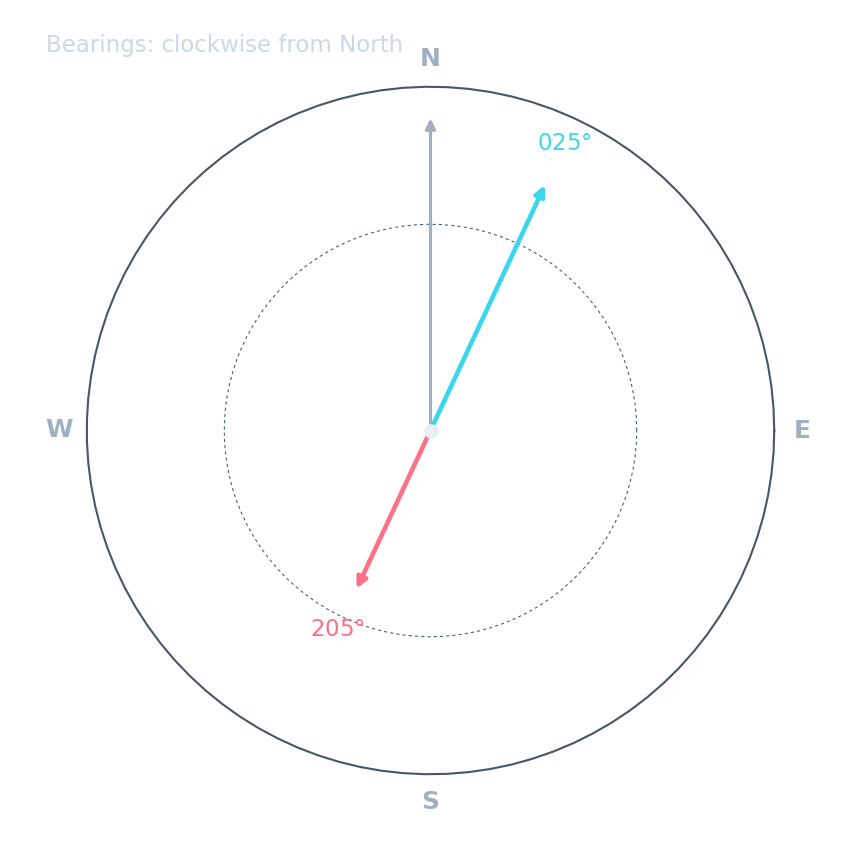
- The back bearing (the return direction) differs from the forward bearing by $180^{\circ}$.
- If the bearing is under $180^{\circ}$, add $180^{\circ}$; if over, subtract $180^{\circ}$.
- Bearing of $B$ from $A$ is $025^{\circ}$ → bearing of $A$ from $B$ is $025 + 180 = 205^{\circ}$.
Bearing of $P$ from $Q$ is $310^{\circ}$. Back bearing: $310 - 180 = 130^{\circ}$. The bearing of $Q$ from $P$ is $130^{\circ}$.

Bearings are measured clockwise from north as three figures; the back bearing differs by $180^\circ$
The bearing of B from A is 025°. What is the bearing of A from B?
Difficulty 2/5 · 140 coins + a small bonus on first completion today
Back bearing: 025 + 180 = 205°.
The bearing of P from Q is 310°. What is the back bearing (bearing of Q from P)?
Difficulty 2/5 · 140 coins + a small bonus on first completion today
310° > 180°, so subtract: 310 − 180 = 130°.
Worked example — three-figure bearings
- A ship sails on bearing $135^{\circ}$ for $20$ km, then turns to bearing $225^{\circ}$.
- The angle turned through $= 225 - 135 = 90^{\circ}$ — a right-angle turn to starboard.
A ship changes from bearing 135° to bearing 225°. How many degrees did it turn?
Difficulty 2/5 · 140 coins + a small bonus on first completion today
225 − 135 = 90° (a right-angle turn).
Bearings in the real world
- Aviation: runways are numbered by their bearing divided by 10 (Runway 27 faces roughly $270^{\circ}$).
- Hiking: a compass bearing tells you which direction to walk, even in fog.
You've got it
- a bearing is three figures, measured clockwise from north
- east $090^{\circ}$, south $180^{\circ}$, west $270^{\circ}$
- back bearing differs by $180^{\circ}$ (add if $<180^{\circ}$, subtract if $>180^{\circ}$)