Writing an essay
IntroducedTwo kinds of essay
- An essay gives your ideas about a topic in an organised way.
- Discursive: look at both sides of the topic.
- Argumentative: argue for one main view.
An essay needs a position, not a traffic jam of opinions.
Explore
For, against or off-topic?
Sort your brainstorm before you write — and throw out everything off-topic.
Practice
A discursive essay…
Discursive = balanced, both sides.
Practice
An argumentative essay argues for ___ main view. (one / two)
Argumentative = one clear view.
Plan and structure
- Introduction: name the topic and your approach.
- Body: one main idea per paragraph, with reasons.
- Conclusion: bring your ideas together.
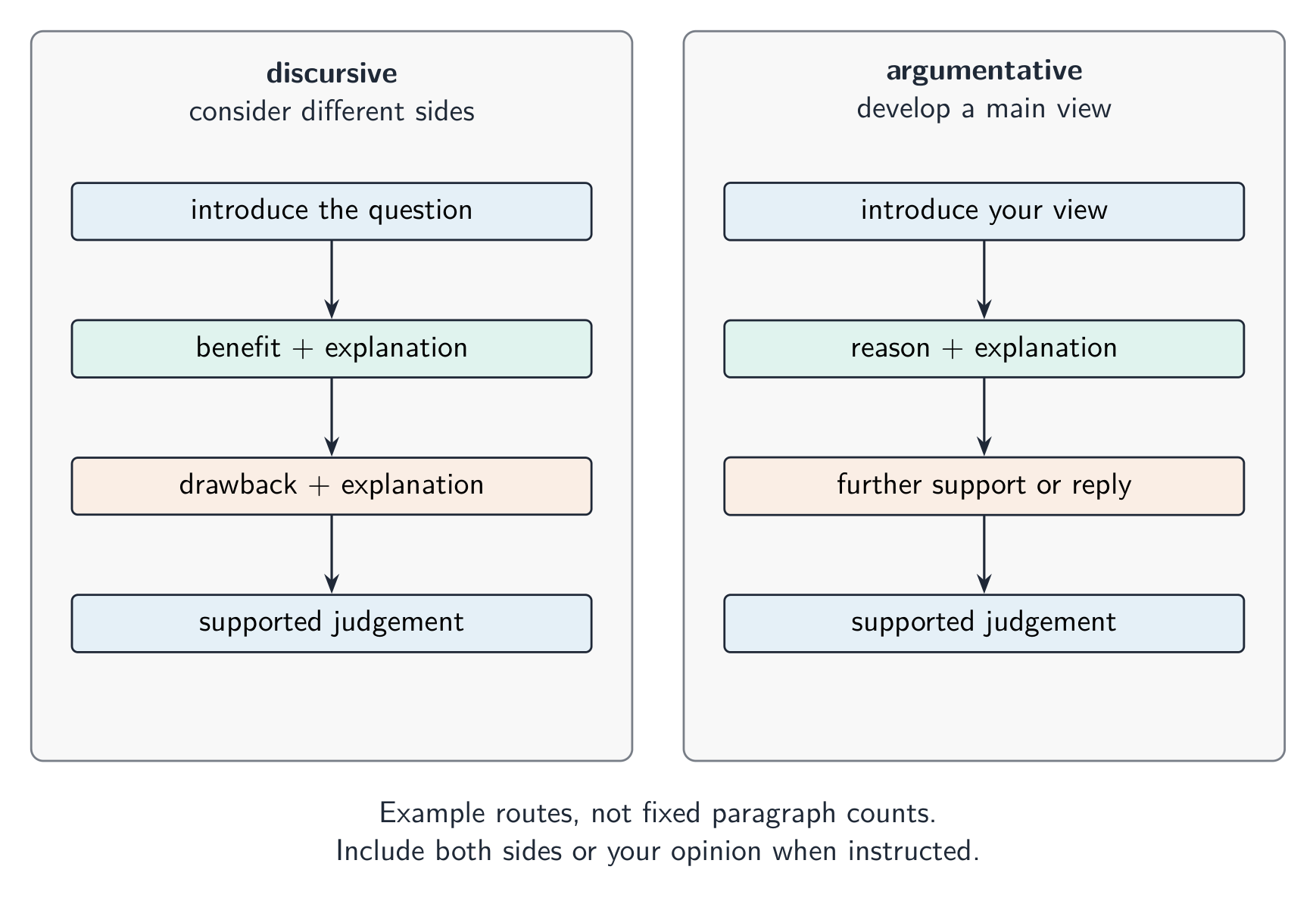
Two essay shapes: discursive weighs both sides; argumentative argues one view
Practice
Where does your conclusion go?
The conclusion comes last and sums up.
Practice
Match each essay part to its job.
Each part has one job — when every part does its job, the essay argues itself.
Reasons and examples
- Support each point with a reason or an example.
- Use linking words to connect ideas.
- Keep a formal, organised style.
Practice
Write one sentence giving your opinion on school uniforms, with a reason.
Example: 'I think uniforms are useful because they save time in the morning.'
Two-minute plan, both sides
- Question: "Should school start later in the morning?"
- FOR: more sleep → better focus; fewer late arrivals. AGAINST: school ends later; bus timetables clash.
- Discursive: give both columns a paragraph each, then your balanced view.
- Argumentative: pick one column, and use the strongest point from the other as your "although…".
Key idea
- Discursive = both sides; argumentative = one view.
- Introduction → body paragraphs → conclusion.
- Support points; connect ideas with linking words.