Structure and recommendation
IntroducedDescribe and evaluate
- Start by saying what you are reviewing.
- In the middle, describe it and evaluate it — the good points and the weak points.
- Write for a general reader.
A film can have a brilliant soundtrack and a confusing ending; say both.
Explore
The review journey
Introduce, describe, weigh up, then land on one clear recommendation.
Practice
A good review should…
A review balances description and opinion.
Support your opinion
- Give reasons for what you think.
- Use examples from your experience.
- Balance description with opinion.
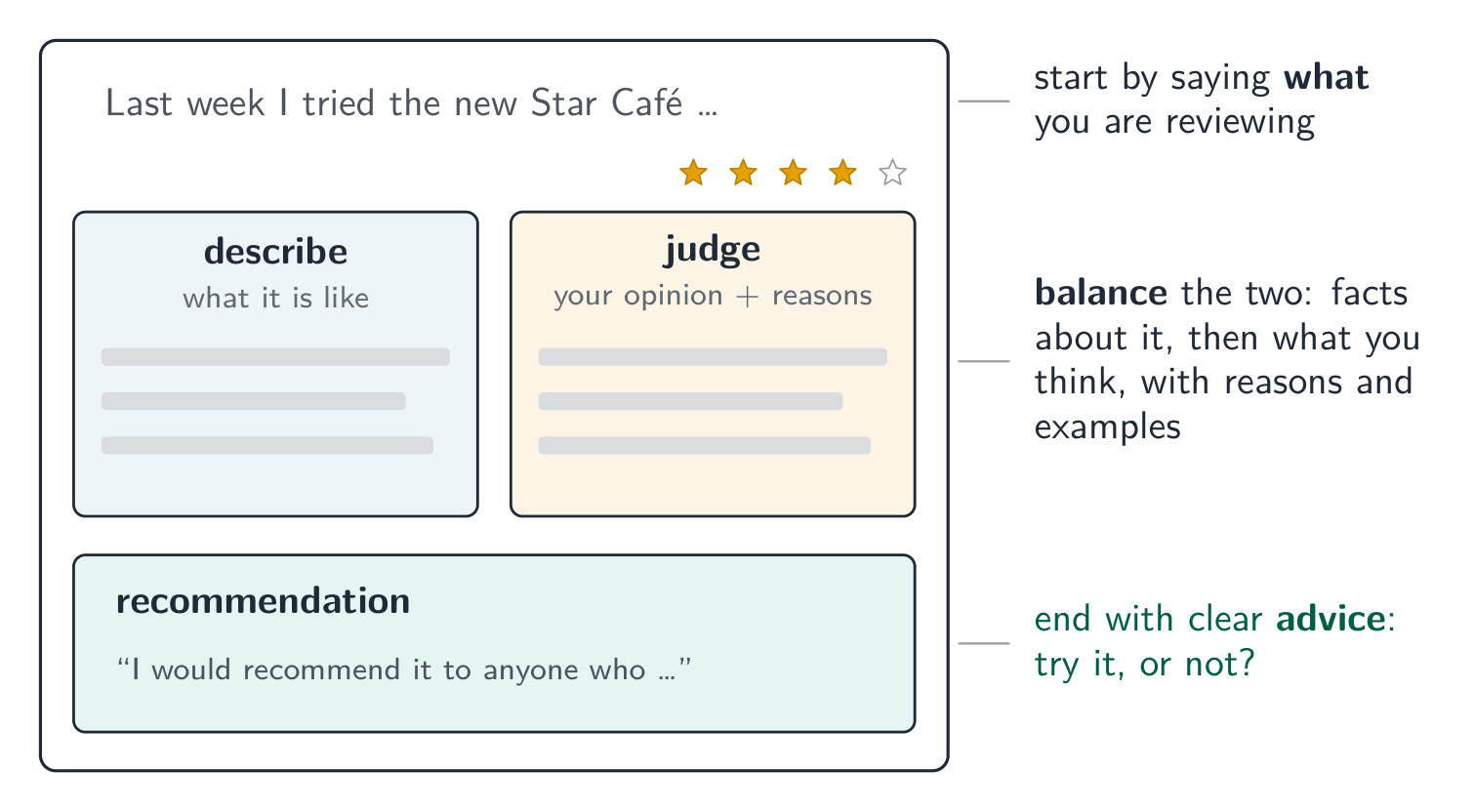
A review describes and judges, then ends with clear advice
Practice
Support your opinion with reasons and ___ from your experience.
Examples make your opinion believable.
End with a recommendation
- Finish with a clear recommendation.
- Do you advise the reader to try it or not?
- Make your advice clear.
Practice
A review should end with a clear recommendation.
Yes — tell the reader whether to try it.
Practice
Write one sentence recommending a place you have visited, with a reason.
Example: 'I recommend the beach because it is quiet and beautiful.'
Verdicts that stick
- Weak: "So all in all it was quite good and I liked it." — says nothing.
- Strong: "Despite the slow start, this is the best £5 you'll spend this month — take a friend."
- The strong verdict weighs good against bad (despite), then gives an action (take a friend).
- One rule: the verdict must match your middle — praise the food all review, then never end with "avoid it".
Practice
Put the review paragraphs in order.
The reader meets it, sees it, judges it with you, then gets your advice.
Key idea
- Introduce → describe and evaluate → recommend.
- Support opinions with reasons and examples.
- End with a clear recommendation.