Connecting ideas across a text
IntroducedIdeas connect
- A long text is not just a list of facts.
- The ideas link to each other — you must follow how.
- This is tested in multiple matching.
A shared word is a handshake, not a marriage between ideas.
Practice
A long text is just a list of separate, unconnected facts.
No — the ideas connect to each other.
Match by meaning
- You read several short texts, or parts of one text.
- Each question describes an idea; pick the text that matches it.
- The words are usually different — look for the same meaning, not the same words.
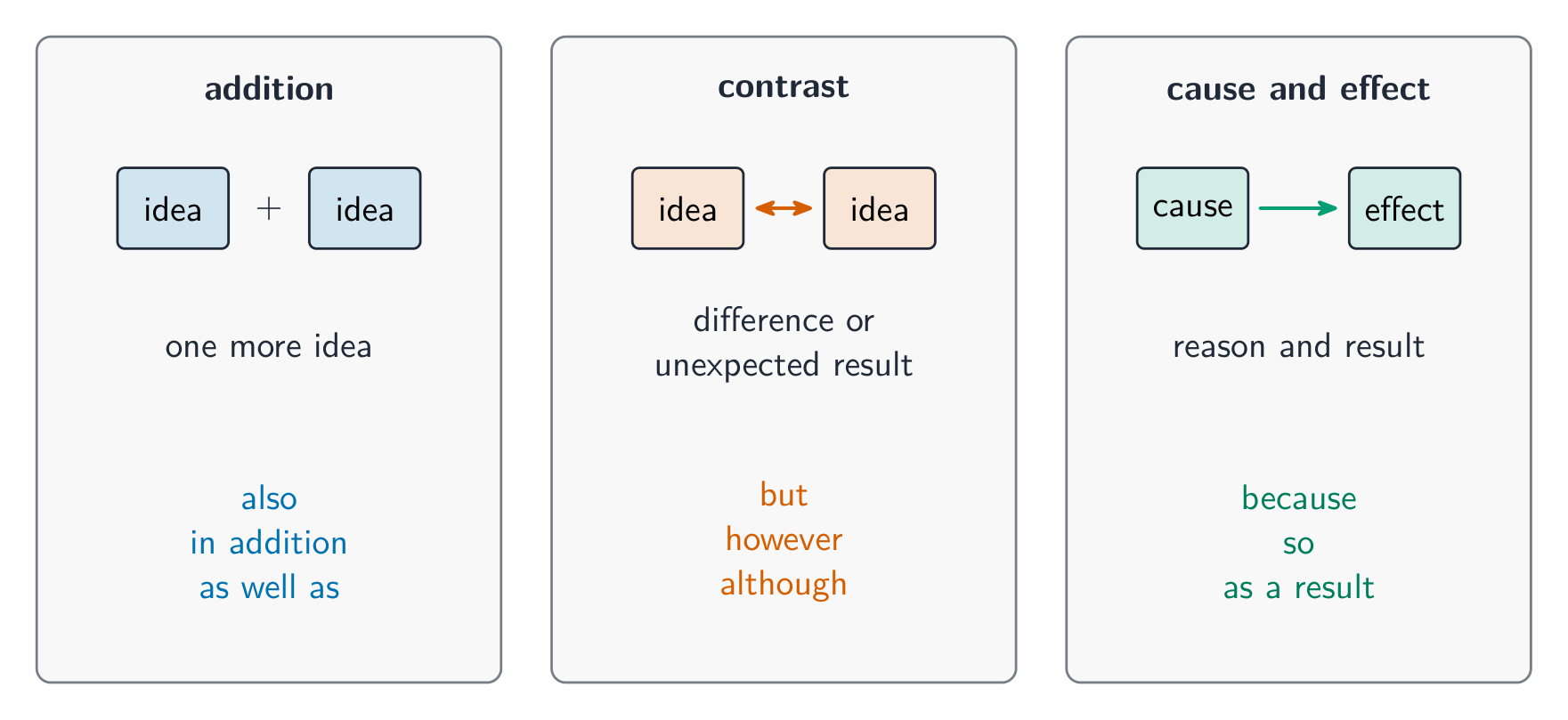
The three signal-word families and what they do to ideas
Practice
In multiple matching, what should you look for?
The words differ; match the meaning.
Practice
Write a sentence, then write the same idea again using different words.
Example: 'The film was great.' / 'I really enjoyed the film.'
Watch the signal words
- Small words show how ideas connect.
- Adding: also, in addition. Contrast: however, but. Result: so, therefore.
- They tell you how the writer's ideas fit together.
Explore
How do the two ideas connect?
Signal words show whether an idea is added, turned around, or caused by the last one.
Practice
Choose a contrast word: 'I like tea. ___, I prefer coffee.'
'However' signals a contrast.
Follow the chain
- "Ben started a rooftop garden. It began as a hobby. However, the project now feeds twenty families."
- It and the project both point back to the garden — one idea, three sentences.
- However warns you the idea is turning: a hobby → something much bigger.
- A matching question might say "grew beyond a pastime" — different words, same meaning as sentence 3.
Practice
Match each signal word to its job.
Signal words are the hinges of a text — they tell you which way the next idea swings.
Key idea
- Ideas in a text connect — follow the links.
- Match by meaning, not by the same words.
- Signal words show addition, contrast and result.