Making notes and summaries
IntroducedTaking the main points
- Sometimes you must pull the key points out of a text.
- You write them in short form, under headings.
- This tests note-making and summary skills.
A summary is a suitcase: pack the essentials and leave the furniture.
Make short notes
- Write short notes, not full sentences — a word or a phrase.
- Choose only the points that fit the heading.
- Leave out examples and extra detail.
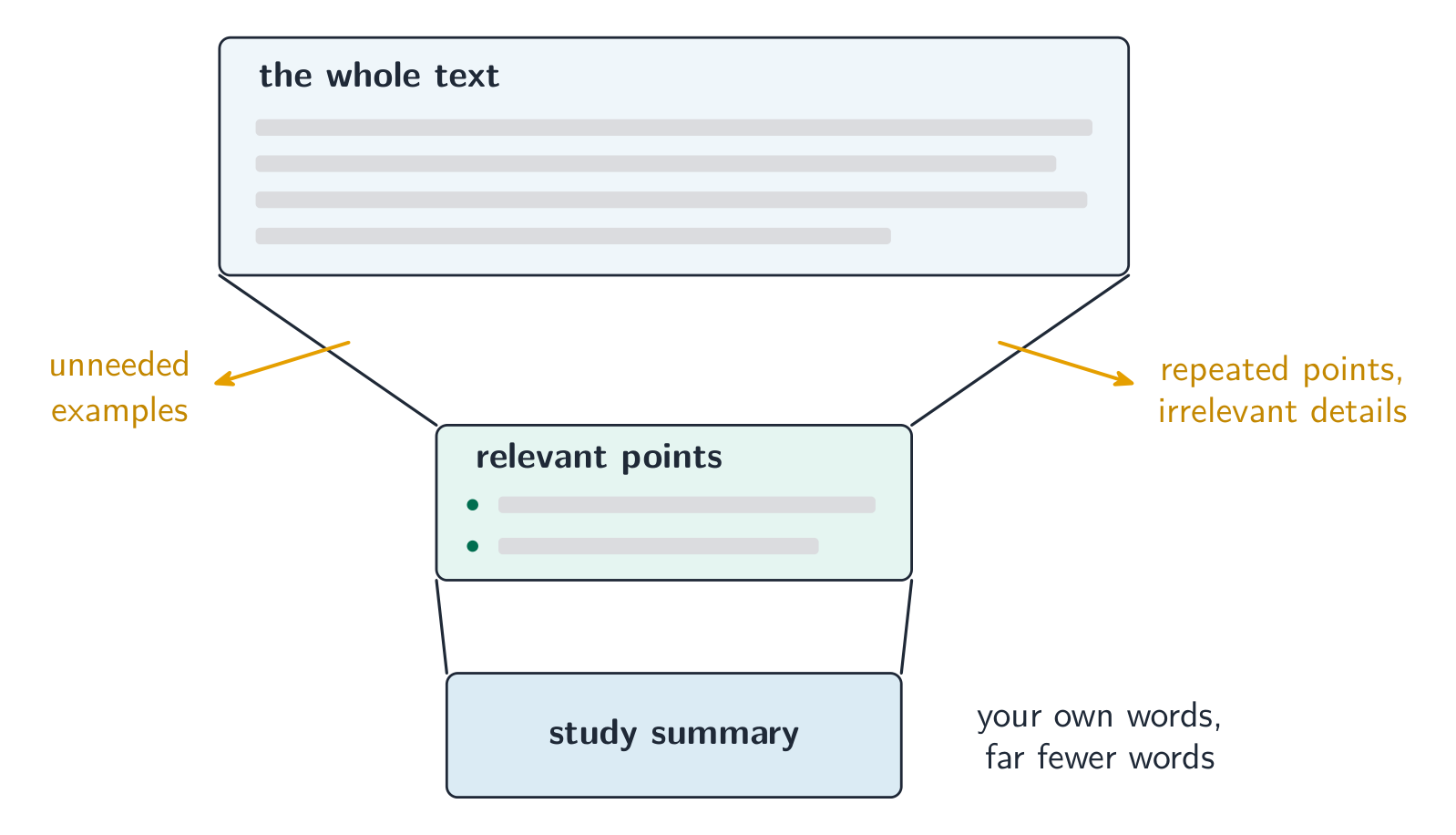
A summary keeps only the key points, in your own words
Practice
In note-making, you should write full sentences.
No — short notes, a word or a phrase.
Practice
Notes should be short: a word or a ___.
Notes use short phrases, not full sentences.
Summary skills
- A summary gives only the most important ideas, in fewer words.
- Ignore examples, repetition and small details.
- Use your own words where you can.
Explore
From text to summary, step by step
Find the points, drop the examples, then rewrite the points in your own words.
Practice
A good summary…
Keep only the key ideas, briefly.
Practice
In one short sentence, summarise what you did yesterday.
Example: 'I studied and played football.'
From text to notes to summary
- "Cycling to school saves money. It also keeps you fit, and many students say they arrive feeling more awake. My neighbour Marco even lost five kilos."
- Notes under the heading Benefits of cycling: saves money · keeps fit · arrive awake.
- Marco and his five kilos are an example — notes leave them out.
- Summary: "Cycling to school is cheap and healthy." — the key ideas, in your own words.
Practice
Which THREE belong in notes under the heading 'Benefits of cycling'?
Marco is an example — an interesting story, but not a point. Notes keep points only.
Key idea
- Notes are short phrases under headings.
- A summary keeps only the key ideas, in fewer words.
- Leave out examples and repetition.