Reading skills: skim and scan
IntroducedRead with a purpose
- In the exam you do not read every word.
- You change your speed to fit your goal.
- Two key skills: skim and scan.
Skimming a menu finds dinner; scanning it finds the price.
You need to find one date in a long text. What is the fastest way?
Scanning means moving your eyes down to find one specific fact.
Skim, then scan
- Skim: read fast for the general idea (the gist).
- Scan: move your eyes down to find one detail.
- Use scanning for names, numbers, dates and times.
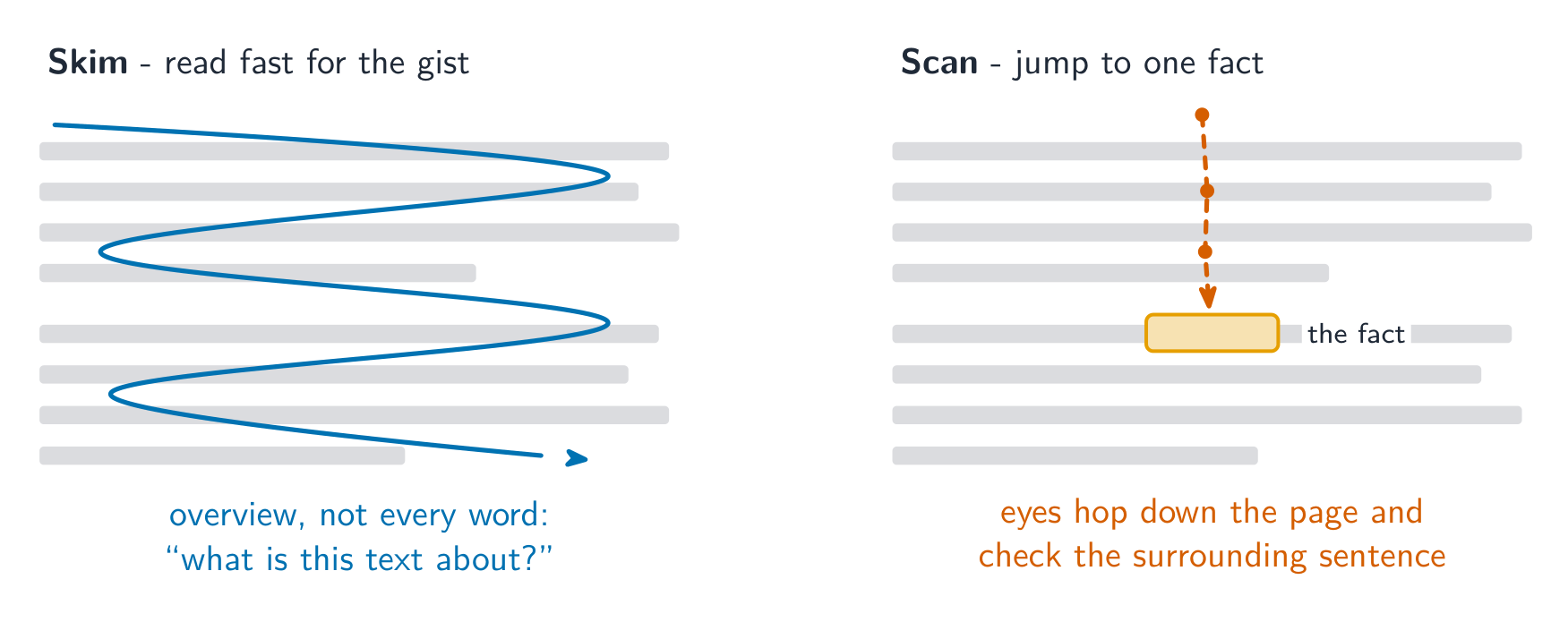
Skim sweeps over everything for the gist; scan jumps straight to one fact
Skim, scan or read closely?
Match your reading speed to the task: gist → skim, one detail → scan, deeper meaning → read closely.
Skimming means reading every word slowly.
No — skimming is reading fast for the general idea.
To get the general idea of a text quickly, you ___ it.
Skim = read fast for the gist.
Find and answer
- Read the question first, and predict the answer.
- Find the part of the text with the same idea.
- Write a short, exact answer — copy the key word.
The text says: 'Anna lives in a small town near Paris.' Best answer to 'Where does Anna live?'
Keep it short and exact — just the information asked for.
Try it on a real text
- "Green Park pool opens on 12 May. Adult tickets cost £4.50, and students pay half price. Manager Rosa Bell says a new café will follow one month later."
- Skim (one fast read): it is about a pool opening — enough for any "best title" question.
- Scan for the student price: your eyes catch £4.50 → half price → answer: £2.25.
- Short and exact wins the mark: write "£2.25", not a whole sentence.
Match the question word to what your eyes should hunt for.
The question word tells you the shape of the answer, so scanning gets much faster.
- Skim for the gist; scan for one detail.
- Predict the answer, then find it in the text.
- Keep answers short and exact.