Encryption
Introduced| English | Meaning |
|---|---|
| encryption/enˈkrɪpʃn/ | Transforming information using an algorithm and key so that unauthorised readers cannot readily understand it. |
| intercepted/ˌɪntəˈseptɪd/ | Captured or accessed while in transit by someone who is not an intended recipient. |
| plaintext/ˈpleɪntekst/ | Readable, unencrypted information before encryption or after decryption. |
| ciphertext/ˈsaɪfətekst/ | Information transformed by encryption into a form intended to be unreadable without the appropriate key. |
| symmetric/sɪˈmetrɪk/ | Having corresponding parts or relationships that remain equivalent under a specified transformation or interchange. |
| asymmetric/ˌeɪsɪˈmetrɪk/ | In cryptography, describing methods that use a related public key and private key rather than one shared secret key. |
| key/kiː/ | A value used by a cryptographic algorithm to encrypt, decrypt or authenticate information. |
| public key/ˈpʌblɪk kiː/ | The shareable key in an asymmetric cryptographic pair, used for encryption or signature verification depending on the scheme. |
| private key/ˈpraɪvət kiː/ | The secret key in an asymmetric cryptographic pair, used for decryption or digital signing depending on the scheme. |
Scrambling a message
- Encryption 加密 scrambles data so it can't be understood if it is intercepted 拦截.
- Readable data is plaintext 明文; scrambled data is ciphertext 密文.
- There are two kinds: symmetric 对称 and asymmetric 非对称.
What encryption does (and doesn't)
- Encryption uses a key 密钥 to turn plaintext into ciphertext, and back again to decrypt.
- It does not stop data from being intercepted — it only stops the intercepted data from being understood.
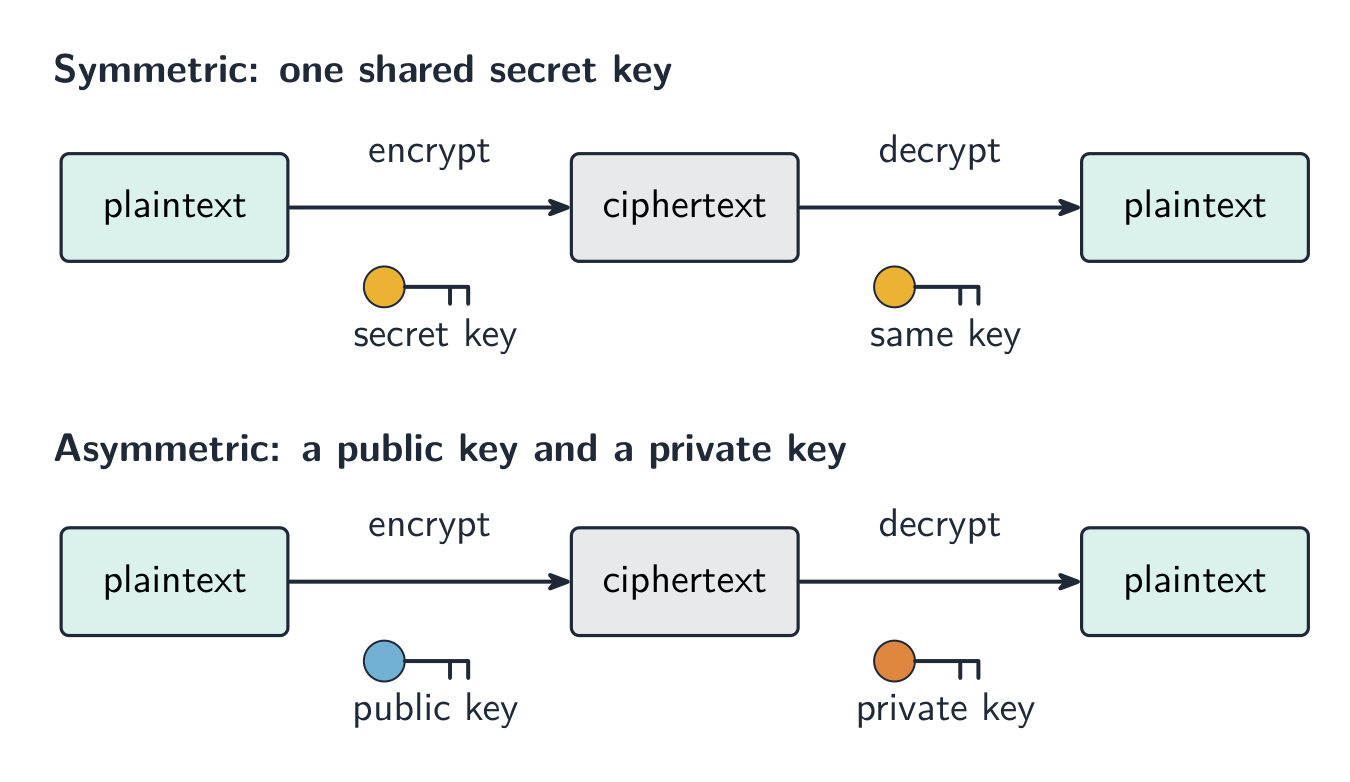
Symmetric uses one shared key; asymmetric uses a public key 公钥 to encrypt and a private key 私钥 to decrypt.
What does encryption achieve?
Difficulty 1/5 · 100 coins + a small bonus on first completion today
Encryption scrambles data so interception is useless — it does not prevent the interception itself.
Symmetric encryption
- Symmetric encryption uses a single key to both encrypt and decrypt.
- The sender and receiver must share this same secret key.
- The risk: the key itself could be stolen while being shared.

Simplex is one way only; half-duplex is both ways but one at a time; full-duplex is both ways at once.
A shift cipher (symmetric key)
Caesar's cipher shifts every letter forward by a fixed key. The SAME key encrypts and decrypts — that is what symmetric means. Slide the key and try to read it without knowing the shift.
Match each encryption term to its meaning.
Difficulty 2/5 · 140 coins + a small bonus on first completion today
Plaintext → (key) → ciphertext; symmetric shares one key, asymmetric uses a public/private pair.
Symmetric encryption uses:
Difficulty 1/5 · 100 coins + a small bonus on first completion today
Symmetric uses one secret key that both sides must share — the risk is that key being stolen.
Asymmetric encryption
- Asymmetric encryption uses two keys: a public key (anyone can have it, used to encrypt) and a private key (kept secret, used to decrypt).
- Data encrypted with the public key can only be decrypted with the matching private key.
- The secret key never has to be shared, so it is safer than symmetric.
In asymmetric encryption, data is encrypted with the ____ key and decrypted with the ____ key.
Difficulty 1/5 · 100 coins + a small bonus on first completion today
The public key encrypts; only the matching private key can decrypt — so the secret key is never shared.
Asymmetric encryption is safer for sharing because only the public key is ever sent — the private key that decrypts the data never has to be shared.
Difficulty 1/5 · 100 coins + a small bonus on first completion today
Symmetric encryption's weak point is getting the shared key to the other side safely; asymmetric removes that by keeping the private key secret.
You've got it
- encryption makes intercepted data unreadable (it doesn't prevent interception)
- plaintext → ciphertext using a key
- symmetric = one shared key (risk: sharing it); asymmetric = public key encrypts, private key decrypts
- asymmetric is safer because the secret key is never shared