The reactivity series
Introduced| English | Meaning |
|---|---|
| reactivity series/rɪəkˈtɪvɪti ˈsɪəriːz/ | An ordering of metals according to their tendency to react by losing electrons. |
| displace/dɪˈspleɪs/ | To replace another element in a compound during a chemical reaction. |
Ranking the metals
- Some metals react violently; others barely react at all.
- The reactivity series 金属活动性顺序 ranks metals from most to least reactive.
Which of these metals is the most reactive?
Difficulty 1/5 · 100 coins + a small bonus on first completion today
Potassium is near the top of the reactivity series.
Put these metals in order from most reactive to least reactive.
Difficulty 3/5 · 200 coins + a small bonus on first completion today
Potassium > magnesium > iron > gold.
Being very unreactive, ______ is found near the bottom of the reactivity series.
Difficulty 1/5 · 100 coins + a small bonus on first completion today
Gold is one of the least reactive metals.
The reactivity series
- Metals are listed from most reactive (potassium) to least reactive (gold).
- The order: potassium, sodium, calcium, magnesium, zinc, iron, copper, gold (and more).
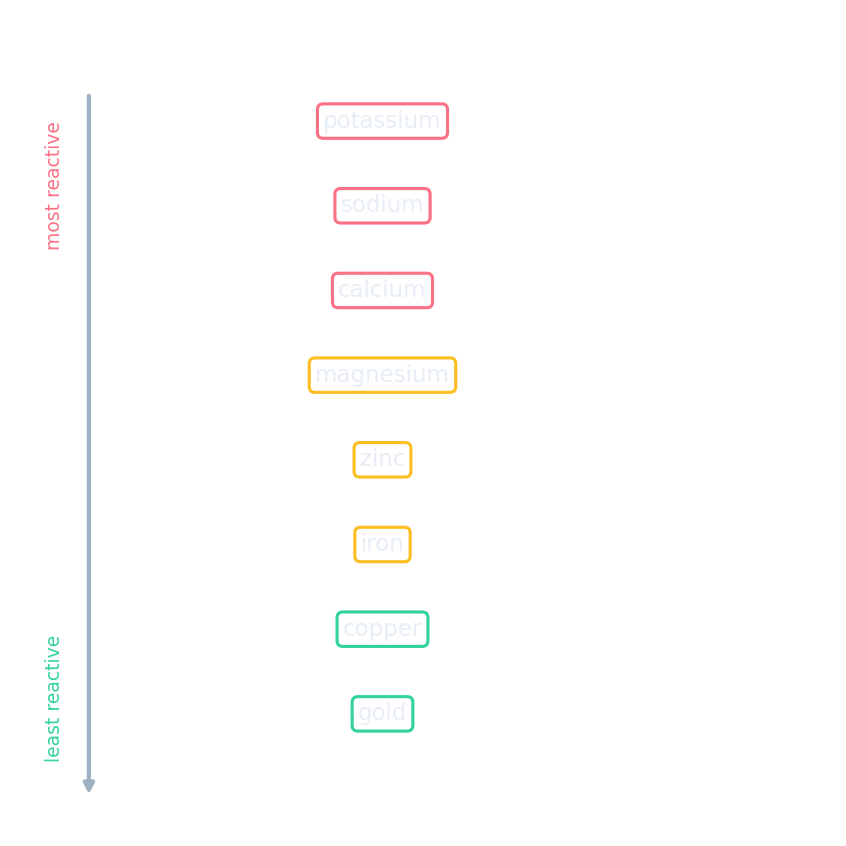
The reactivity series ranks metals from most reactive at the top to least reactive at the bottom.
Displacement and the reactivity series
Step through a displacement. A more reactive metal pushes a less reactive one out of its compound — which is exactly what the reactivity series predicts.
A more reactive metal can:
Difficulty 1/5 · 100 coins + a small bonus on first completion today
More reactive metals displace less reactive ones.
Displacement reactions
- A more reactive metal will displace 置换 a less reactive one from its compound.
- For example, iron displaces copper from copper sulfate solution.
An iron nail placed in copper sulfate solution will:
Difficulty 1/5 · 100 coins + a small bonus on first completion today
Iron is more reactive than copper, so it displaces it.
Reactions with water and acid
- The most reactive metals react with cold water; less reactive ones only with acid; the least don't react.
- The series predicts how vigorously a metal will react.
Worked example. Put an iron nail in copper sulfate solution. Iron is more reactive than copper, so it displaces it: the nail gets a copper coating and the blue solution fades. The series predicts the result.
You've got it
- the reactivity series ranks metals from most (potassium) to least (gold) reactive
- a more reactive metal displaces a less reactive one from its compound
- the series predicts reactions with water and acid