Marketing strategy
Introduced| English | Meaning |
|---|---|
| strategy/ˈstrætədʒi/ | A coordinated long-term approach for achieving an organisation's objectives and allocating its resources. |
| Ansoff matrix/ˈænsɒf ˈmeɪtrɪks/ | A growth-planning framework comparing existing or new products with existing or new markets. |
| market penetration/ˈmɑːkɪt ˌpenɪˈtreɪʃn/ | Increasing sales of existing products in markets a business already serves. |
| product development/ˈprɒdʌkt dɪˈveləpmənt/ | Creating new or improved products, including offering new products to an existing market in a growth strategy. |
| market development/ˈmɑːkɪt dɪˈveləpmənt/ | Seeking new markets or customer groups for an existing product. |
| diversification/daɪˌvɜːsɪfɪˈkeɪʃn/ | Expanding into different products, markets or activities to spread risk or seek growth. |
| consumers/kənˈsuːməz/ | People or organisations that buy or use goods and services. |
| misleading/mɪˈsliːdɪŋ/ | Likely to cause someone to form an incorrect impression or conclusion. |
Planning the way forward
- Beyond the daily mix, a business needs a marketing strategy 战略 — a plan to reach its goals.
- A useful way to think about growth is the Ansoff matrix 安索夫矩阵. (This is an enrichment framework — it goes beyond the IGCSE 0450 syllabus, but it organises the growth ideas you do need.)
Ansoff strategy lab
Sort growth choices by product and market risk.
The Ansoff matrix crosses products with ______.
Difficulty 1/5 · 100 coins + a small bonus on first completion today
Products (existing/new) against markets (existing/new).
The Ansoff matrix
- It crosses products (existing / new) with markets (existing / new), giving four strategies.
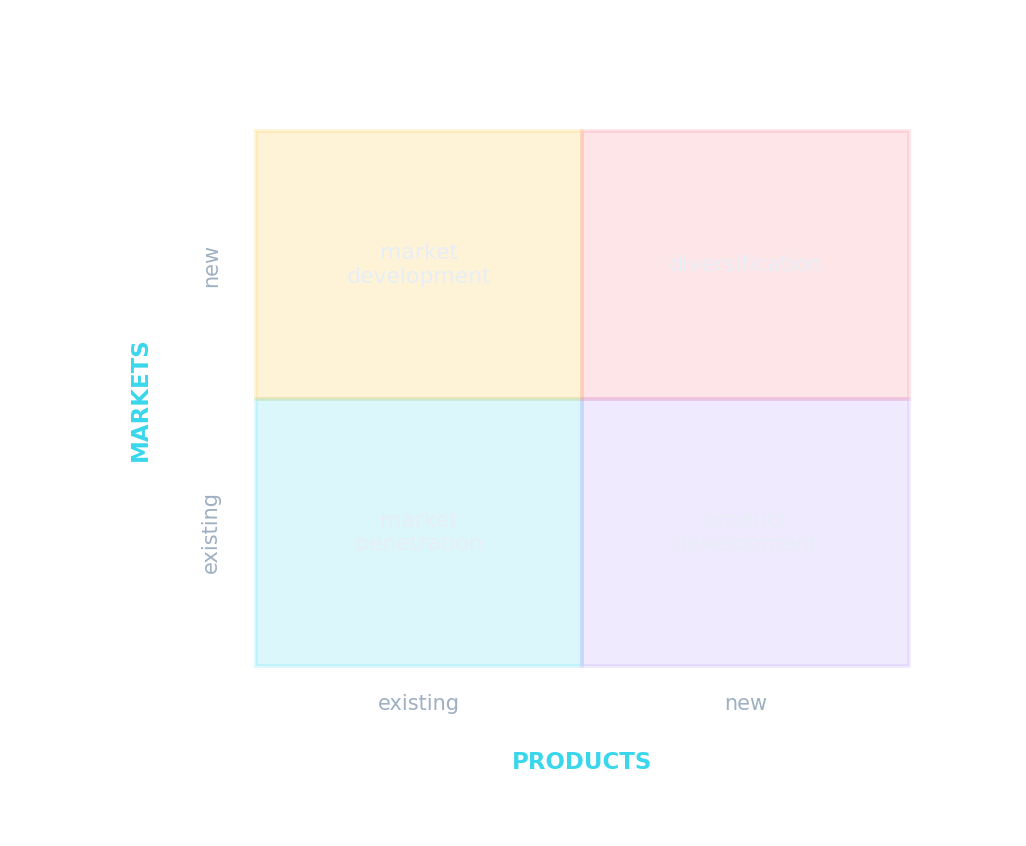
Risk rises as you move towards new products and new markets.
Selling more of an existing product to existing customers is:
Difficulty 1/5 · 100 coins + a small bonus on first completion today
Penetration deepens sales in the current market.
Launching a new product in a new market is:
Difficulty 1/5 · 100 coins + a small bonus on first completion today
New product + new market = diversification, the highest-risk option.
The four growth strategies
- Market penetration 市场渗透: sell more existing products to existing customers. Lowest risk.
- Product development 产品开发: new products for existing markets.
- Market development 市场开发: existing products into new markets.
- Diversification 多元化: new products and new markets. Highest risk.
Consumer-protection laws require that products are:
Difficulty 1/5 · 100 coins + a small bonus on first completion today
Goods must be safe and accurately described.
Diversification is generally the highest-risk growth strategy.
Difficulty 1/5 · 100 coins + a small bonus on first completion today
It moves into both new products and new markets.
Legal controls on marketing
- Laws protect consumers 消费者: products must be safe and described honestly.
- Misleading 误导 adverts and unsafe goods are illegal — and damage a firm's reputation.
Higher reward usually means higher risk. Diversification offers the biggest growth but the greatest chance of failure — the business moves into the unknown. Match the strategy to the firm.
You've got it
- the Ansoff matrix crosses products (existing/new) with markets (existing/new)
- four strategies: penetration, product development, market development, diversification
- marketing is controlled by consumer-protection laws (honest, safe products)