Populations
Introduced| English | Meaning |
|---|---|
| population/ˌpɒpjʊˈleɪʃn/ | All the organisms of one species living in a particular area at a particular time. |
| exponential/ˌekspəˈnenʃl/ | Describing a relationship in which a variable occurs in an exponent. |
| carrying capacity/ˈkæriɪŋ kəˈpæsɪti/ | The largest population an environment can support sustainably under the prevailing conditions. |
| limiting factors/ˈlɪmɪtɪŋ ˈfæktəz/ | A factor whose availability restricts the rate or extent of a process. |
Booming, then balancing
- Put a few organisms in a good habitat and their numbers grow — but not forever.
- A population 种群 follows a characteristic growth curve.
Put the phases of population growth in order.
Difficulty 3/5 · 200 coins + a small bonus on first completion today
Slow start, rapid growth, then a plateau.
Population growth levels off at the ______ capacity.
Difficulty 1/5 · 100 coins + a small bonus on first completion today
The carrying capacity is the habitat's maximum.
The population growth curve
- At first, slow growth (lag phase) while numbers are small.
- Then rapid (exponential 指数的) growth as there's plenty of food and space.
- Finally growth levels off at the carrying capacity 环境容纳量.

Numbers rise rapidly, then level off at the carrying capacity the habitat can support.
Populations
logistic growth → capacity K
Growth is exponential at first, then levels off at the carrying capacity as resources run low.
The carrying capacity is:
Difficulty 1/5 · 100 coins + a small bonus on first completion today
It is the maximum the habitat can sustain.
Which are limiting factors on a population? (Select all that apply.)
Difficulty 2/5 · 140 coins + a small bonus on first completion today
Food, space and predators limit growth.
Limiting factors 限制因素
- Growth slows because of limiting factors: food, space, water, predators and disease.
- These set the carrying capacity — the maximum the habitat can support.
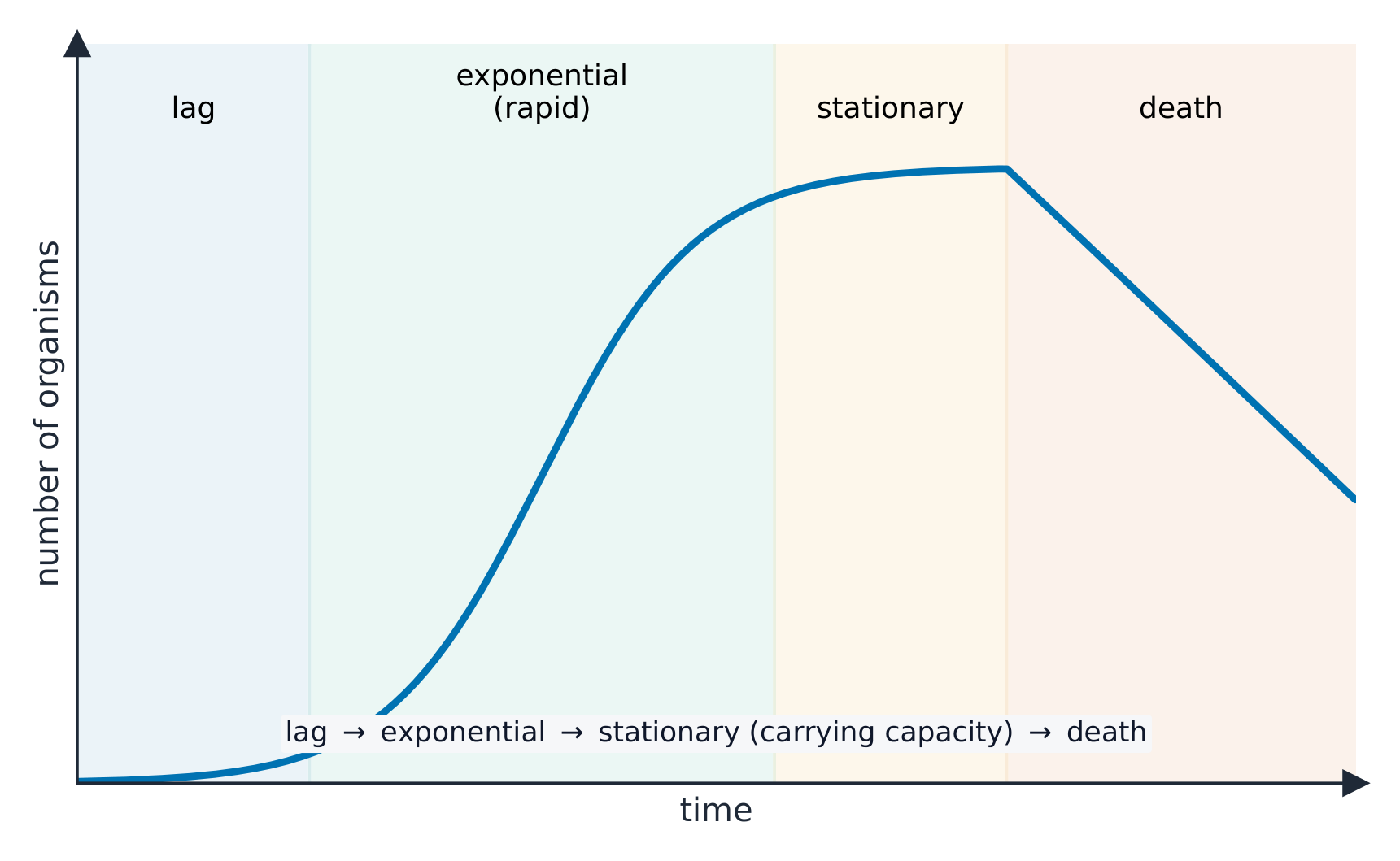
A population in a limited space grows in four phases: lag, exponential, stationary, death
A population increases through:
Difficulty 1/5 · 100 coins + a small bonus on first completion today
Births and immigration add to a population.
What changes a population
- A population rises with births and immigration; it falls with deaths and emigration.
- Predators, disease and competition keep most populations near their carrying capacity.
Populations don't grow forever. The exponential phase can't last — food and space run out, and limiting factors bring the population to a plateau at the carrying capacity.
You've got it
- a population grows: lag → rapid (exponential) growth → plateau at the carrying capacity
- limiting factors (food, space, predators, disease) slow growth
- populations rise with births/immigration, fall with deaths/emigration