Monohybrid crosses
Introduced| English | Meaning |
|---|---|
| Punnett square/ˈpʌnɪt skweə/ | A grid used to predict possible offspring genotypes from combinations of parental gametes. |
| monohybrid cross/ˈmɒnəʊhaɪbrɪd krɒs/ | A genetic cross used to study inheritance at one gene locus. |
| ratio/ˈreɪʃɪəʊ/ | A comparison of quantities expressed through division or the relative number of parts. |
Predicting the offspring
- If you know the parents' alleles, you can predict the likely characteristics of their children.
- A Punnett square 庞纳特方格 does exactly this for a monohybrid cross 单基因杂交 (one gene).
A parent with genotype Bb can make gametes carrying:
Difficulty 1/5 · 100 coins + a small bonus on first completion today
Each gamete gets one allele: B or b.
A capital letter is used for the dominant allele.
Difficulty 1/5 · 100 coins + a small bonus on first completion today
Capital = dominant; lowercase = recessive.
Setting up the cross
- Choose letters: a capital for the dominant allele (B), lowercase for recessive (b).
- Write each parent's two alleles, then list the gametes each can make.
Monohybrid crosses
Aa × Aa → 3 : 1
Cross two parents and read the offspring ratio from the Punnett square.
The grid used to predict offspring from a cross is a ______ square.
Difficulty 1/5 · 100 coins + a small bonus on first completion today
It combines the parents' gametes.
The Punnett square
- A Punnett square combines the parents' gametes to show all possible offspring.
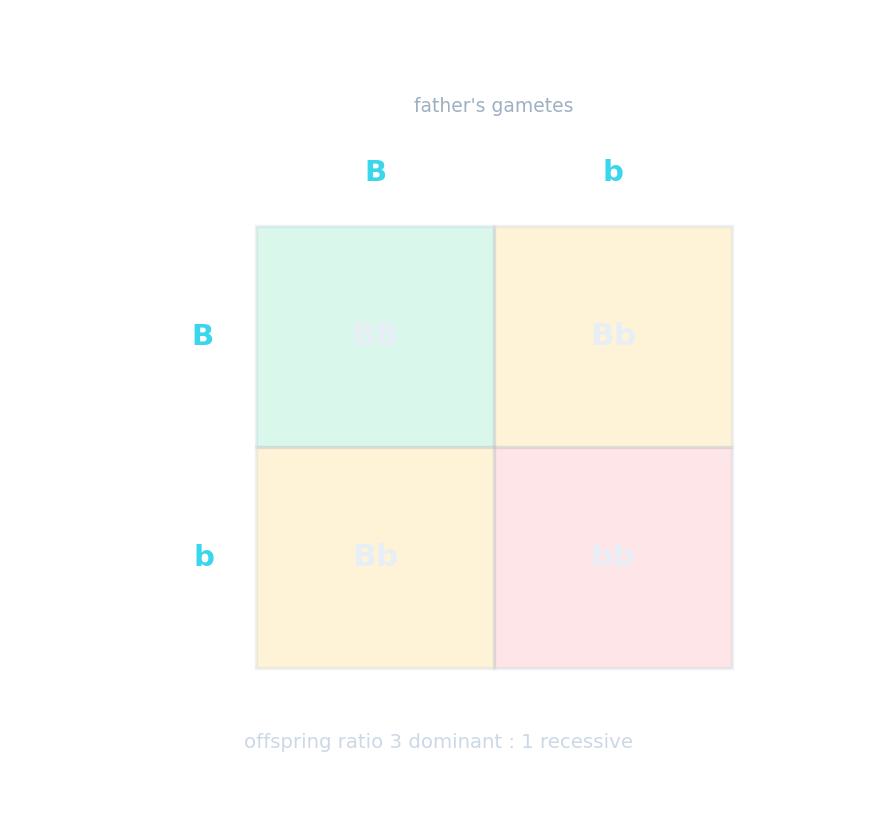
Crossing Bb × Bb gives a 3 : 1 ratio 比例 of dominant to recessive offspring.
A cross between two heterozygotes (Bb x Bb) gives a ratio of:
Difficulty 1/5 · 100 coins + a small bonus on first completion today
BB, Bb, Bb, bb → 3 dominant : 1 recessive.
In a Bb x Bb cross, out of 4 offspring, how many show the recessive trait?
Difficulty 2/5 · 140 coins + a small bonus on first completion today
Only bb (1 in 4) shows the recessive trait.
Reading the ratio
- Count the genotypes to find the ratio of offspring.
- A Bb × Bb cross gives 3 dominant : 1 recessive — a classic result.
Worked example. Bb × Bb. Gametes B and b from each parent give BB, Bb, Bb, bb. Three show the dominant trait, one shows the recessive — a 3 : 1 ratio.
You've got it
- a monohybrid cross follows one gene; capital = dominant, lowercase = recessive
- a Punnett square combines gametes to show all possible offspring
- Bb × Bb gives a 3 : 1 ratio of dominant to recessive