Breathing and gas exchange
Introduced| English | Meaning |
|---|---|
| ventilation/ˌventɪˈleɪʃn/ | The movement of air into and out of the lungs by breathing. |
| diaphragm/ˈdaɪəfræm/ | The sheet of muscle below the lungs whose contraction draws air in. |
| inhaled/ɪnˈheɪld/ | inhaled |
| exhaled/eksˈheɪld/ | exhaled |
Breathing in and out
- To keep the gradient steep at the alveoli, fresh air must be pumped in and stale air out.
- This is ventilation 通气 (breathing), powered by muscles.
When you breathe in, the diaphragm:
Difficulty 1/5 · 100 coins + a small bonus on first completion today
The diaphragm flattens to increase chest volume.
Air rushes into the lungs when the pressure inside the chest:
Difficulty 1/5 · 100 coins + a small bonus on first completion today
Lower internal pressure draws air in.
During inhaling, the rib muscles lift the ribs up and out.
Difficulty 1/5 · 100 coins + a small bonus on first completion today
This expands the chest, lowering pressure.
The movement of air in and out of the lungs is called ______ (breathing).
Difficulty 1/5 · 100 coins + a small bonus on first completion today
Ventilation keeps the gas-exchange gradient steep.
Breathing in (inhaling)
- The diaphragm 膈肌 flattens and the rib muscles lift the ribs up and out.
- This increases the chest volume, lowering the pressure, so air rushes in.
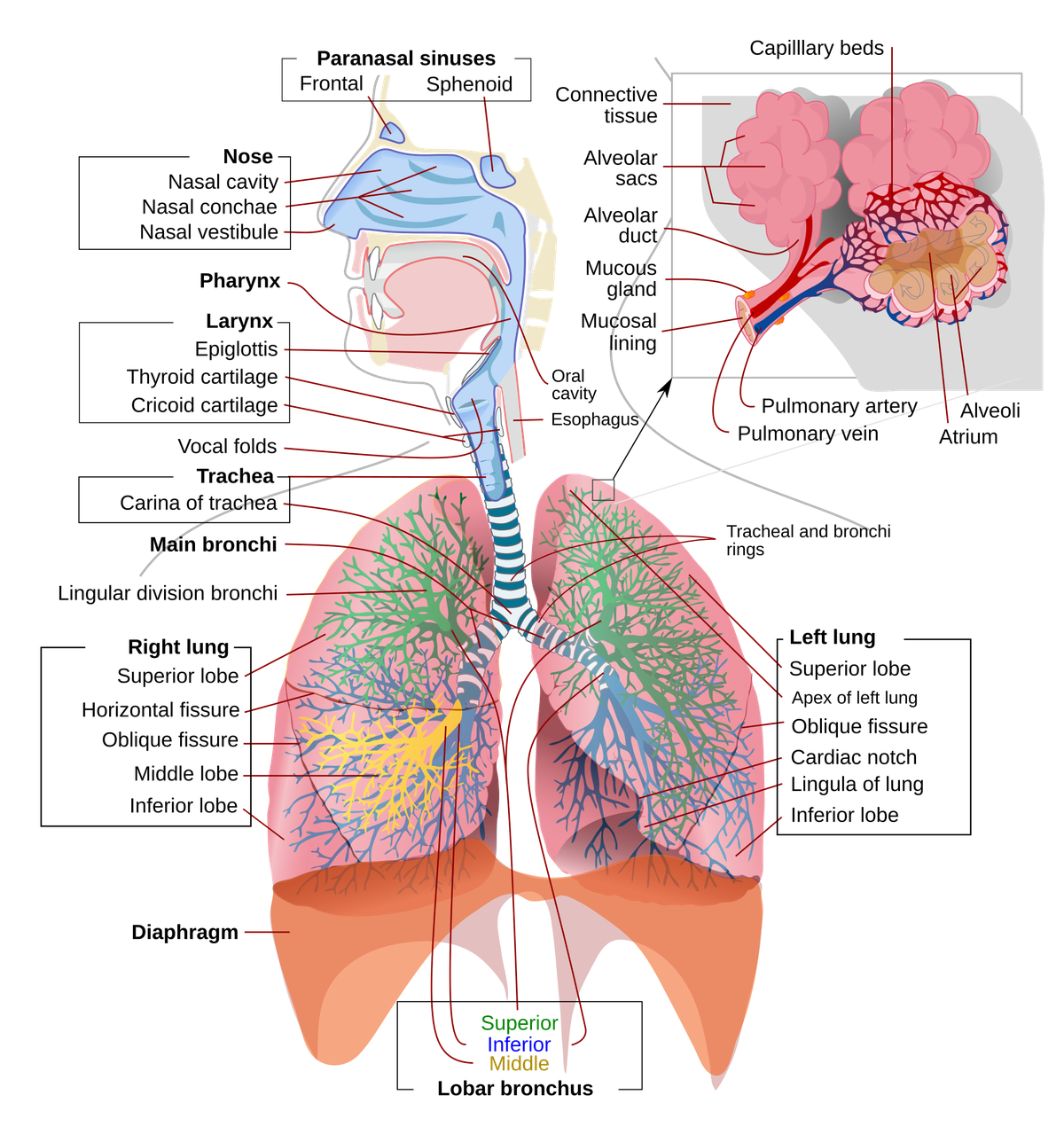
The lungs are the gas-exchange organs of the body
Breathing in and out
Breathing changes the volume of the chest, which changes the pressure and makes air flow in or out.
Compared with inhaled air, exhaled air has:
Difficulty 1/5 · 100 coins + a small bonus on first completion today
Oxygen is used and carbon dioxide added.
Breathing out (exhaling)
- The diaphragm relaxes (domes up) and the ribs drop.
- Chest volume decreases, pressure rises, and air is pushed out.

Air travels from the trachea through the bronchi and bronchioles to the alveoli
Breathing mechanism
Watch a breath — the diaphragm flattens and ribs lift, the chest grows, the pressure drops, and air flows in. Relax and it pushes back out.
Inhaled 吸入的 vs exhaled 呼出的 air
- Inhaled air has more oxygen and less carbon dioxide.
- Exhaled air has less oxygen, more carbon dioxide, and more water vapour.
Worked example. When you breathe in, the diaphragm contracts and flattens, the chest expands, pressure inside falls below the outside, and air flows in — exactly like pulling out a syringe plunger draws air in.

Breathing in makes the thorax bigger; breathing out makes it smaller
You've got it
- inhaling: diaphragm flattens, ribs rise → chest volume up, pressure down → air in
- exhaling: diaphragm relaxes, ribs drop → chest volume down, pressure up → air out
- exhaled air has less oxygen and more carbon dioxide than inhaled air