Knowledge and the knower: what would change your judgement?
Introduced| English | Meaning |
|---|---|
| perspective/pəˈspektɪv/ | A particular viewpoint from which an issue or experience is understood. |
| value/ˈvæljuː/ | A belief or standard concerning what is important, desirable or worthwhile, which can influence judgments and choices. |
| blind spot/blaɪnd spɒt/ | A relevant part of a question that the current viewpoint misses. |
Two students describe the same library
- One student calls the library quiet after morning visits. Another calls it noisy after afternoon group work. Their experiences can both be accurate while supporting different claims.
- A perspective 视角 reflects a knower’s position, experiences and assumptions. Identify the settings of the observations before treating disagreement as a contradiction.
State the question and the criterion
- Quiet at 09:00 differs from quiet throughout the day. A good library for silent study may also differ from a good library for collaboration. State the claim you are evaluating.
- A value 价值取向 affects what people judge worth pursuing. Preferring silence can guide a decision without establishing that every observed sound level is low.
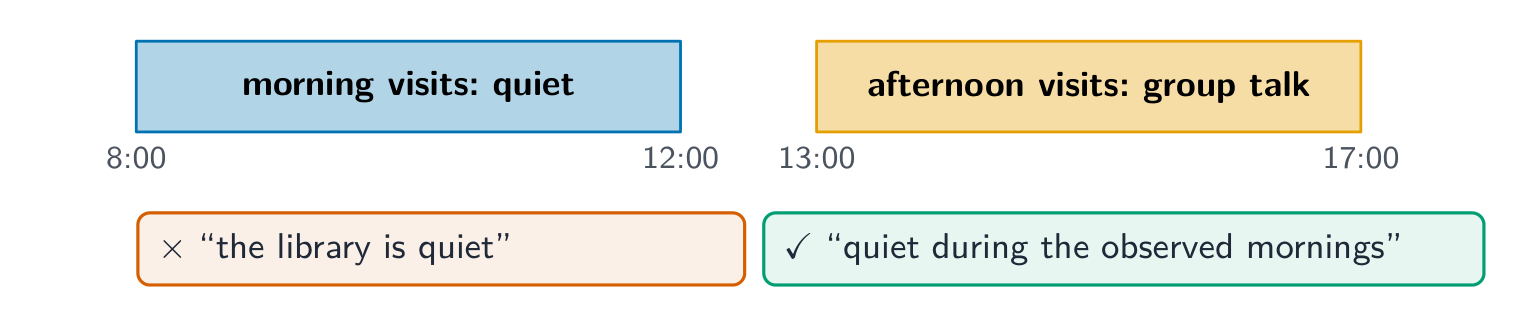
Why can both initial reports be accurate?
Difficulty 1/5 · 100 coins + a small bonus on first completion today
The morning and afternoon settings differ.
Preferring a silent library proves that observed sound levels are low.
Difficulty 1/5 · 100 coins + a small bonus on first completion today
A value judgement about purpose is not a measurement of current conditions.
Identify a blind spot in the evidence
- Morning visitors may not observe afternoon use; regular users may not know which barriers keep others away. A blind spot 认知盲点 is a relevant part of a question that the current viewpoint misses.
- Compare observations across the periods or groups that the claim covers. Including another perspective helps when it supplies relevant missing evidence, not merely because it adds another opinion.
Which evidence addresses the morning visitor’s blind spot?
Difficulty 1/5 · 100 coins + a small bonus on first completion today
The whole-day claim requires evidence from the period not observed.
Name what would revise the claim
- A student claiming silence all day should be ready to revise that claim after reliable afternoon observations. Specify a relevant check before seeing whether it supports your preference.
- Disagreement can reveal a difference in evidence, meaning or values. Decide which kind matters here instead of assuming every disagreement is solved by collecting more numbers.
Which revision fits the morning evidence?
Difficulty 1/5 · 100 coins + a small bonus on first completion today
The revised claim retains the supported finding and narrows its scope.
Reflect on responsibility as a knower
- Ask how your position affects what you notice and trust. Explain the initial judgement, the evidence it lacked and the revision supported by another setting.
- Being open to revision does not mean accepting every claim. Use clear criteria and relevant checks, acknowledge uncertainty and explain why some reasons deserve more weight.
Match each difference to its role.
Difficulty 2/5 · 140 coins + a small bonus on first completion today
Clarify the kind of disagreement before choosing a check.
Which moves show reasoned openness to revision?
Difficulty 2/5 · 140 coins + a small bonus on first completion today
Revision follows reasons and evidence, not automatic agreement.
The morning student reports quiet visits and initially generalizes to the whole day. The afternoon student supplies dated observations of group discussion. The first student revises the claim to quiet during the observed mornings. They then separate a factual question about use across times from a value question about balancing silence and collaboration. Their disagreement becomes clearer without pretending that one purpose must matter equally to every student.
Adding both sides is not sufficient reflection. Explain how the second perspective changes the claim, its meaning or the evidence required.
Locate your perspective, distinguish evidence from values, identify what is missing and state which relevant check would justify revision.
Write from two visits
- Morning visits find the library quiet. Afternoon group work finds it noisy.
- Both can be accurate. Name the missing check before revising a claim that the library is always quiet.
One student finds the library quiet in the morning. Another finds it noisy during afternoon group work. How can both be accurate, and what check would revise a claim that it is always quiet?
Perspective includes when and where the knower looked. A missing setting is a reason to limit the claim.
Which conclusion fits the two visits?
Difficulty 1/5 · 100 coins + a small bonus on first completion today
The visits cover different times. The first visit does not erase the afternoon.