Knowledge and language: what changed in the translation?
Introduced| English | Meaning |
|---|---|
| translation/trænˈsleɪʃn/ | Expressing the meaning of a message or text in another language. |
| category/ˈkætɪɡəri/ | A class used to sort things. |
| modality/məʊˈdælɪti/ | How strongly a statement is offered, from possible to certain. |
A small word changes the message
- An original school notice says students may use the library after class. A translated version says students must use it. The place and time are the same, but the instruction has changed.
- A translation 翻译 should preserve the relevant meaning, including whether an action is permitted, required or uncertain. Similar topic words do not guarantee an equivalent claim.
Compare the exact wording and setting
- Check the source sentence, intended readers and purpose. In this notice, may expresses permission; must expresses a requirement. The surrounding rules help confirm that use.
- Do not assume one word has the same role in every sentence. In another setting, may can express a possibility; context determines which meaning is being conveyed.
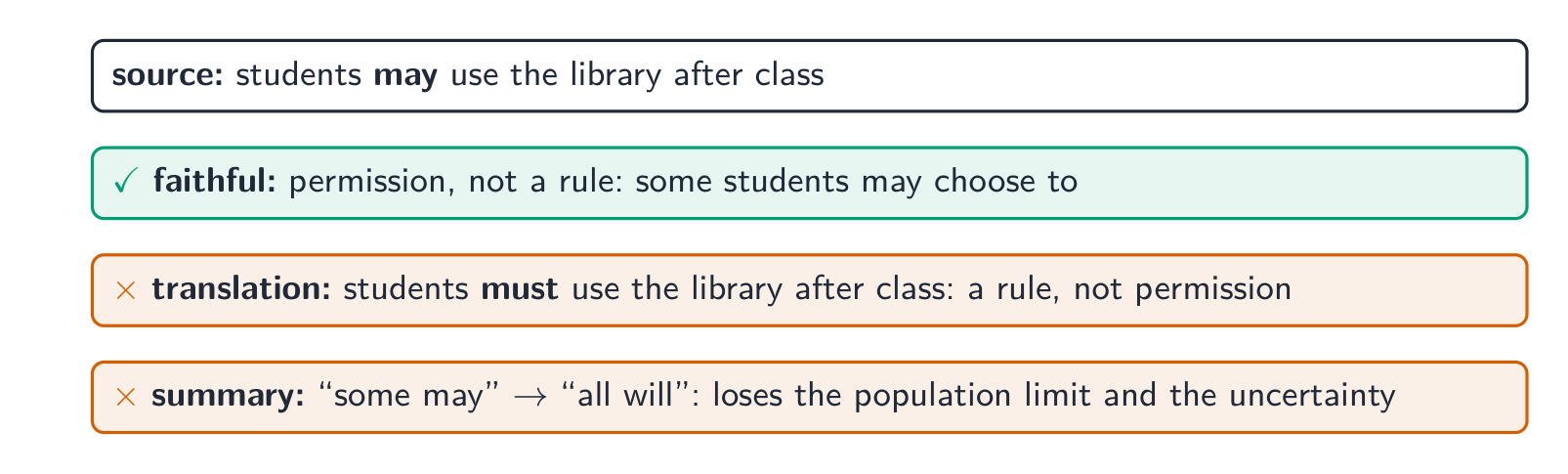
What changed from may use to must use in the notice?
Difficulty 1/5 · 100 coins + a small bonus on first completion today
The translated obligation is stronger than the original permission.
The word may can express possibility as well as permission, depending on context.
Difficulty 1/5 · 100 coins + a small bonus on first completion today
True. “It may rain” is about possibility, “You may leave” about permission; the sentence and setting decide.
Notice what a label leaves out
- Calling a source reliable compresses several judgements: its method, evidence, context and relevance. State which property the label is meant to describe before using it as a reason.
- A category 范畴 groups things under a label. Categories can make comparison useful, but a broad label can hide differences that matter to the current question.
Why should reliable be explained before it supports a judgement?
Difficulty 1/5 · 100 coins + a small bonus on first completion today
Identify which relevant property the judgement actually depends on.
Preserve the strength of the claim
- A report saying a change may help does not say it will help. Modality 情态 expresses possibility, permission, necessity or other strength in a statement. Check it when comparing versions.
- Qualifiers such as some, under these conditions and according to this source can carry important limits. Removing them can make a cautious claim appear universal.
Which change makes the report stronger than its original evidence claim?
Difficulty 1/5 · 100 coins + a small bonus on first completion today
Both the population limit and uncertainty have been removed.
Use language to make reasoning inspectable
- Ask how wording affects what readers believe they know. Show the original claim, the changed wording and the inference each version invites.
- Clarify the meaning and return to the evidence. Clear language helps a claim be checked, but a clear sentence alone does not establish that the claim is true.
Match each wording check to its role.
Difficulty 2/5 · 140 coins + a small bonus on first completion today
These wording choices affect what the sentence asks readers to accept.
Which actions improve a translation of an evidence claim?
Difficulty 2/5 · 140 coins + a small bonus on first completion today
Preserve the meaning and strength supported by the source.
The source notice permits after-class library use. The translation requires it. A reader following the translation could infer a school obligation that the original does not establish. The correction restores permission and checks the surrounding conditions. Similarly, changing some students may benefit to all students will benefit removes both a population limit and uncertainty. The issue is the strength of the resulting knowledge claim, not merely whether the vocabulary sounds fluent.
Do not replace a qualification with a stronger word because the stronger sentence sounds smoother. Preserve the claim’s limits.
Compare wording in context, preserve modality and qualifiers, and explain how a language choice changes the inference.
Write from may and must
- The notice says students may use the library after class. A translation says they must.
- The place and time match. The strength of the instruction does not.
A notice says students may use the library after class. A translation says they must. What changed, and what stayed?
Modality carries permission, necessity or possibility. Similar topic words do not preserve it.
What did the translation change?
Difficulty 1/5 · 100 coins + a small bonus on first completion today
The place and time match. The strength of the instruction does not. Other options — The library and the time (which the translation moved); Nothing (because both sentences are about the library).