Hydration: interpret balance without forcing dehydration
Introduced| English | Meaning |
|---|---|
| water balance/ˈwɔːtə ˈbæləns/ | The match between fluid taken in and fluid lost. |
| sweat rate/swet reɪt/ | The amount of sweat produced per unit time. |
| absorption/əbˈsɔːpʃn/ | Movement of digested nutrients across the intestinal lining into the body. |
| digestion/daɪˈdʒestʃn/ | The breakdown of large, insoluble food molecules into smaller, soluble molecules that can be absorbed. |
What would explain this observation?
- Body mass can change during activity, but the change is not a direct measurement of sweat alone. Drinking, urine, clothing and scale uncertainty affect the estimate.
Build the model
- Water balance 水平衡 compares inputs and outputs.
- During exercise, heat production can increase sweating, while thirst and hormonal regulation contribute to fluid balance.
- Hydration needs vary with activity, environment and the person; a classroom calculation cannot prescribe a universal intake or diagnose a health condition.
- water balance: Relationship between water inputs, outputs and storage.
- sweat rate 出汗率: Sweat volume lost per unit time under stated conditions.

Which quantity is required in addition to before/after mass in this model?
Difficulty 1/5 · 100 coins + a small bonus on first completion today
Mass change alone confounds sweat with drinking and urination. Recording fluid intake and urine output as well lets the balance separate sweat loss; a forced no-drinking period would be unsafe and is not required.
Match each technical term to its precise meaning.
Difficulty 2/5 · 140 coins + a small bonus on first completion today
Use the definitions to distinguish related quantities and processes.
Choose evidence that can test it
- For a simplified field estimate, sweat loss in kilograms is approximately pre-activity mass minus post-activity mass plus drink mass minus urine mass.
- Express the estimate per hour only after recording duration.
- This approximation omits some respiratory and metabolic mass changes and assumes comparable dry clothing and a suitable balance.
In the lab: Analyse fictional or consented teacher-approved low-risk data. Record balance resolution, time, intake and whether clothing conditions match. Students need not exercise or disclose personal body mass. Never restrict drinking or induce dehydration to create a result. Compare uncertainties and alternative explanations before interpreting a difference.
Which two habits make the investigation or model in this case more defensible?
Difficulty 2/5 · 140 coins + a small bonus on first completion today
Stating the conditions and assumptions lets others repeat the work exactly, and recording the supporting evidence lets them check the conclusion. Hiding disagreeing results removes the evidence that could challenge a wrong conclusion, and one measurement can never establish a wider claim.
Work from known quantities
- Known: fictional mass is 60.0 kg before and 59.6 kg after one hour; drink intake is 0.50 kg and urine output 0.10 kg.
- Estimated sweat loss = 60.0−59.6+0.50−0.10 = 0.80 kg, approximately 0.80 L using 1 kg/L.
- The 0.40 kg body-mass decrease alone would underestimate this modelled loss.
Your turn: Fictional mass changes from 70.0 to 69.7 kg, with 0.40 kg drink and 0.10 kg urine in one hour. Estimate sweat loss.
Fictional mass changes from 70.0 to 69.7 kg, with 0.40 kg drink and 0.10 kg urine in one hour. Estimate sweat loss.
Difficulty 2/5 · 140 coins + a small bonus on first completion today
The result is 0.6 kg. Known: mass 70.0 to 69.7 kg; drink 0.40 kg; urine 0.10 kg in one hour. Sweat estimate = mass loss + intake - urine = (70.0 - 69.7) + 0.40 - 0.10 = 0.60 kg, about 0.60 L at 1 kg per litre. The mass drop alone (0.30 kg) would underestimate it.
Check the conclusion and its limits
- A change in mass is not necessarily a change in body fat.
- A modelled sweat estimate does not justify fluid restriction, diagnosis, or a one-size-fits-all sports recommendation.
Not true: Body-mass change during an activity directly measures sweat loss without other information. Mass change during exercise mixes sweat loss with fluid intake, urine and even substrate use. Only the full balance - mass change plus recorded intake and output - estimates sweat loss.
- Water balance compares inputs and outputs.
- For a simplified field estimate, sweat loss in kilograms is approximately pre-activity mass minus post-activity mass plus drink mass minus urine mass.
- Watch for: A change in mass is not necessarily a change in body fat.
Body-mass change during an activity directly measures sweat loss without other information.
Difficulty 1/5 · 100 coins + a small bonus on first completion today
Mass change during exercise mixes sweat loss with fluid intake, urine and even substrate use. Only the full balance - mass change plus recorded intake and output - estimates sweat loss.
Relationship between water inputs, outputs and storage: write the technical term.
Difficulty 1/5 · 100 coins + a small bonus on first completion today
water balance means Relationship between water inputs, outputs and storage.
Write from a sweat loss of 0.70 kg
- Fictional mass changes from 55.0 kg to 54.5 kg. Drink intake is 0.40 kg and urine output is 0.20 kg.
- Estimate sweat loss. The mass change alone is not the sweat loss.
Fictional mass changes from 55.0 kg to 54.5 kg, with 0.40 kg drink and 0.20 kg urine. What is the estimated sweat loss, and why is the mass change not enough?
Sweat loss uses the full balance. Mass change, drink and urine are all required.
Fictional mass falls from 55.0 to 54.5 kg, with 0.40 kg drink intake and 0.20 kg urine output. What is the estimated sweat loss?
Difficulty 1/5 · 100 coins + a small bonus on first completion today
0.50 plus 0.40 minus 0.20 is 0.70 kg. The mass change leaves out the drink and the urine. Other options — 0.50 kg (the mass change alone); 0.40 kg (the drink intake).
Account for inputs, outputs and storage
- Water enters through food and drinks and is also produced in metabolism. Outputs include urine, sweat, respiratory loss and water in faeces. A change in stored water depends on their balance.
- Net change = inputs − outputs for a defined boundary and interval. State which terms were measured and which were omitted; a balance is not a measurement of one output alone.
Does a net mass decrease alone specify the sweat output?
Difficulty 1/5 · 100 coins + a small bonus on first completion today
A net change combines several flows.
Locate absorption 吸收 rather than naming only the colon
- The small intestine absorbs water and nutrients; the large intestine absorbs further water and electrolytes. Water and ions do not first need digestion 消化 like a starch molecule.
- Digestion breaks molecules down; absorption transfers material across an epithelial surface. The gut and kidney play different roles in the body’s water balance.
Is the large intestine the only place water enters the body?
Difficulty 1/5 · 100 coins + a small bonus on first completion today
Distinguish the regions and processes rather than assigning all water absorption to one site.
Separate total solute from concentration
- Concentration relates an amount of solute to the relevant volume. Losing water and solute together can still increase concentration if water falls proportionately more.
- In an invented compartment, 100 solute units in 10 water units gives 10. Losing 10 solute and 2 water units gives 90/8 = 11.25, a 12.5% concentration increase.
Can concentration rise while total solute falls?
Difficulty 1/5 · 100 coins + a small bonus on first completion today
Track both numerator and denominator.
Recalculate the final concentration
- A second invented model starts with 120 solute units in 12 water units. After losses of 12 solute and 3 water units, the final quantities are 108 and 9.
- Initial concentration = 120/12 = 10; final concentration = 108/9 = 12 solute units per water unit. Percentage increase = (12−10)/10 × 100 = 20%. This simple compartment omits real body compartments, excretion and feedback and is not a clinical sodium calculation.
A model starts with 120 solute units in 12 water units, then loses 12 solute units and 3 water units. What is the final concentration?
Difficulty 1/5 · 100 coins + a small bonus on first completion today
Remaining solute = 120 − 12 = 108 units; remaining water = 12 − 3 = 9 units. Final concentration = 108/9 = 12 solute units per water unit. Both amounts fall, but not in the same proportion.
Find final model concentration after 120 solute units in 12 water units lose 12 solute units and 3 water units.
Difficulty 2/5 · 140 coins + a small bonus on first completion today
Remaining solute = 120 − 12 = 108 units. Remaining water = 12 − 3 = 9 units. Concentration = solute/water = 108/9 = 12 solute units per water unit.
Trace the ADH feedback direction
- Increased plasma osmotic concentration can stimulate hypothalamic signals and ADH release from the posterior pituitary. ADH is made in hypothalamic neurons.
- Renal water reabsorption increases, reducing urine water loss and tending to oppose the disturbance. Other signals, including blood volume and thirst, also contribute.
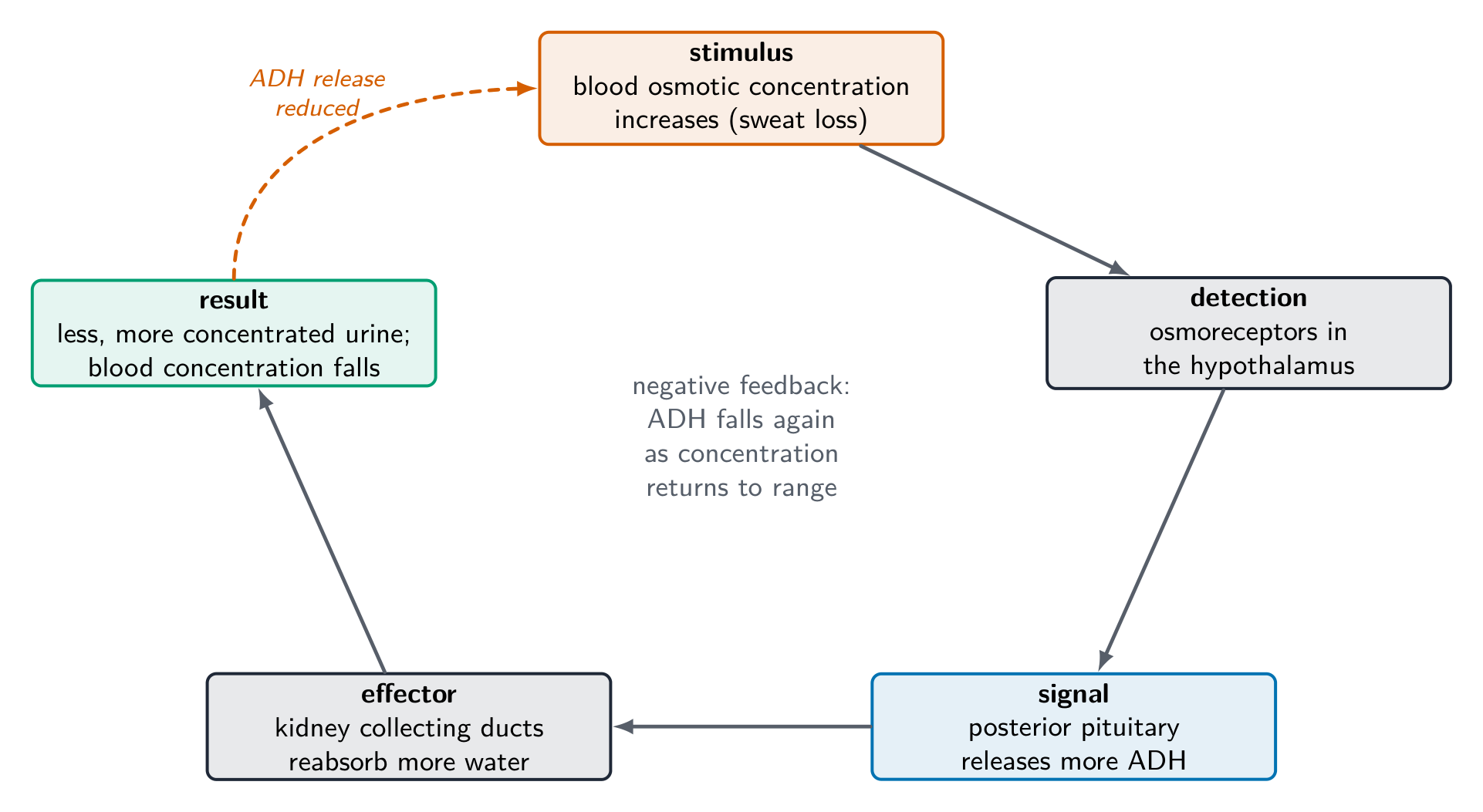
How does increased water reabsorption affect urine water loss?
Difficulty 1/5 · 100 coins + a small bonus on first completion today
Reabsorption returns filtered water rather than manufacturing new water.
Do not equate three different fluid problems
- Dehydration concerns body-water loss. Hypernatraemia means abnormally high blood sodium concentration; hyponatraemia means abnormally low concentration.
- Water and solute accounting, kidney responses and clinical context matter. Neither a dark urine sample nor a worksheet mass calculation diagnoses blood sodium status.
Does the word dehydration directly report a blood sodium concentration?
Difficulty 1/5 · 100 coins + a small bonus on first completion today
State the measured condition and avoid treating related terms as synonyms.
Recognise that more intake is not automatically better
- Fluid needs and tolerance vary with the person, event, environment and losses. Excessive hypotonic intake relative to losses, together with impaired excretion, can contribute to exercise-associated hyponatraemia.
- A drink’s sports label does not guarantee protection from overconsumption. Evaluate supplied records; do not turn a classroom example into a universal intake rule or a personal treatment decision.
Does a sports-drink label remove every risk from excessive intake?
Difficulty 1/5 · 100 coins + a small bonus on first completion today
The fluid balance and physiological context matter more than a marketing category.
Use body mass as a defined indicator
- Consistent before-and-after mass can estimate net change over a short interval. Use a suitable balance and comparable dry clothing and record relevant intake and output.
- Wet clothing, retained food, respiratory exchange, metabolic changes and balance error affect interpretation. A short-term fall is not proof of that amount of body-fat loss.
What could conceal some lost mass on the final weighing?
Difficulty 1/5 · 100 coins + a small bonus on first completion today
The weighing includes the stated person and clothing, not one isolated body component.
Interpret urine colour as limited evidence
- Colour is a simple observation, but pigments, supplements, medication, lighting and collection timing can affect it. Urine concentration can lag behind a changing exercise state.
- Specify the sample and context, compare appropriate measures and discuss limitations. One dark sample cannot establish a precise dehydration percentage or every aspect of fluid status.
What makes a urine-colour interpretation more defensible?
Difficulty 1/5 · 100 coins + a small bonus on first completion today
An indicator can inform a question without measuring every relevant variable.
Distinguish osmolarity and osmolality
- Osmolarity counts osmotically active particles per volume of solution; osmolality uses mass of solvent as the denominator. The sample and measurement method must be stated.
- A urine value is not automatically the same as a plasma value. Similar words and units do not erase differences in sampled compartment or physiological regulation.
Which denominator defines osmolality?
Difficulty 1/5 · 100 coins + a small bonus on first completion today
Name the denominator rather than relying on a general word such as concentration.
Explain the sweat-estimate signs
- Simplified sweat loss = pre-activity mass − post-activity mass + drink mass − urine mass, using compatible mass units.
- Add drink because it replaced some lost mass. Subtract urine because it explains another recorded output. The approximation omits some respiratory and metabolic exchanges.
Why is recorded urine subtracted?
Difficulty 1/5 · 100 coins + a small bonus on first completion today
The signs follow the defined mass balance.
Calculate the written-case loss before its rate
- Invented masses fall from 55.0 to 54.5 kg, with 0.40 kg drink and 0.20 kg urine. Estimated sweat loss is 0.50 + 0.40 − 0.20 = 0.70 kg.
- The 0.50 kg net mass decrease and the 0.70 kg sweat estimate answer different questions. The calculation does not establish exact body-water status or a personal replacement prescription.
Mass falls from 55.0 to 54.5 kg, with 0.40 kg drink intake and 0.20 kg urine output. What is the estimated sweat loss?
Difficulty 1/5 · 100 coins + a small bonus on first completion today
Sweat estimate = initial mass − final mass + drink − urine = 55.0 − 54.5 + 0.40 − 0.20 = 0.70 kg. Net mass change alone gives only 0.50 kg.
Record time before calculating a rate
- If that 0.70 kg loss occurs over 45 minutes, the interval is 45/60 = 0.75 h. Rate = 0.70/0.75 ≈ 0.93 kg/h.
- A different duration changes the rate without changing the amount lost. A kilogram of water is approximately a litre for this estimate; this is not an identity for every liquid.
What interval in hours corresponds to 45 minutes?
Difficulty 1/5 · 100 coins + a small bonus on first completion today
Convert minutes by dividing by 60, not by treating them as decimal hundredths.
Find kg/h for a modelled loss of 0.70 kg over 45 minutes.
Difficulty 2/5 · 140 coins + a small bonus on first completion today
45/60=0.75 h; 0.70/0.75=0.9333... kg/h.
Choose the correct denominator for percentage change
- In the invented 55.0 to 54.5 kg case, percentage body-mass fall = 0.50/55.0 × 100 ≈ 0.91%. Use the initial mass for this stated percentage change.
- The sweat estimate divided by initial mass would be a different ratio. Neither ratio alone diagnoses hydration, electrolyte status or fat change.
Mass falls from 55.0 to 54.5 kg; the sweat estimate including drink and urine is 0.70 kg. Which numerator gives percentage body-mass fall relative to the initial mass?
Difficulty 1/5 · 100 coins + a small bonus on first completion today
Net mass decrease = 55.0 − 54.5 = 0.50 kg. Percentage body-mass fall = 0.50/55.0 × 100 ≈ 0.91%. The 0.70 kg sweat estimate describes a different quantity.
Keep amount and rate distinct in a second scenario
- The original lesson’s 60.0 to 59.6 kg, 0.50 kg drink and 0.10 kg urine case gives 0.80 kg estimated sweat. Over its stated one hour this is 0.80 kg/h.
- If a separate scenario has the same amounts over 1.5 hours, its rate is 0.80/1.5 ≈ 0.53 kg/h. Never assume every dataset lasts an hour.
Can identical loss amounts imply different rates?
Difficulty 1/5 · 100 coins + a small bonus on first completion today
A rate divides an amount by an interval.
Use uncertainty to qualify the estimate
- Balance resolution and recording error affect each term of the sweat estimate. Comparable clothing and a consistent protocol reduce some avoidable variation.
- If several independently uncertain quantities enter a calculation, describe the chosen uncertainty convention. A tiny difference between estimated rates may not justify a strong physiological claim.
What should be considered before interpreting a small rate difference?
Difficulty 1/5 · 100 coins + a small bonus on first completion today
A numerical order is not automatically a meaningful physiological distinction.
Explain cardiovascular drift as a pattern
- During prolonged steady submaximal work, heart rate may gradually rise while stroke volume falls. Heat stress and fluid loss can contribute through skin circulation demand, plasma volume and filling.
- Drift can occur in thermoneutral conditions too. A higher heart rate at the same external workload does not automatically mean the person is doing more mechanical work.
Does a later higher heart rate necessarily mean higher external workload?
Difficulty 1/5 · 100 coins + a small bonus on first completion today
Distinguish a physiological response from the task’s external demand.
Check the product rather than heart rate alone
- Invented early values 110 beats/min × 100 mL/beat give 11.0 L/min. Later 125 × 88 also give 11.0 L/min.
- The illustrated compensation keeps the product constant in this model. Real output may be maintained or fall; heart-rate rise alone does not determine it or diagnose hydration.
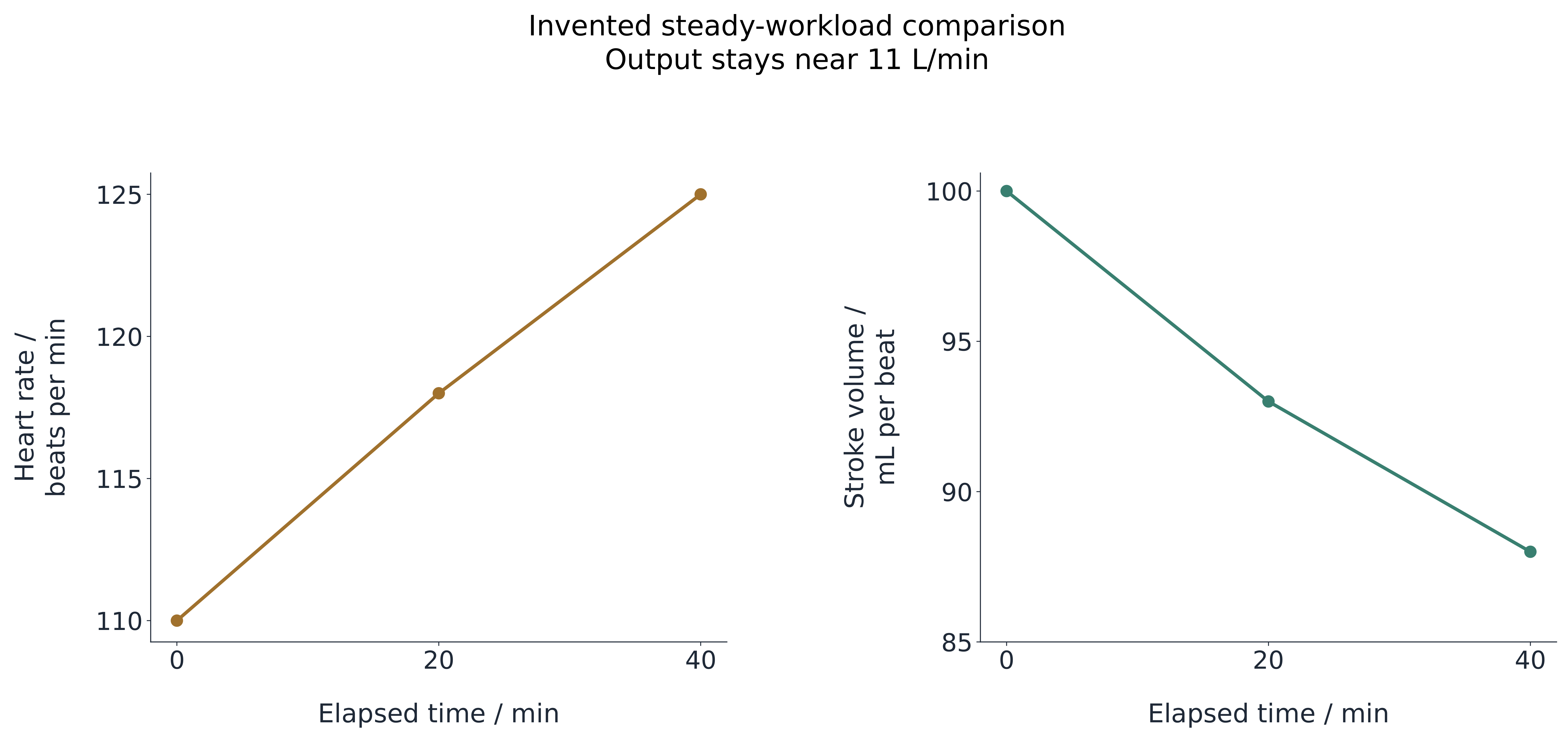
What is the later output for 125 beats/min and 88 mL/beat?
Difficulty 1/5 · 100 coins + a small bonus on first completion today
125×88=11 000 mL/min; use both factors.
Find cardiac output in L/min for 125 beats/min and 88 mL/beat.
Difficulty 2/5 · 140 coins + a small bonus on first completion today
125×88/1000=11.0 L/min.
Test drift with another pair of values
- Invented steady-work values change from 120 beats/min and 90 mL/beat to 135 and 80. Both products are 10 800 mL/min = 10.8 L/min.
- Record timing and stroke-volume evidence rather than assuming that every rising pulse is compensated exactly. Matched workload alone does not control all thermal and fluid conditions.
Does this example prove exact compensation in every person?
Difficulty 1/5 · 100 coins + a small bonus on first completion today
A model example explains a mechanism without establishing its universal magnitude.
Separate sweating from evaporative cooling
- High humidity can limit evaporation even while sweat secretion continues. Airflow, clothing, temperature gradients and acclimatisation also affect the heat balance.
- Visible sweat or net body-mass change alone does not measure heat successfully removed. Compare conditions before explaining why two records differ.
What is the key cooling process for the latent heat effect?
Difficulty 1/5 · 100 coins + a small bonus on first completion today
Production and successful transfer of heat are different processes.
Design a comparison without inducing dehydration
- Use invented, published or voluntary teacher-approved low-risk records. State workload, environment, timing, intake/output recording, clothing and measurement resolution.
- Students need not exercise or disclose personal mass. Do not restrict drinking, induce dehydration or use the record to diagnose a peer; the task is to evaluate evidence and its limits.
Which design matches the classroom purpose?
Difficulty 1/5 · 100 coins + a small bonus on first completion today
The investigation can test reasoning without creating the physiological hazard.
Give a proportional conclusion
- State the estimate, units, duration and model assumptions, then distinguish it from the net mass change and from unmeasured clinical variables.
- A useful evaluation links a specific limitation to its effect and improvement: wet clothing can inflate final mass, so use comparable dry clothing or a documented correction.
Which evaluation is operational?
Difficulty 1/5 · 100 coins + a small bonus on first completion today
Connect the limitation, its consequence and a feasible improvement.