Magnetic forces: turn velocity without increasing speed
Introduced| English | Meaning |
|---|---|
| magnetic force/mæɡˈnetɪk fɔːs/ | Force due to a magnetic field on a moving charge or current. |
| momentum/məʊˈmentəm/ | The product of mass and velocity. |
What would explain this observation?
- A charged particle curves in a uniform magnetic field. Its direction changes although the magnetic force 磁力 alone does not increase its kinetic energy.
Build the model
- The magnetic force magnitude is F = |q|vB sinθ.
- It is perpendicular to velocity and magnetic field, with direction determined by charge sign.
- For perpendicular entry into a uniform field, it can provide the centripetal force for circular motion.
- magnetic force: Force due to a magnetic field on a moving charge or current.
- momentum 动量: Mass multiplied by velocity in the classical model.

What changes under a magnetic force alone in perpendicular circular motion?
Difficulty 1/5 · 100 coins + a small bonus on first completion today
A magnetic force acts perpendicular to the velocity, so it changes the velocity's DIRECTION only, producing circular motion. A perpendicular force does no work, so kinetic energy cannot increase, and the charge magnitude is intrinsic.
Match each technical term to its precise meaning.
Difficulty 2/5 · 140 coins + a small bonus on first completion today
Use the definitions to distinguish related quantities and processes.
Choose evidence that can test it
- Equate magnetic force with mv²/r to obtain r = mv/(|q|B) for perpendicular motion.
- A stronger field makes a smaller radius at fixed momentum.
- Parallel entry gives zero magnetic force in this model.
In the lab: Draw velocity, field and force as separate arrows using stated into/out-of-page conventions. Use supplied beam data or a simulation. Do not treat a current-carrying wire direction as identical to electron-motion direction.
Which two habits make the investigation or model in this case more defensible?
Difficulty 2/5 · 140 coins + a small bonus on first completion today
Stating the conditions and assumptions lets others repeat the work exactly, and recording the supporting evidence lets them check the conclusion. Hiding disagreeing results removes the evidence that could challenge a wrong conclusion, and one measurement can never establish a wider claim.
Work from known quantities
- Known: a particle has m = 2.0×10⁻²⁷ kg, v = 3.0×10⁶ m/s, |q| = 1.0×10⁻¹⁹ C and B = 0.20 T. r = mv/(|q|B) = 0.30 m.
- The calculation assumes non-relativistic motion and perpendicular entry.
Your turn: Use r = mv/(|q|B). For m=2×10⁻²⁷ kg, v=2×10⁶ m/s, |q|=1×10⁻¹⁹ C and B=0.20 T, find r.
Turn the velocity without increasing speed
The lesson’s particle has a 0.30 m radius in a 0.20 T field. Reverse charge or field direction, and compare field strength, curvature and constant kinetic energy on a fixed spatial scale.
Use r = mv/(|q|B). For m=2×10⁻²⁷ kg, v=2×10⁶ m/s, |q|=1×10⁻¹⁹ C and B=0.20 T, find r.
Difficulty 2/5 · 140 coins + a small bonus on first completion today
The result is 0.2 m. Known: m = 2x10^-27 kg; v = 2x10^6 m/s; |q| = 1x10^-19 C; B = 0.20 T, perpendicular entry. Use r = mv/(|q|B). r = (2x10^-27 x 2x10^6)/(1x10^-19 x 0.20) = 0.2 m. The path is a circle of this radius under the stated model.
Check the conclusion and its limits
- A magnetic force can change momentum direction without doing work.
- Adding an electric field can change the energy, so conclusions about a magnetic field alone do not cover every combined-field apparatus.
Not true: A magnetic force alone continuously increases the kinetic energy of a charged particle. A force perpendicular to the velocity does no work (work = force x distance ALONG the force), so a magnetic field alone cannot change a particle's kinetic energy - only its direction. Of the electric and magnetic forces considered here, only the electric force can supply work along the motion; other forces, such as gravity, can also transfer energy.
- The magnetic force magnitude is F = |q|vB sinθ.
- Equate magnetic force with mv²/r to obtain r = mv/(|q|B) for perpendicular motion.
- Watch for: A magnetic force can change momentum direction without doing work.
A force perpendicular to the velocity does no work (work = force x distance ALONG the force), so a magnetic field alone cannot change a particle's kinetic energy - only its direction.
Difficulty 1/5 · 100 coins + a small bonus on first completion today
True. A force perpendicular to the velocity does no work (work = force x distance ALONG the force), so a magnetic field alone cannot change a particle's kinetic energy - only its direction. Of the electric and magnetic forces considered here, only the electric force can supply work along the motion; other forces, such as gravity, can also transfer energy.
Force due to a magnetic field on a moving charge or current: write the technical term.
Difficulty 1/5 · 100 coins + a small bonus on first completion today
magnetic force means Force due to a magnetic field on a moving charge or current.
Write from the data: find the orbital radius
- Use r = mv divided by the product of charge magnitude and magnetic field.
- Take m = 2 times 10 to the minus 27 kg, v = 2 times 10 to the 6 metres per second, charge magnitude 1 times 10 to the minus 19 coulomb and B = 0.08 T. A magnetic force perpendicular to the velocity does no work.
A charged particle has mass 2 times 10 to the minus 27 kg, speed 2 times 10 to the 6 metres per second and charge magnitude 1 times 10 to the minus 19 coulomb, in a 0.08 T magnetic field perpendicular to its velocity. What is the radius of its path, and why does this force not increase the kinetic energy?
r = mv/(|q|B) = [(2 × 10⁻²⁷)(2 × 10⁶)]/[(1 × 10⁻¹⁹)(0.08)] = 0.50 m. Magnetic force is perpendicular to velocity, so its power F·v is zero and kinetic energy stays constant.
A particle of mass 2 × 10⁻²⁷ kg, speed 2 × 10⁶ m/s and charge magnitude 1 × 10⁻¹⁹ C moves perpendicular to a uniform 0.08 T magnetic field. With magnetic force alone, what is its circular-path radius?
Difficulty 1/5 · 100 coins + a small bonus on first completion today
Use r = mv/(|q|B). Momentum is (2 × 10⁻²⁷)(2 × 10⁶) = 4 × 10⁻²¹ kg m/s. The product |q|B is (1 × 10⁻¹⁹)(0.08), so r = (4 × 10⁻²¹)/[(1 × 10⁻¹⁹)(0.08)] = 0.50 m. The 0.20 m alternative belongs to the separate 0.20 T lesson case; 0.08 T is a field strength, not a radius.
Separate steering from energy transfer
- An auroral curtain glows because energetic particles, mainly electrons, excite atmospheric atoms and molecules. Their light is released as those particles return to lower energy states. Solar-wind energy enters Earth's magnetosphere; it is misleading to describe every auroral electron as travelling directly from the Sun to the atmosphere.
- NOAA's aurora explanation distinguishes electron acceleration from magnetic guidance. Our uniform-field model explains local steering; Earth's curved, changing fields and particle interactions need more physics. A magnetic force alone does no work on a particle. An electric field can transfer energy when its force has a component along the motion. Always name the force responsible for the energy change.
Which account distinguishes magnetic guidance from energy transfer in an aurora?
Difficulty 1/5 · 100 coins + a small bonus on first completion today
Solar-wind energy enters the magnetosphere. Energetic electrons collide with the upper atmosphere; a local uniform magnetic field explains steering rather than the entire acceleration process.
Accelerate with a stated voltage magnitude
- For an invented proton starting from rest, a 500 V accelerating potential difference gives a kinetic-energy gain $eV=8.0\times10^{-17}$ J, or 500 eV. In the classical model, $v=\sqrt{2eV/m}$; using $e=1.60\times10^{-19}$ C and proton mass $1.67\times10^{-27}$ kg gives $3.10\times10^5\ \dfrac{\mathrm m}{\mathrm s}$. An electron gains the same energy magnitude through the same accelerating voltage, but its smaller mass gives a greater speed.
- Here $V$ is a positive accelerating voltage magnitude, so write $\Delta K=|q|V$. Do not put a negative electron charge into a positive-energy magnitude equation. The force is $q\mathbf E$: a positive particle accelerates along the electric field, an electron against it. For signed potential change the general energy statement is $\Delta K=-q\Delta V$ when the electric force supplies the work. Check that a classical speed is well below light speed.
An invented proton starts from rest through a 500 V accelerating voltage. Use e = 1.60 × 10⁻¹⁹ C. Find its kinetic-energy gain.
Difficulty 2/5 · 140 coins + a small bonus on first completion today
ΔK = eV = 8.0 × 10⁻¹⁷ J = 500 eV. A negative charge accelerating in the opposite direction can gain the same energy magnitude.
Treat electric deflection as two motions
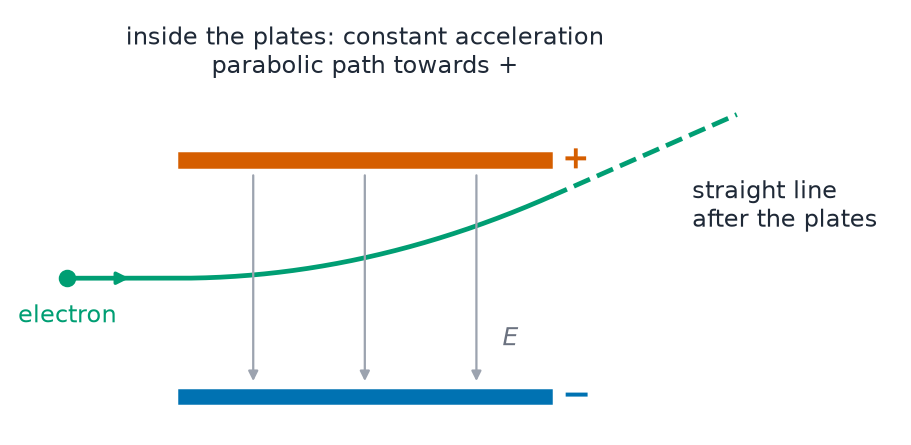
- Consider an invented electron beam entering horizontally between ideal broad plates. The upper plate is positive, so the electric field is downward and electron acceleration upward. The horizontal force is zero inside this ideal region; horizontal velocity remains $v_x$. The vertical force is constant, so $a_y=eE/m_e$ and $y=\tfrac12a_yt^2$ if initial vertical velocity is zero. Eliminating time gives a parabola, rather than a circular arc.
- The figure shows the ideal boundary between uniform field and field-free space; actual plate edges have fringe fields. Once outside with no other forces, the particle follows a straight tangent to its exit path. It does not suddenly return to its original horizontal line. An electric field line shows force direction for a positive charge, not the electron's trajectory. Starting with zero horizontal velocity instead would give straight acceleration, so a uniform electric field does not always produce a parabola.
Check whether the beam clears the plates
- With $E=2.0\times10^4\ \dfrac{\mathrm V}{\mathrm m}$, plate length .050 m and horizontal speed $2.0\times10^7\ \dfrac{\mathrm m}{\mathrm s}$, time in the ideal field is $L/v_x=2.50\times10^{-9}$ s. Taking $m_e=9.11\times10^{-31}$ kg gives $a_y=3.51\times10^{15}\ \dfrac{\mathrm m}{\mathrm{s^2}}$, exit deflection .01098 m and vertical velocity $8.78\times10^6\ \dfrac{\mathrm m}{\mathrm s}$. The invented beam clears a positive plate .015 m above its entrance line.
- Exit speed is the magnitude of both velocity components, about $2.18\times10^7\ \dfrac{\mathrm m}{\mathrm s}$, rather than simply $v_x$. The exit slope is $v_y/v_x\approx .439$, about 23.7° upward. Doubling plate length would multiply deflection by four under the model, but this particular beam would strike the plate first. Check geometry before extending a formula to a path the apparatus cannot allow.
For an invented beam with horizontal speed 2.0 × 10⁷ m/s across plates .050 m long, find time inside the ideal field in ns.
Difficulty 2/5 · 140 coins + a small bonus on first completion today
t = L/vₓ = 0.050/(2.0 × 10⁷) = 2.50 × 10⁻⁹ s = 2.50 ns. With no horizontal electric force the horizontal velocity is constant.
An invented electron has upward acceleration 3.5126 × 10¹⁵ m/s² for 2.50 ns, starting with zero vertical speed. Find upward deflection in mm.
Difficulty 2/5 · 140 coins + a small bonus on first completion today
Convert t = 2.50 ns = 2.50 × 10⁻⁹ s. Then y = at²/2 = (3.5126 × 10¹⁵)(2.50 × 10⁻⁹)²/2 = 0.010976875 m = 10.976875 mm ≈ 10.98 mm. If a plate is only 5 mm above the entrance line the particle strikes it before the exit.
Find magnetic force before drawing a path
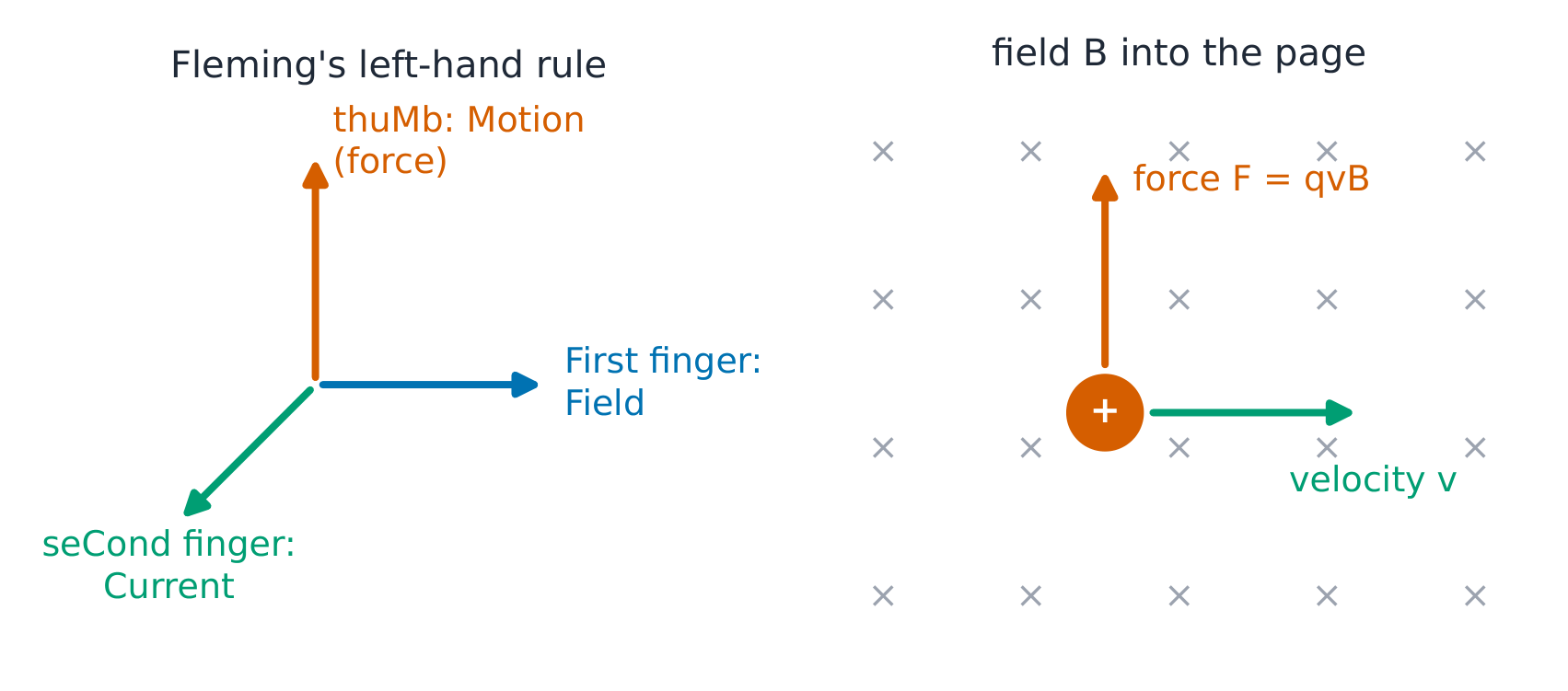
- Magnetic-force magnitude is $F=|q|vB\sin\theta$, with $\theta$ measured between velocity and magnetic field. A stationary particle, or one travelling exactly parallel or antiparallel to the field, has zero magnetic force. A proton at $3.0\times10^6\ \dfrac{\mathrm m}{\mathrm s}$ in .20 T feels $9.6\times10^{-14}$ N at 90° and half that at 30°. A negative charge has the same force magnitude as a positive charge of equal magnitude at the same velocity.
- For direction, apply Fleming's left-hand rule with conventional current along positive-charge velocity. Reverse the result for a negative charge, rather than reversing the field itself. In this figure a positive charge moving right with field into the page is forced upward; an electron moving right is forced downward. A dot represents motion or field out of the page, a cross into it. Write these conventions before using a two-dimensional drawing.
An electron moves right in a magnetic field into the page. What is its magnetic-force direction?
Difficulty 1/5 · 100 coins + a small bonus on first completion today
For a positive right-moving charge, v × B points up. Electron charge reverses the direction, giving downward force perpendicular to both velocity and field.
Derive a magnetic radius using magnitudes
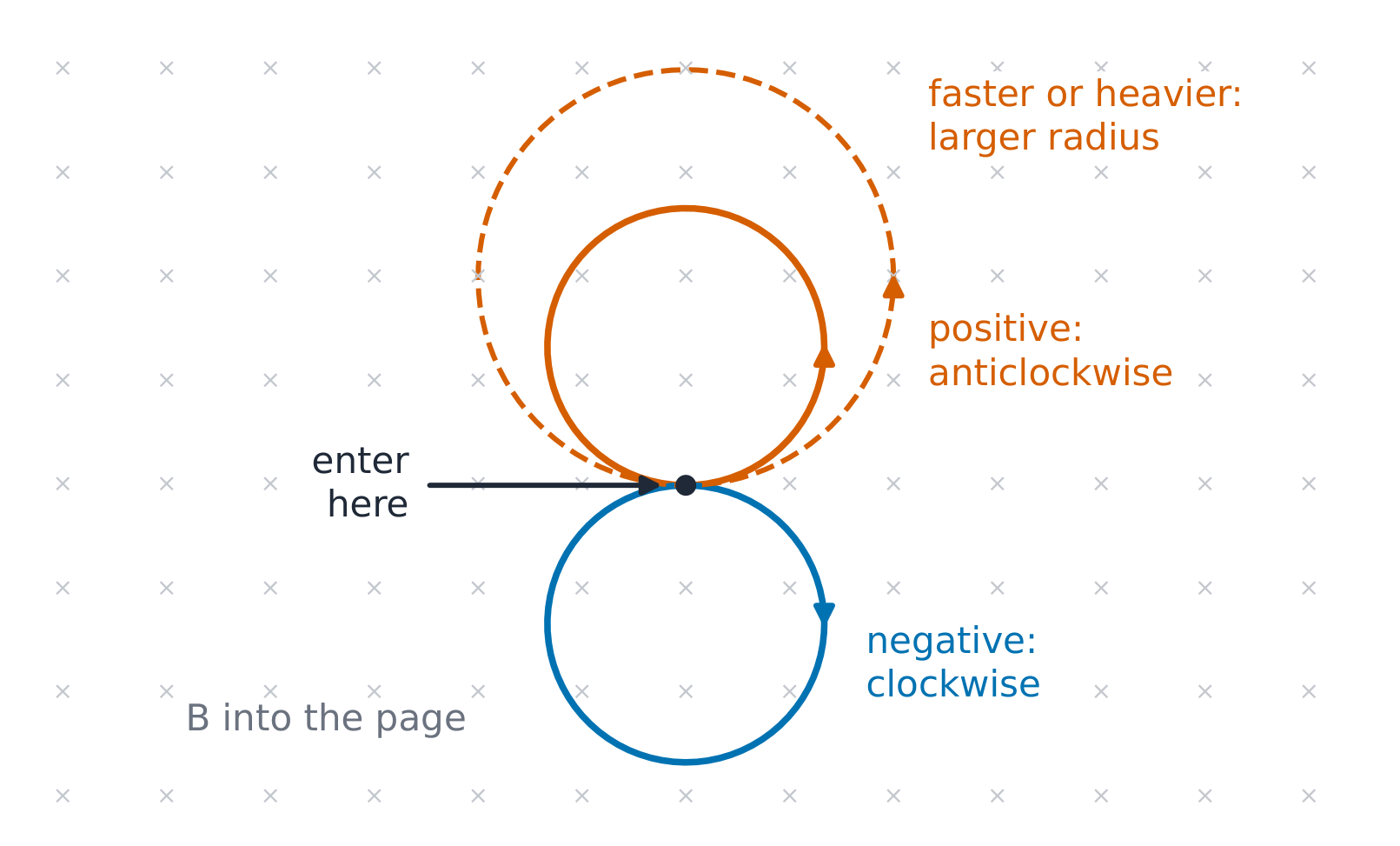
- For perpendicular entry into a uniform field, the magnetic force points towards the circle's centre. There is no extra outward balancing force on the particle: $|q|vB=mv^2/r$, hence $r=mv/(|q|B)$. The force changes velocity direction continuously while doing zero work. The circle centre lies along the instantaneous force direction, not necessarily at the source of the magnetic field.
- With proton mass $1.67\times10^{-27}$ kg, speed $3.0\times10^6\ \dfrac{\mathrm m}{\mathrm s}$ and .20 T, radius is .1566 m, about .16 m. Charge sign determines which way the path curves, while charge magnitude determines radius. At fixed mass, speed and field, reversing charge sign reflects the curvature without producing a negative radius. These statements describe the magnetic force alone; other forces or collisions can change the actual trajectory.
An invented proton enters .20 T perpendicularly at 3.0 × 10⁶ m/s. Use m = 1.67 × 10⁻²⁷ kg and e = 1.60 × 10⁻¹⁹ C. Find radius.
Difficulty 2/5 · 140 coins + a small bonus on first completion today
r = mv/(eB) = [(1.67 × 10⁻²⁷)(3.0 × 10⁶)]/[(1.60 × 10⁻¹⁹)(0.20)] = 0.1565625 m ≈ 0.16 m. Radius is positive; charge sign determines curvature direction.
Explain the period and its limits
- Divide circumference by speed: $T=2\pi r/v=2\pi m/(|q|B)$. For the previous proton, the classical period is $3.28\times10^{-7}$ s. Doubling speed doubles radius and circumference, so their ratio to speed is unchanged. Doubling field at fixed speed halves radius and period. This speed-independent period requires the non-relativistic model, a constant mass and a uniform field.
- Compare particles only after stating what is fixed. At equal speed in the same field, an alpha particle with four times a proton's mass and twice its charge magnitude has twice the radius. At equal kinetic energy, momentum is $\sqrt{2mK}$, so the alpha particle has twice the momentum but also twice the charge; its radius then equals the proton's. Mass alone cannot determine the curvature of a beam whose speeds or charge states differ.
An alpha particle has four proton masses and twice the charge magnitude. At equal kinetic energy, both enter the same field perpendicularly. How do their radii compare?
Difficulty 1/5 · 100 coins + a small bonus on first completion today
At equal K, p = √(2mK), so the alpha momentum is twice the proton momentum. Divide by twice the charge magnitude to obtain the same radius. Equal speed would give a different comparison.
Resolve a helical path into components
- If velocity makes an oblique angle to a uniform magnetic field, split it into $v_\parallel=v\cos\theta$ and $v_\perp=v\sin\theta$. The parallel component feels no magnetic force and remains constant. The perpendicular component gives circular motion with $r=mv_\perp/(|q|B)$. Combining them makes a helix. The distance advanced along the field during one turn, the pitch, is $v_\parallel T$; use its magnitude for a positive distance.
- In an invented proton example, let perpendicular speed be $3.0\times10^6\ \dfrac{\mathrm m}{\mathrm s}$, parallel speed $1.0\times10^6\ \dfrac{\mathrm m}{\mathrm s}$ and field .20 T. Radius remains .1566 m, while pitch is .328 m per turn. Using total speed in the radius equation would overestimate the radius. Real auroral paths occur in a nonuniform field, so this local helix model does not by itself predict where a particle will reach the atmosphere.
An invented proton makes one turn in 3.279 × 10⁻⁷ s and moves parallel to B at 1.0 × 10⁶ m/s. Find the helix pitch.
Difficulty 2/5 · 140 coins + a small bonus on first completion today
Pitch = |v_parallel|T = .3279 m. Perpendicular velocity controls circle radius; the parallel component controls advance per turn.
Measure charge-to-mass ratio with a beam
- A fine-beam tube accelerates electrons through a measured voltage magnitude $V$ before they enter a nearly uniform perpendicular magnetic field. Low-pressure gas makes the beam visible. Combine $\tfrac12m_ev^2=eV$ with $r=m_ev/(eB)$ to obtain $e/m_e=2V/(B^2r^2)$. This experiment measures the magnitude of electron charge-to-mass ratio; signed electron $q/m_e$ is negative. The diagram's out-of-page field makes a right-moving electron curve upward.
- For invented readings $V=200$ V, $B=1.0$ mT and $r=.048$ m, the result is $1.736\times10^{11}\ \dfrac{\mathrm C}{\mathrm{kg}}$, reasonably close to $1.76\times10^{11}$. Convert mT and cm before squaring. A measured diameter .096 m must first be halved. Check the current-to-field calibration, perpendicular alignment and parallax; a luminous beam has finite width, so avoid pretending the radius is exact.

Invented beam readings are V = 200 V, B = 1.0 mT and radius .048 m. Find e/m in units of 10¹¹ C/kg.
Difficulty 2/5 · 140 coins + a small bonus on first completion today
Convert B = 1.0 mT = 1.0 × 10⁻³ T. Then e/m = 2V/(B²r²) = (2 × 200)/[(1.0 × 10⁻³)²(0.048)²] = 1.73611 × 10¹¹ C/kg. Enter 1.73611 in the requested units. This is the positive magnitude; signed electron q/m is negative. A diameter must be halved first.
Design a test rather than one substitution
- At fixed calibrated $B$, rearrange the beam equation to $r^2=[2m_e/(eB^2)]V$. Plot radius squared against voltage and fit a straight line through the trend. Its gradient is $2/[(e/m_e)B^2]$, so a larger gradient at the same field implies a smaller charge-to-mass magnitude. An unexpected intercept or curvature can signal neglected initial energy, misalignment or an incorrect field calibration; it is a reason to investigate the model.
- For small independent reading limits treated conservatively, the fractional uncertainty in $e/m_e$ is approximately the voltage fraction plus twice the field fraction plus twice the radius fraction. For 1%, 2% and 3% respective uncertainties, this gives 11%. Halving every quoted unit does not halve fractional uncertainty. The squared field and radius make those measurements especially important. Repeated readings can reduce random scatter; they do not automatically remove a systematic field-calibration error.
Small reading uncertainties in V, B and r are 1%, 2% and 3%. Estimate a conservative percentage uncertainty for e/m = 2V/(B²r²).
Difficulty 2/5 · 140 coins + a small bonus on first completion today
Add fractional contributions with absolute powers: 1 + 2×2 + 2×3 = 11%. Repeats do not by themselves remove a systematic B calibration error.
Balance forces in a velocity selector
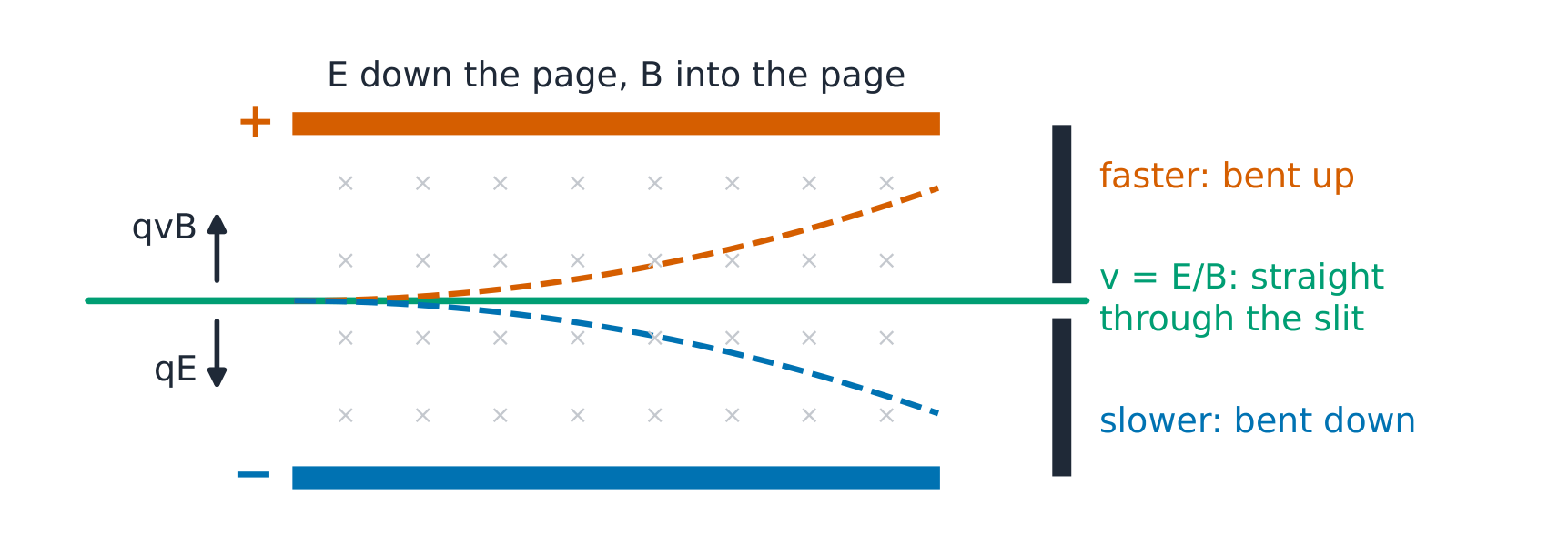
- Set a uniform electric field downward and magnetic field into the page for particles entering horizontally to the right. For positive particles, electric force is down and magnetic force up. A straight trajectory needs both directions and magnitudes to cancel: $|q|E=|q|vB$, giving $v=E/B$. For invented $E=3.0\times10^4\ \dfrac{\mathrm V}{\mathrm m}$ and $B=.010$ T, selected speed is $3.0\times10^6\ \dfrac{\mathrm m}{\mathrm s}$.
- The speed condition is independent of the nonzero charge magnitude and mass for the stated incoming direction. Reversing charge reverses both forces, so the same speed still balances. Slower positive particles initially deflect downward and faster ones upward; negative particles reverse those initial deflections. Neutral particles feel neither force, so passing straight does not establish that an unknown particle is charged. A real slit passes a small range of speeds rather than a mathematically exact single speed.
An invented perpendicular velocity selector has E = 3.0 × 10⁴ V/m and B = .010 T, arranged so forces oppose. Find selected speed.
Difficulty 2/5 · 140 coins + a small bonus on first completion today
v = E/B = 3.0 × 10⁶ m/s. For the stated beam direction, reversing charge reverses both forces and leaves the selected speed unchanged.
Separate speed selection from mass analysis
- After a selector, a separate magnetic analysing region bends a perpendicular beam with known selected speed. Rearranging radius gives $m=|q|Br/v$. An invented ion with charge magnitude $1.60\times10^{-19}$ C, selected speed $3.0\times10^6\ \dfrac{\mathrm m}{\mathrm s}$ and analysing field .20 T follows a .313 m radius, giving mass $3.34\times10^{-27}$ kg. Read the radius, rather than a detector separation or full diameter, before substitution.
- Radius separates momentum per charge magnitude, not mass by itself. The mass interpretation needs known charge states and a common speed. Doubly charged ions of a different mass can overlap a singly charged beam. An accelerating-voltage apparatus without a speed selector gives different speeds for different masses at the same charge; its radius relation must also use the energy equation. State the apparatus before comparing radii.
An invented ion with |q| = 1.60 × 10⁻¹⁹ C and selected speed 3.0 × 10⁶ m/s follows radius .313 m in a separate .20 T perpendicular field. Find mass in units of 10⁻²⁷ kg.
Difficulty 2/5 · 140 coins + a small bonus on first completion today
m = |q|Br/v = [(1.60 × 10⁻¹⁹)(0.20)(0.313)]/(3.0 × 10⁶) = 3.33867 × 10⁻²⁷ kg. Enter 3.33867 in the requested units. The interpretation needs the stated charge magnitude and selected speed; radius alone measures momentum per charge magnitude.
Transfer the charge model to a wire
- A straight length $L$ of wire carrying conventional current $I$ through a uniform field feels force magnitude $F=BIL\sin\theta$. Use the length actually within the field and the angle between current direction and field. An invented .050 m segment carrying 3.0 A at right angles to .40 T feels .060 N; at 30° it feels .030 N. A wire parallel to the field has zero magnetic force under this model even though current still flows.
- Fleming's left-hand rule uses conventional current, which is opposite electron drift in an ordinary metal. Reversing either current or field reverses the force; reversing both leaves it unchanged. The sideways magnetic force on moving charge helps transmit force to the conductor. A motor can perform mechanical work because the electrical supply transfers energy into the system; this does not mean a magnetic field alone directly increases each free charge's kinetic energy.
An invented .050 m straight wire segment carries 3.0 A at 30° to a uniform .40 T field. Find force magnitude.
Difficulty 2/5 · 140 coins + a small bonus on first completion today
F = BIL sin30° = .40 × 3.0 × .050 × .5 = .030 N. Use active length in field and conventional current for direction.
Explain attraction between parallel currents
- At one long straight wire, first calculate the field made by the other: $B_1=\mu_0 I_1/(2\pi d)$. Then use $F_2/L=I_2B_1$, giving $F/L=\mu_0 I_1I_2/(2\pi d)$ for current magnitudes in vacuum or approximately air. Here $d$ is wire separation, not wire radius, and the model requires long parallel wires far from ends and return paths. Use the right-hand grip rule to find field direction before applying the force rule.
- For two invented wires .050 m apart carrying 10 A each, take $\mu_0\approx4\pi\times10^{-7}\ \dfrac{\mathrm{T\,m}}{\mathrm A}$. Field at the other wire is $4.0\times10^{-5}$ T and force per metre $4.0\times10^{-4}\ \dfrac{\mathrm N}{\mathrm m}$. Same-direction currents attract; opposite currents repel. Their forces are equal and opposite even when currents differ. This attraction concerns currents and their magnetic fields, so the electrostatic rule for two stationary positive charges is not the appropriate comparison.

Two invented long parallel 10 A wires are .050 m apart in air. Use μ₀ ≈ 4π × 10⁻⁷ T m/A. Find force per metre.
Difficulty 2/5 · 140 coins + a small bonus on first completion today
F/L = μ₀I₁I₂/(2πd) = [(4π × 10⁻⁷)(10)(10)]/[2π(0.050)] = 4.0 × 10⁻⁴ N/m. Same-direction currents attract, opposite currents repel, with equal and opposite forces.
Test the whole apparatus model
- Sketch the charge sign, initial velocity, electric field and magnetic field separately. Name which region accelerates, selects speed or bends a beam. Use energy for acceleration, two perpendicular constant-acceleration equations for plate deflection, and a centripetal equation for perpendicular magnetic circles. A helix needs the perpendicular component for radius and the parallel component for pitch. A detector trace alone is insufficient to identify mass without speed and charge-state information.
- Finish with a direction, unit, assumption and size check. Convert millitesla, centimetres and charge prefixes before squaring; compare classical speed with light speed; check that a path fits within the plates. For currents, distinguish conventional direction from electron motion, state the active wire length and use the other wire's field. Explain why electric work can change energy while a magnetic force on a free particle acts perpendicular to its instantaneous velocity.
Explain a beam apparatus that accelerates particles, selects speed and bends the accepted beam. Include charge directions, equations, measurements, limits and the related force on wires.
A correct numerical radius is one part of the explanation. Name the force, incoming geometry, measured quantities and limits for every apparatus region.