Oscillation, resonance and phase
Introduced| English | Meaning |
|---|---|
| damping/ˈdæmpɪŋ/ | The reduction of oscillation amplitude caused by energy transfer out of the oscillating system. |
| resonance/ˈrezənəns/ | In the trial method, overlap with the complementary function requires extra factors of x. An undamped system forced at its natural frequency can have a growing response. |
What would explain this observation?
- A swing gains a large amplitude when pushes arrive with the right timing. The forcing frequency and damping 阻尼 help determine the response.
Build the model
- Simple harmonic motion has acceleration proportional to displacement and directed toward equilibrium.
- Period is time per cycle; frequency is its reciprocal.
- Damping transfers energy away from the oscillating system.
- resonance 共振: A large response to periodic forcing near a natural frequency.
- damping: Energy transfer out of an oscillating system.

Energy changes during one oscillation
In ideal SHM, speed is greatest at equilibrium while kinetic and potential energy exchange.
For ideal SHM, where is speed greatest?
Difficulty 1/5 · 100 coins + a small bonus on first completion today
In SHM, kinetic energy is greatest where the restoring force has done the most work - at equilibrium, where displacement and acceleration are zero. At maximum displacement the oscillator is instantaneously at rest.
Match each technical term to its precise meaning.
Difficulty 2/5 · 140 coins + a small bonus on first completion today
Use the definitions to distinguish related quantities and processes.
Choose evidence that can test it
- Velocity is greatest near equilibrium for ideal SHM, while acceleration magnitude is greatest at extreme displacement.
- Resonance can occur near the natural frequency under periodic driving, with amplitude limited by damping.
In the lab: Measure time for several complete oscillations and divide. Define a cycle consistently and use a small displacement when the model requires it. Keep pendulum paths clear and record damping effects rather than assuming perfect motion.
Which two habits make the investigation or model in this case more defensible?
Difficulty 2/5 · 140 coins + a small bonus on first completion today
Stating the conditions and assumptions lets others repeat the work exactly, and recording the supporting evidence lets them check the conclusion. Hiding disagreeing results removes the evidence that could challenge a wrong conclusion, and one measurement can never establish a wider claim.
Work from known quantities
- Known: 20 cycles take 32 s.
- T=total time/cycles=32/20=1.6 s.
- Frequency=1/T=1/1.6=0.625 Hz.
- A shorter total timing interval would make reaction-time error a larger fraction of the measurement.
Your turn: 30 cycles take 45 s. Find period.
30 cycles take 45 s. Find period.
Difficulty 2/5 · 140 coins + a small bonus on first completion today
The result is 1.5 s. Known: 30 cycles in 45 s. Use period = total time / cycles. T = 45/30 = 1.5 s. Timing many cycles and dividing reduces the effect of reaction-time error.
Check the conclusion and its limits
- Not every repeated motion is SHM.
- A force proportional to displacement but directed away from equilibrium does not produce SHM.
Not true: Every periodic motion satisfies the condition for simple harmonic motion. SHM needs a restoring force proportional to displacement and directed TOWARD equilibrium. Motion that merely repeats - a bouncing ball, a circular orbit - is periodic without satisfying that condition.
- Simple harmonic motion has acceleration proportional to displacement and directed toward equilibrium.
- Velocity is greatest near equilibrium for ideal SHM, while acceleration magnitude is greatest at extreme displacement.
- Watch for: not every repeated motion is SHM.
Every periodic motion satisfies the condition for simple harmonic motion.
Difficulty 1/5 · 100 coins + a small bonus on first completion today
SHM needs a restoring force proportional to displacement and directed TOWARD equilibrium. Motion that merely repeats - a bouncing ball, a circular orbit - is periodic without satisfying that condition.
A large response to periodic forcing near a natural frequency: write the technical term.
Difficulty 1/5 · 100 coins + a small bonus on first completion today
resonance means A large response to periodic forcing near a natural frequency.
Write from the data: find the period
- 20 cycles take 50 s.
- Find the period and the frequency. Not every periodic motion is simple harmonic.
20 cycles take 50 s. What are the period and the frequency, and why is periodic motion not always simple harmonic?
Period T = total time / complete cycles = 50/20 = 2.5 s. Frequency f = cycles / total time = 20/50 = 0.4 Hz. Check fT = 1. For SHM, acceleration along the oscillation coordinate must be proportional to displacement and directed towards equilibrium; repetition alone does not establish this.
In the written timing case, 20 cycles take 50 s. What is the period?
Difficulty 1/5 · 100 coins + a small bonus on first completion today
50 divided by 20 is 2.5 s. Other options — 1.5 s (the lesson timing of 30 cycles in 45 s); 0.40 Hz (the frequency).
Define displacement and amplitude from equilibrium
- In an oscillation, displacement is signed position relative to equilibrium, while amplitude is the greatest magnitude of that displacement. A model object travelling between −5.0 and +5.0 cm has amplitude 5.0 cm and total end-to-end range 10 cm. It travels four amplitudes during a complete cycle, returning to the same position and direction of motion.
- The examples here are invented ideal models, with g = 9.8 m/s² where needed. Simple harmonic motion describes a particular restoring relationship, not every repeating motion. A bouncing ball repeats, but its constant downward acceleration during free flight is not proportional to displacement from equilibrium. Real springs, pendulums and structures approximate SHM only over ranges where the model conditions hold.
Test the restoring relationship rather than periodicity alone
- For ideal SHM, acceleration along the oscillation coordinate is proportional to displacement and oppositely directed: $a=-\omega^2x$. The angular frequency ω is constant for the model. When x is positive, a is negative; when x is negative, a is positive. The minus sign identifies the restoring direction, not a rule that velocity is always negative.
- A force proportional to displacement but pointing away from equilibrium gives unstable motion rather than SHM. For a constant-mass system, demonstrating net force proportional to −x establishes the acceleration condition. Include all relevant forces: the spring force alone does not equal the resultant force for a vertically hanging mass because weight also acts. Specify the equilibrium position before assigning the displacement sign.
Read angular frequency from acceleration and displacement
- An acceleration-against-displacement graph for ideal SHM is a straight line through the origin with gradient −ω². If a = −64x using SI quantities, ω = 8.0 rad/s, period is 2π/8 ≈ .785 s and frequency is about 1.27 Hz. Take the square root of the gradient's magnitude; the negative gradient does not imply a negative frequency.
- In a separate invented oscillator with ω = 12.6 rad/s, displacement +.020 m gives acceleration −3.1752 m/s², about −3.2 m/s². At displacement −.020 m the acceleration is +3.2 m/s². At a given displacement the object can be travelling either way, so acceleration alone does not determine its velocity direction. Keep centimetres and metres consistent when reading graph gradients.
An invented oscillator has angular frequency 12.6 rad/s and displacement +.020 m. Find its signed acceleration along the SHM coordinate.
Difficulty 2/5 · 140 coins + a small bonus on first completion today
a = −ω²x = −12.6² × .020 = −3.1752 m/s², about −3.2 m/s². The negative sign means acceleration points back towards equilibrium for positive displacement.
Measure a full period and distinguish angular frequency
- Period T is time per complete cycle, frequency f is cycles per second and angular frequency is ω = 2πf = 2π/T. A model timing of 20 cycles in 31.0 s gives T = 1.55 s and f ≈ .645 Hz. Count the start as cycle zero and stop when the object returns to the same position moving in the same direction after the required number of cycles.
- A 440 Hz oscillation has period about .00227 s and angular frequency about 2,765 rad/s. The factors of 2π distinguish cycles from radians; neither frequency nor angular frequency is the displacement amplitude. Ideal linear SHM has period independent of amplitude. This is a property of the model, not a guarantee that arbitrarily large real-pendulum swings have the same period.
A model timing records 20 complete cycles in 31.0 s. Find the period.
Difficulty 2/5 · 140 coins + a small bonus on first completion today
T = total time/number of cycles = 31.0/20 = 1.55 s. A complete cycle returns to the same position with the same direction of motion.
Compare displacement, velocity and acceleration graphs
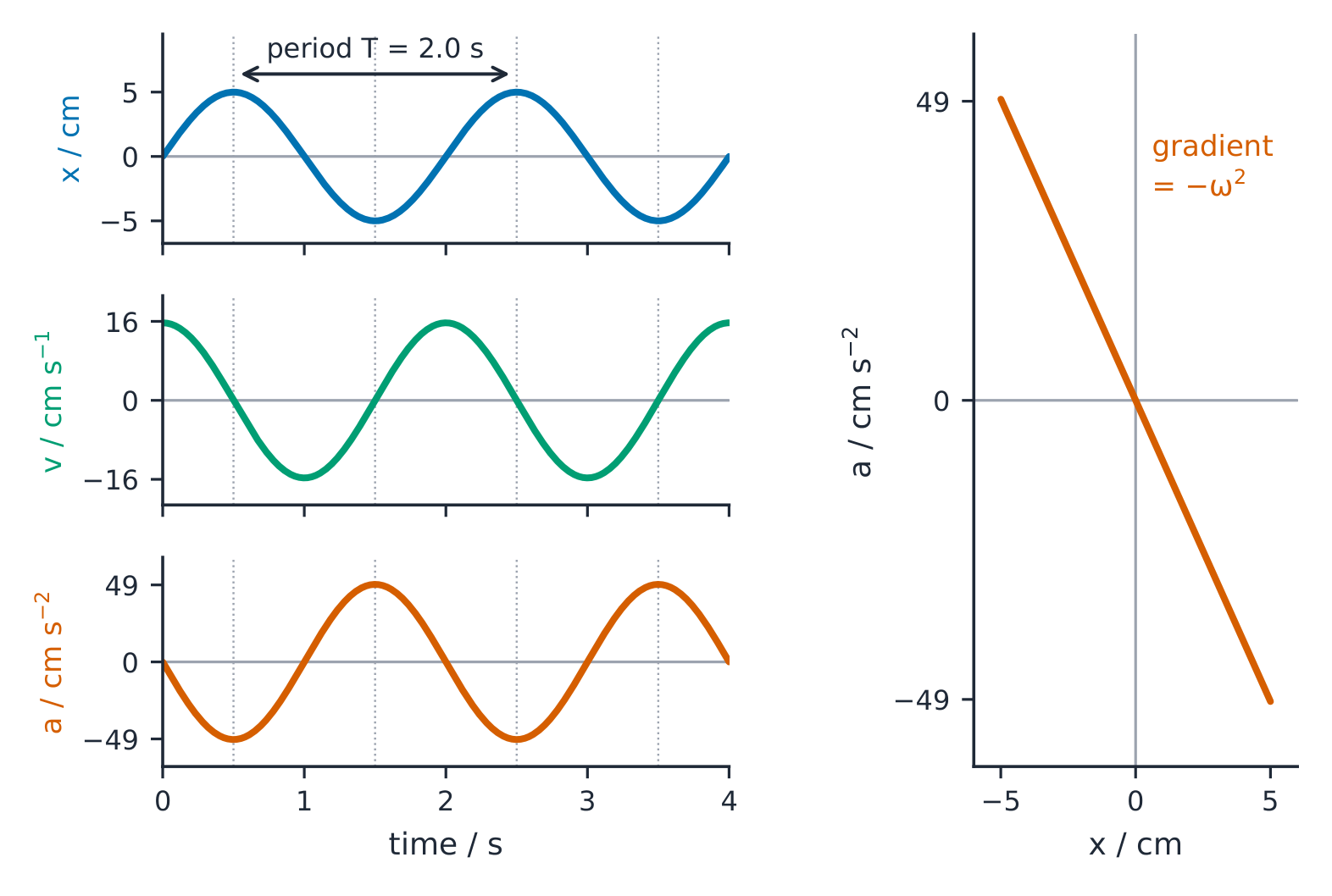
- In the illustrative plots, displacement starts at zero moving positively, reaches its positive maximum after a quarter period, returns through zero after half a period and repeats after 2.0 s. Velocity is the gradient of displacement: positive on rising sections, zero at turning points and negative on falling sections. Acceleration is the gradient of velocity and is opposite in sign to displacement.
- At either end, instantaneous speed is zero but acceleration magnitude is greatest. At equilibrium, speed is greatest while the acceleration along the SHM coordinate is zero. A zero instantaneous velocity does not mean zero acceleration, and a zero acceleration does not mean the object must be stationary. In the model graph amplitude is 5 cm and the acceleration extremes have magnitude about 49 cm/s².
At positive maximum displacement in ideal one-dimensional SHM, which describes the motion?
Difficulty 1/5 · 100 coins + a small bonus on first completion today
At a turning point the instantaneous velocity is zero, but a = −ω²x has its greatest magnitude and points towards equilibrium. The object can stop for an instant while still accelerating.
Predict the mass–spring period from force and inertia
- For a mass on an ideal linear spring, the net restoring force gives ω² = k/m and $T=2\pi\sqrt{m/k}$. Larger mass increases inertia and lengthens the period; a stiffer spring increases the restoring force for a given displacement and shortens the period. For m = .40 kg and k = 40 N/m, ω = 10 rad/s and T ≈ .628 s.
- For .50 kg on 200 N/m, period is about .314 s and frequency about 3.18 Hz. If a particular spring oscillator originally has period .80 s, quadrupling its mass at unchanged k doubles its period to 1.60 s. Doubling amplitude leaves the period unchanged while the spring remains linear. These predictions assume negligible spring mass and damping; changing the load can also move a real spring outside its linear range.
An ideal spring oscillator has period .80 s. Its mass is quadrupled with unchanged spring constant. Find its new period.
Difficulty 2/5 · 140 coins + a small bonus on first completion today
T is proportional to √m at fixed k. Quadrupling mass multiplies period by two, so the new period is 1.60 s. Amplitude does not enter the ideal linear-spring period formula.
Measure a vertical spring from its shifted equilibrium
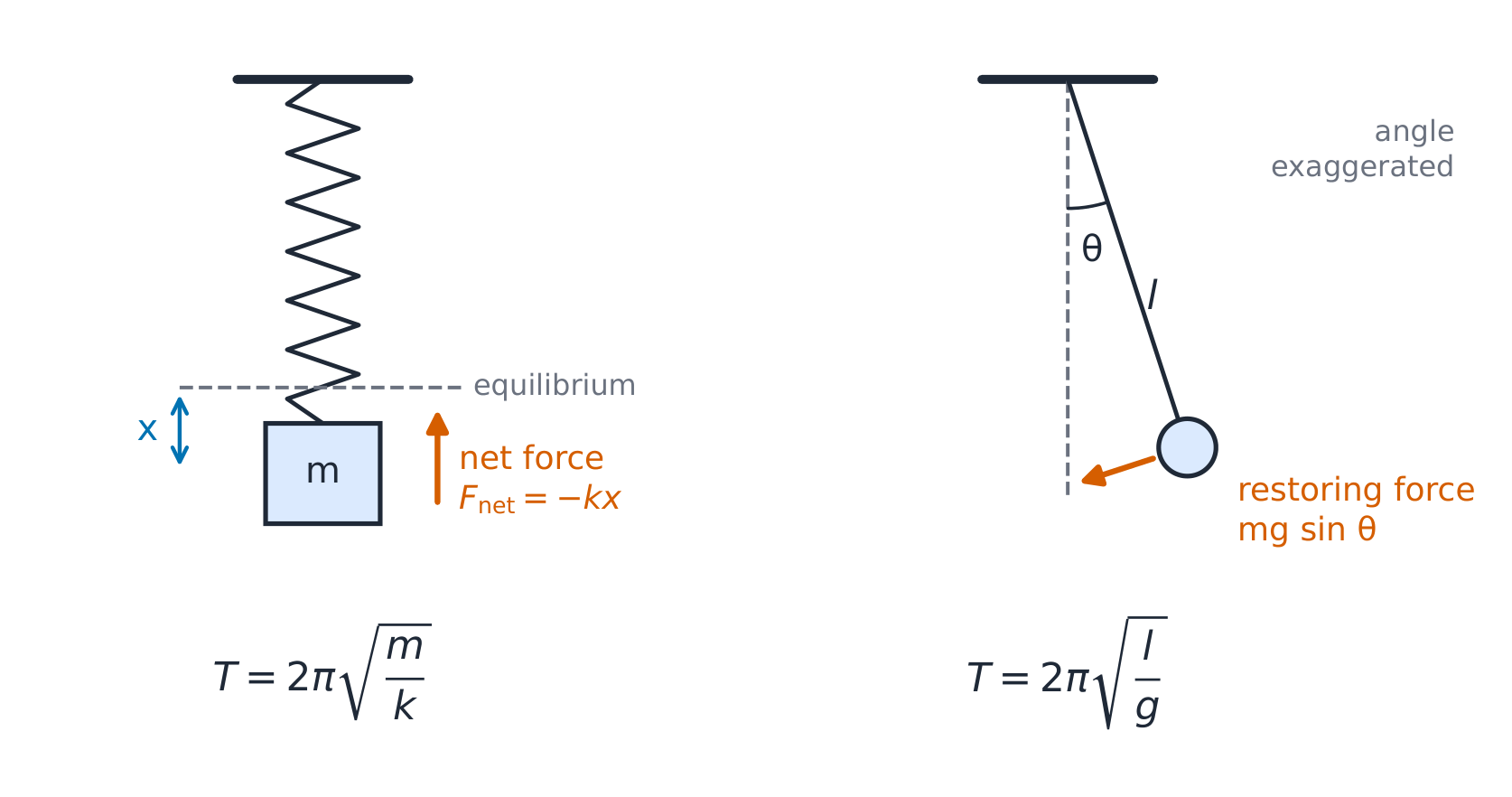
- A hanging spring is already stretched at equilibrium. If s is extension from natural length, equilibrium satisfies ks = mg. For a further downward displacement x, weight and spring force combine to give a resultant −kx. Gravity shifts the equilibrium extension, but it does not change the small-oscillation period of this constant-k model. Do not insert the full extension into −kx while forgetting the constant weight.
- The figure compares a spring mass with a pendulum. Its spring restoring arrow represents the resultant associated with displacement from equilibrium. Its pendulum arrow is the tangential component of weight. A vertical spring's changing potential energy includes both elastic and gravitational contributions; the elastic energy by itself is not generally smallest at the hanging equilibrium position.
Apply the pendulum approximation to the correct component
- For a light inextensible string with a compact bob, arc displacement is x = lθ and the tangential restoring component is −mg sin θ. At sufficiently small angles, sin θ ≈ θ with θ in radians, giving tangential acceleration approximately −gx/l and $T=2\pi\sqrt{l/g}$. The period depends on length and g, rather than bob mass, in this model.
- A 1.0 m model pendulum has period about 2.01 s on Earth and 4.97 s with g = 1.6 m/s². A period of 1.0 s on Earth requires length about .248 m. Quadrupling length doubles period. At equilibrium the tangential acceleration is zero, but the moving bob still has radial acceleration towards the pivot. Do not identify zero tangential acceleration with a zero full acceleration vector.
Find the length for an invented small-angle pendulum of period 1.0 s, using g = 9.8 m/s².
Difficulty 2/5 · 140 coins + a small bonus on first completion today
T = 2π√(l/g), so l = gT²/(4π²) = 9.8/(4π²) ≈ .248 m, about .25 m. The model uses a light string and small angles.
Estimate gravitational acceleration with a controlled graph
- Rearranging the small-angle model gives $g=4\pi^2l/T^2$. For a model length .60 m and 20 cycles taking 31.0 s, T = 1.55 s gives g ≈ 9.86 m/s². Measure length from pivot to bob centre, not merely string length. Time several complete cycles and divide, retaining unrounded period until the final calculation.
- With several lengths, plot T² vertically against l horizontally. The ideal gradient is 4π²/g, so g is 4π² divided by that gradient. Repeats help estimate timing uncertainty; they do not remove a wrong length zero. Keep amplitude small, release without a push and note damping. A nonzero fitted intercept or curved trend can point to systematic geometry errors or limits of the model rather than a reason to force points onto an ideal line.
An invented .60 m small-angle pendulum makes 20 complete cycles in 31.0 s. Estimate g from these data.
Difficulty 2/5 · 140 coins + a small bonus on first completion today
T = 31.0/20 = 1.55 s. g = 4π²l/T² = 4π² × .60/1.55² ≈ 9.86 m/s², about 9.9 m/s². Use length from pivot to bob centre.
Track kinetic and potential energy through one cycle
- For an undriven oscillator without dissipative losses, total mechanical energy is constant. Taking potential energy zero at its minimum, a pendulum released at an end has zero kinetic energy and maximum potential energy. It speeds up towards equilibrium, where kinetic energy is largest, then slows while climbing towards the other end. The return journey repeats that energy exchange.
- In this illustrative energy graph, the oscillator starts at positive maximum displacement, unlike the earlier displacement graph that started at equilibrium. Kinetic energy peaks at T/4 and 3T/4, once for each direction through equilibrium. Each energy curve therefore repeats after T/2, while the displacement needs a full T to repeat with the same direction. A different starting phase changes timings on the page, not the physical exchange rule.

An invented undamped oscillator has displacement period 2.0 s. What is the period of its kinetic-energy graph?
Difficulty 1/5 · 100 coins + a small bonus on first completion today
Kinetic energy is proportional to speed squared, so the two opposite equilibrium crossings have the same energy. The energy graph repeats every T/2 = 1.0 s, even though displacement needs T to repeat.
Distinguish free decay from a driven response
- Damping transfers mechanical energy to the surroundings, often through friction or drag, reducing the amplitude of free oscillation. The system's energy is transferred rather than destroyed. Ideal undamped SHM keeps amplitude constant; a decaying real trace is an approximation over a suitable interval, not exact constant-amplitude motion at all times.
- Periodic driving can maintain a response by replacing transferred energy. The existing resonance introduction concerns a large driven response near a natural frequency, whose amplitude depends on damping as well as the driving conditions. That does not make every driven motion free SHM. The shared standing-wave/resonance topic develops those connections separately; here first establish the restoring relationship and the meaning of each graph.
Check the motion model before calculating
- Start with equilibrium, a signed displacement and a defined complete cycle. Test whether the restoring acceleration is proportional to −x over the range used. Use period ratios as an independent check: four times spring mass or pendulum length gives twice the corresponding ideal period. Distinguish the time for a full oscillation from one trip between opposite extremes, which is only half a period.
- Check graph slopes against velocity and acceleration, use the same time origin when comparing curves, and account for mechanical energy transferred to surroundings if amplitude falls. For a pendulum specify tangential motion and the small-angle condition; for a spring specify the linear-force range and negligible spring mass. A plausible period alone is not evidence that all these assumptions were satisfied.
Explain how to recognise, calculate and experimentally test simple harmonic motion. Include graph signs and the spring and pendulum model conditions.
A full account connects the restoring force, measured motion, energy and conditions under which the ideal model is justified.
Form a stationary pattern from two moving waves
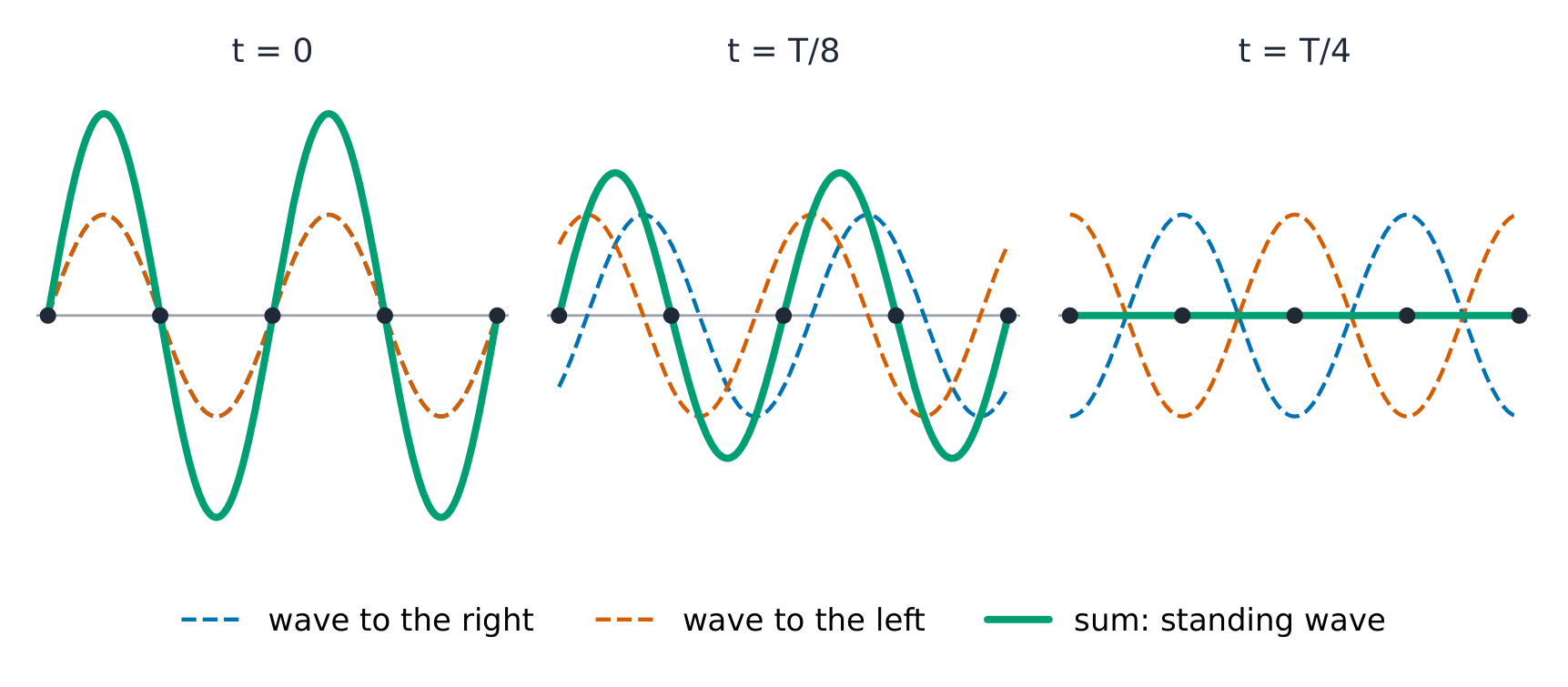
- Two sinusoidal waves of the same frequency and wavelength travelling in opposite directions can superpose to produce a standing pattern. Equal amplitudes give exact stationary nodes. A reflected wave often provides the second wave; strong losses or unequal amplitudes leave an imperfect pattern with minima rather than exact zero-motion nodes. Do not describe one travelling crest as stopping at the end of a string.
- In the illustrated model the two dashed contributions add to the solid green resultant. At t = 0 their crests reinforce. An eighth of a period later their individual shapes have moved in opposite directions, but the resultant nodes remain in place. At T/4 the resultant displacement is zero everywhere; non-node points are moving through equilibrium, while the nodes remain at rest. The string has kinetic energy despite its flat instantaneous shape. The calculations below use invented ideal strings and uniform air columns, with sound speed 340 m/s unless stated otherwise.
An ideal standing-wave string is momentarily flat away from its fixed nodes. What can be concluded?
Difficulty 1/5 · 100 coins + a small bonus on first completion today
A snapshot gives displacement, not velocity. At this equilibrium crossing the non-node points have kinetic energy; nodes stay fixed throughout the cycle.
Read amplitude and phase without confusing a snapshot with an envelope
- A node has zero displacement at all times, while an antinode has the greatest oscillation amplitude. Adjacent nodes are λ/2 apart, adjacent antinodes are λ/2 apart, and a node to its nearest antinode is λ/4. A point that happens to cross equilibrium in one photograph is not necessarily a node: follow it through a cycle before deciding.
- Within one loop between neighbouring nodes, all non-node points move in phase but have different amplitudes. In neighbouring loops they move in antiphase, a difference of π radians or half a cycle. Points separated by two nodes are in phase again. The phase of a node itself is not assigned from an oscillation, because it does not oscillate. A drawn pair of extreme shapes is an envelope showing allowed displacement, not two simultaneous positions of each particle.
X and Y are non-node points in neighbouring loops of an ideal standing wave. How do they move?
Difficulty 1/5 · 100 coins + a small bonus on first completion today
A node separates neighbouring loops whose displacements have opposite signs at corresponding times. The phase difference is π; the amplitudes depend on distance from the nodes.
Infer wavelength from a measured node interval
- In an invented microwave experiment, neighbouring detector minima are 1.5 cm apart and approximate standing-wave nodes. Their separation is half a wavelength, so λ = 3.0 cm = .030 m. Using c = 3.00 × 10⁸ m/s, f = c/λ = 1.0 × 10¹⁰ Hz. Using 1.5 cm as a full wavelength would incorrectly double the frequency.
- Reduce relative measurement uncertainty by spanning several intervals. If the first and sixth successive nodes are 25.0 cm apart, there are five half-wavelength intervals: λ = 2 × .250/5 = .100 m. Count intervals, not marked points. A displacement detector and a pressure-sensitive sound microphone need not locate the same kind of node; state what the instrument actually measures.
The first and sixth successive nodes in an invented standing wave are 25.0 cm apart. Find wavelength in cm.
Difficulty 2/5 · 140 coins + a small bonus on first completion today
Six nodes span five intervals, each λ/2. λ = 2 × 25.0/5 = 10.0 cm. Counting six intervals would underestimate wavelength.
Account for energy in the ideal standing-wave model
- The two component travelling waves carry equal average energy fluxes in opposite directions. Their ideal standing-wave sum therefore has zero net energy transfer along the medium. Energy still exchanges between kinetic and elastic stores during the motion. Destructive displacement at one instant does not destroy energy, just as a moving pendulum at equilibrium can have zero displacement and substantial kinetic energy.
- Real driven strings and air columns dissipate energy and need a continuing energy supply to maintain their amplitude. Their steady observed pattern can approximate a standing wave while energy flows from a driver to lossy parts. Similarly, constant amplitude everywhere describes an ideal undamped plane travelling wave; spreading, absorption or changing medium can make real travelling-wave amplitudes vary. State the idealisation when using a comparison table.
Fit string modes to the actual end conditions
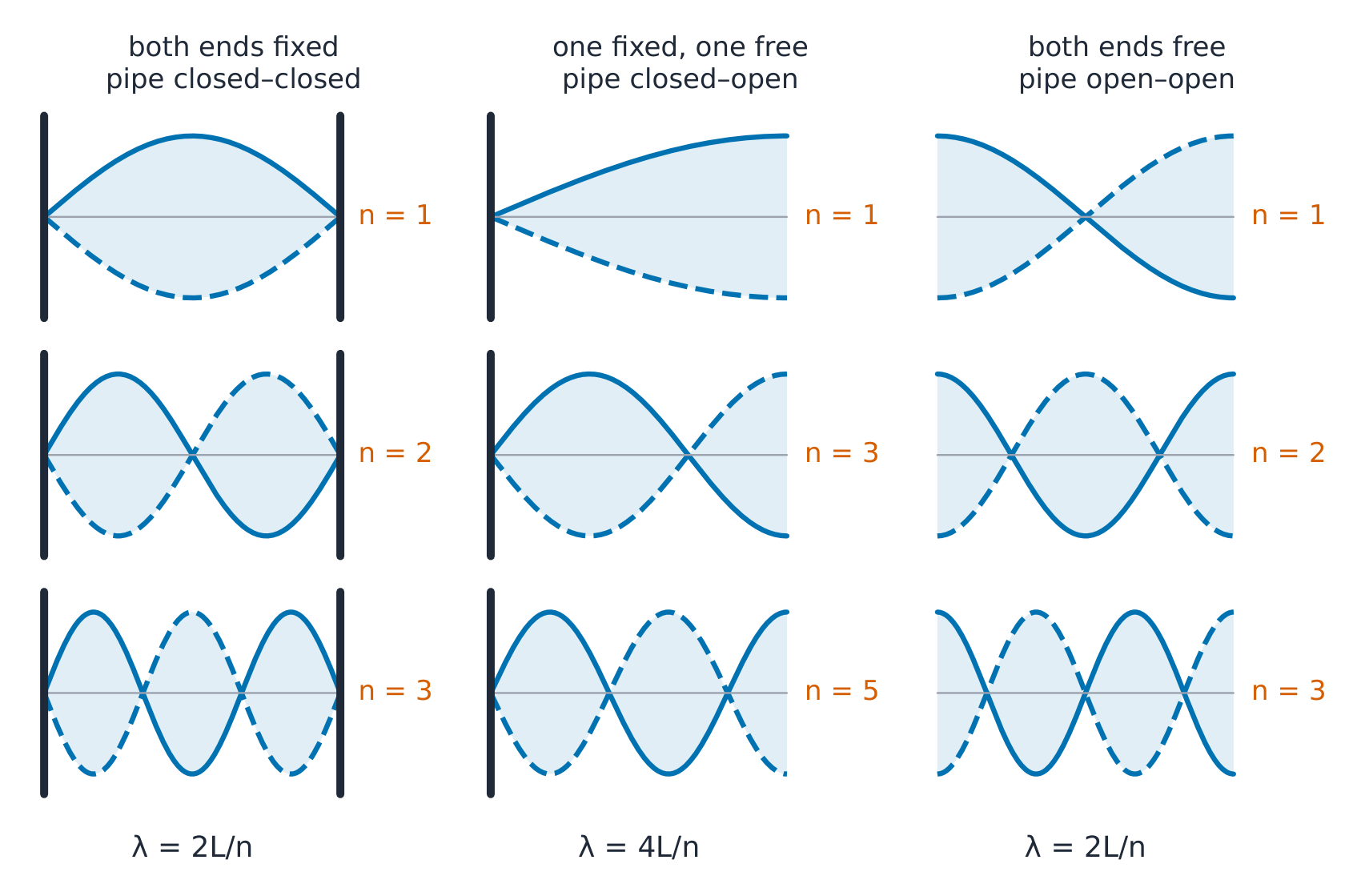
- A fixed string end is a displacement node. An ideal freely sliding end with no transverse force is a displacement antinode. Both fixed or both free ends admit positive harmonic numbers n = 1, 2, 3, …, with λₙ = 2L/n and fₙ = nv/(2L). Here n counts the harmonic order, L is vibrating length and v is wave speed along the string. A freely translating zero-frequency motion is not the first oscillating harmonic.
- With one fixed and one free end, the shortest pattern has a node at one end and an antinode at the other: L = λ/4. The next patterns contain three and five quarter wavelengths, giving λₙ = 4L/n and fₙ = nv/(4L) for n = 1, 3, 5, …. The second allowed mode is the third harmonic, not the second harmonic. Begin with an end-labelled sketch, rather than choosing a formula because a question happens to mention a string.
Work from a string length to its harmonic series
- An invented string fixed at both ends has L = .80 m and v = 240 m/s. The first harmonic has λ₁ = 2L = 1.60 m and f₁ = 240/1.60 = 150 Hz. The next frequencies are 300 and 450 Hz. The third-harmonic sketch has three loops and four nodes including the two ends; its wavelength is 2L/3, not L/3.
- A separate .65 m string with first-harmonic frequency 110 Hz has wave speed 110 × 1.30 = 143 m/s. Touching its midpoint lightly suppresses modes that require midpoint motion; the lowest remaining mode is the second harmonic at 220 Hz. A normal pluck excites several modes, giving timbre as well as pitch. These predictions hold at unchanged tension, length and linear density; touching or loading a real string strongly can change its properties.
An invented .80 m string fixed at both ends has wave speed 240 m/s. Find its third-harmonic frequency.
Difficulty 2/5 · 140 coins + a small bonus on first completion today
A fixed–fixed string has λ₃ = 2L/3 = 2 × .80/3 = 1.60/3 m. Therefore f₃ = v/λ₃ = 240/(1.60/3) = 450 Hz. Equivalently f₁ = 240/1.60 = 150 Hz and f₃ = 3f₁ = 450 Hz. The third mode has three loops and four nodes including the ends.
Identify displacement boundaries in an air column
- In a longitudinal sound wave, air oscillates along the tube rather than following the curved transverse lines of a sketch. The plotted curve represents displacement amplitude along the column. A rigid closed end is a displacement node; an ideal open end is a displacement antinode. Pressure variation has the opposite pattern: a closed end is a pressure antinode and an open end approximately a pressure node.
- For a uniform pipe with negligible end correction, open–open and closed–closed boundaries give all positive harmonics, fₙ = nv/(2L). A closed–open column admits odd orders only, fₙ = nv/(4L). Do not transfer a displacement-node label to a pressure graph unchanged. Real open ends have an effective acoustic length slightly beyond the physical end, so a precise experiment must consider end correction rather than force a measured length into the simplest model.

At the ideal closed end of an air column, which pair of boundary descriptions is correct?
Difficulty 1/5 · 100 coins + a small bonus on first completion today
The rigid end stops longitudinal air displacement, while pressure can vary strongly there. A pressure graph and a displacement envelope have opposite node/antinode positions.
Distinguish the next mode from the next harmonic number
- For invented pipes .34 m long, the open–open first harmonic is 340/(2 × .34) = 500 Hz, followed by 1,000 and 1,500 Hz. A closed–open pipe of the same length has first harmonic 250 Hz, followed by 750 and 1,250 Hz. The latter allowed frequencies are in ratio 1:3:5; their spacing is 2f₁, despite the lowest value itself being f₁.
- Two known neighbouring resonances at 300 and 500 Hz cannot be adjacent modes of an ideal uniform open–open pipe: their difference would give f₁ = 200 Hz, of which 300 is not an integer multiple. They fit a closed–open pipe with f₁ = 100 Hz, where 300 and 500 are the third and fifth harmonics. This conclusion depends on knowing they are neighbouring modes of one uniform pipe. A list with missing or unrelated peaks cannot justify the same inference automatically.
An invented ideal closed–open pipe has first-harmonic frequency 200 Hz. Find the next allowed resonant frequency.
Difficulty 2/5 · 140 coins + a small bonus on first completion today
Closed–open modes have odd harmonic orders 1, 3, 5, … . The second allowed mode is the third harmonic: 3 × 200 = 600 Hz, not 400 Hz.
Measure sound speed with successive resonant lengths
- In an invented water-column experiment, a 512 Hz fork first resonates when the closed–open air column is .166 m long. Neglecting end correction, λ = 4L = .664 m and v = fλ = 339.968 m/s, about 340 m/s. The next resonance occurs at 3λ/4 = .498 m. Its length is three times the first, while the driving frequency is unchanged.
- With a roughly constant open-end correction e, the two resonances obey L₁ + e = λ/4 and L₂ + e = 3λ/4. Subtraction gives λ = 2(L₂ − L₁), removing the shared correction. For invented lengths .160 and .492 m, λ = .664 m and the same speed follows, even though 4L₁ alone would give the wrong estimate. Raise or lower water gradually, identify a reproducible loudness maximum and keep the fork clear of the tube; finite damping broadens each resonance.
An invented 512 Hz fork resonates at successive closed–open air-column lengths .160 and .492 m. Assuming a constant open-end correction, find sound speed.
Difficulty 2/5 · 140 coins + a small bonus on first completion today
The correction cancels in the difference: λ = 2(.492 − .160) = .664 m. v = 512 × .664 = 339.968 m/s, about 340 m/s. Using 4L₁ would retain the end-correction error.
Separate natural modes from a forced response
- A free oscillator moves at a natural mode frequency after displacement and release. A periodically driven oscillator settles, after transients, into motion at the driving frequency. Its amplitude depends on driving strength, frequency and damping. A complex structure can have many natural modes; saying a bridge has one frequency hides its different sideways, vertical and twisting motions.
- Resonance means an enhanced response near a natural frequency. A swing gains energy when pushes do positive work with appropriate timing. At steady amplitude the average supplied power balances dissipated power: energy does not accumulate without limit in a damped oscillator. An ideal undamped oscillator driven exactly at its natural frequency has no finite steady resonant amplitude, so a real measured peak always needs losses or other limiting effects in its model.
After transients decay, a damped oscillator is driven sinusoidally at 4.5 Hz near its 5.0 Hz natural mode. What is its steady-response frequency?
Difficulty 1/5 · 100 coins + a small bonus on first completion today
The forced steady response follows the driving frequency. Free transients can initially coexist but decay. Resonance describes a large response near a mode, not a rule forcing all motion to its free frequency.
Read a resonance curve with its controlled quantities
- The illustrated curves compare displacement amplitudes for a model oscillator with undamped natural frequency 5.0 Hz and the same sinusoidal driving-force amplitude. Light and moderate damping give peaks below that frequency. The orange, overdamped case decreases from its static limit and has no displacement resonance peak. At low driving frequency the response tends towards a finite static displacement, approximately force amplitude divided by stiffness, rather than necessarily tending to zero.
- The displacement-amplitude peak is close to the undamped natural frequency only for weak damping. In the linear viscously damped model, maximum average absorbed power occurs at the undamped natural frequency even when the displacement peak is shifted. Sufficient damping removes a distinct displacement peak. Do not read the curve as three different force amplitudes or assume every possible response measure peaks at exactly the same frequency.

At equal driving-force amplitude, what typically happens to a lightly damped displacement-resonance peak when damping is increased?
Difficulty 1/5 · 100 coins + a small bonus on first completion today
Distinguish displacement amplitude from mean absorbed power. In the linear viscous model their maxima need not be at the same frequency. Energy is supplied by the driver and dissipated by damping.
Compare free-decay curves after the same release
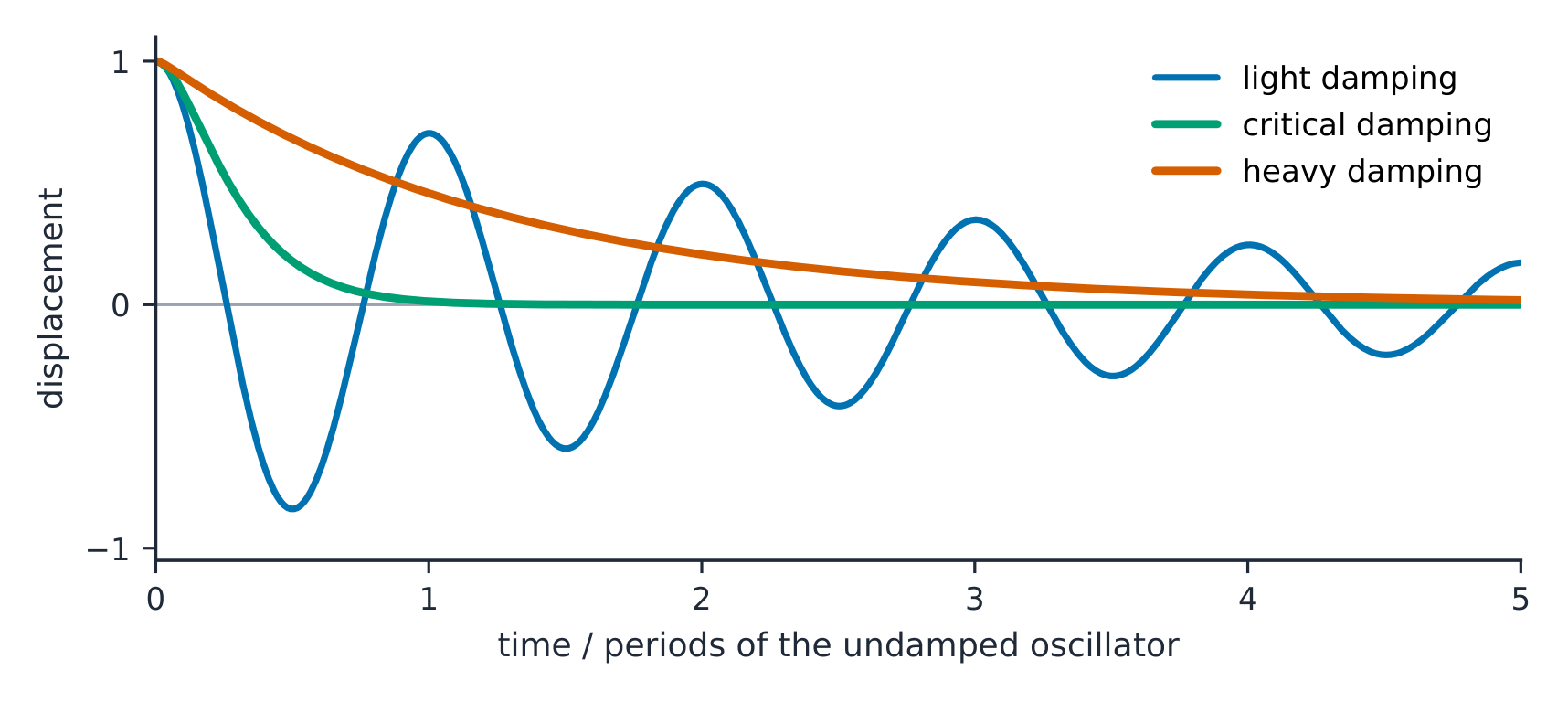
- In this model all three systems start at the same positive displacement with zero velocity and the same undamped natural frequency. Light damping gives repeated equilibrium crossings with decreasing amplitude. Critical damping gives the fastest non-oscillatory return for that release. Heavy, or overdamping, returns without oscillation but more slowly. A non-oscillating curve is not enough to identify critical damping: compare it with the other model responses.
- Damping transfers mechanical energy to other stores, often thermal. A driven damped oscillator can nevertheless keep constant amplitude because its driver replenishes the lost energy. An ideal suspension released from rest can illustrate the compromise between bouncing and slow recovery; real vehicles have coupled modes, tyre-contact and comfort requirements, so exact critical damping is not a universal design specification. Keep a free-decay graph separate from an amplitude-versus-driving-frequency graph.
Use physical examples without extending the model beyond its evidence
- Resonance helps musical instruments and tuned radio circuits select responses. A quartz timing resonator provides a stable mode; 32,768 Hz is common in watches, rather than a universal quartz frequency. MRI uses nuclear-spin resonance in a magnetic field. Microwave ovens instead heat through the response and dissipation of molecular dipoles in an alternating electric field; they do not select a special water-molecule resonance. See the IAPWS explanation.
- Crowd-induced bridge sway can involve feedback between people and the moving structure. The Millennium Bridge engineers' account describes lateral pedestrian forces feeding deck motion and damping as a remedy. This is richer than an independent fixed-frequency driver acting on a single oscillator. Likewise, earthquake damage depends on strength, damping, duration and the shaking spectrum as well as modal frequencies. Use the simple model to identify a possible amplification mechanism, then state the additional evidence needed for a real structure.
Which explanation correctly distinguishes two applications?
Difficulty 1/5 · 100 coins + a small bonus on first completion today
A shared word such as radiation does not establish the same physical mechanism. Use the mode and energy-transfer process stated for each example; the IAPWS explanation specifically rejects a special water-resonance account of oven heating.
Test the complete standing-wave and resonance account
- For a mode problem, identify the moving quantity and boundaries, sketch node/antinode positions, fit half- or quarter-wavelength segments and only then calculate f = v/λ. Name harmonic orders separately from the sequence of allowed modes. Check lengths, speed, units and adjacent-frequency spacing. A flat snapshot does not prove the system has no energy; a pressure node does not mean the air has zero displacement amplitude.
- For a resonance problem, distinguish a free release from a driven steady response and label both graph axes. Compare damping at fixed force amplitude and specify which response has a maximum. Support an application with the actual mechanism rather than a name alone. Write a complete explanation before opening the worked answers, then use a different mode, a ratio or a second resonant-length measurement as an independent check.
Give a complete model-based account of standing-wave formation, string and pipe modes, a sound-speed measurement, resonance and damping.
A complete explanation combines the boundary picture, an appropriate equation and a statement of the conditions under which it applies.