Motion graphs and acceleration
Introduced| English | Meaning |
|---|---|
| velocity/vəˈlɒsɪti/ | The rate of change of displacement. |
| acceleration/əkˌseləˈreɪʃn/ | The rate of change of velocity. |
What would explain this observation?
- A speedometer gives a reading at one moment. A journey average can hide stops and rapid changes in speed.
Build the model
- Displacement includes direction; distance counts total path length.
- Velocity 速度 is change in displacement per time.
- Acceleration 加速度 is change in velocity per time.
- velocity: Rate of change of displacement.
- acceleration: Rate of change of velocity.

What does area under a velocity-time graph represent?
Difficulty 1/5 · 100 coins + a small bonus on first completion today
Area under a velocity-time graph has units of velocity x time = metres, which is displacement. Acceleration is the GRADIENT of the same graph, and mass does not appear on it at all.
Match each technical term to its precise meaning.
Difficulty 2/5 · 140 coins + a small bonus on first completion today
Use the definitions to distinguish related quantities and processes.
Choose evidence that can test it
- The gradient of a displacement-time graph is velocity.
- The area under a velocity-time graph gives displacement.
- A constant-acceleration formula is valid only when its assumption is justified.
In the lab: Choose a positive direction and state it. Use a light gate or video with a known scale and frame interval for repeatable motion measurements. Avoid assuming hand timing is exact over very short intervals.
Which two habits make the investigation or model in this case more defensible?
Difficulty 2/5 · 140 coins + a small bonus on first completion today
Stating the conditions and assumptions lets others repeat the work exactly, and recording the supporting evidence lets them check the conclusion. Hiding disagreeing results removes the evidence that could challenge a wrong conclusion, and one measurement can never establish a wider claim.
Work from known quantities
- Known: velocity rises uniformly from 2 to 10 metres per second in 4 s. a = (v-u)/t. a = (10-2)/4 = 2 metres per second squared.
- Displacement is trapezium area: s = (u+v)t/2 = (2+10)×4/2 = 24 m.
Your turn: Velocity changes from 3 to 15 metres per second in 6 s. Find average acceleration.
Velocity–time: displacement and distance
$v=u+at;\quad s=ut+\frac12at^2$
Signed area gives displacement; total absolute area gives distance.
Velocity changes from 3 to 15 metres per second in 6 s. Find average acceleration.
Difficulty 2/5 · 140 coins + a small bonus on first completion today
The result is 2 m/s². Known: velocity changes from 3 to 15 metres per second in 6 s. Use average acceleration a = (v - u)/t. a = (15 - 3)/6 = 2 metres per second squared. The positive sign shows the acceleration is in the direction of motion.
Check the conclusion and its limits
- Negative velocity indicates direction under the chosen sign convention; it does not necessarily mean slowing down.
Not true: A negative velocity always means the object is slowing down. Negative velocity means motion opposite to the chosen positive direction. The object slows down only when the acceleration opposes the velocity; a negative velocity with negative acceleration is speeding up.
- Displacement includes direction; distance counts total path length.
- The gradient of a displacement-time graph is velocity.
- Watch for: negative velocity indicates direction under the chosen sign convention; it does not necessarily mean slowing down.
A negative velocity always means the object is slowing down.
Difficulty 1/5 · 100 coins + a small bonus on first completion today
Negative velocity means motion opposite to the chosen positive direction. The object slows down only when the acceleration opposes the velocity; a negative velocity with negative acceleration is speeding up.
Rate of change of displacement: write the technical term.
Difficulty 1/5 · 100 coins + a small bonus on first completion today
velocity means Rate of change of displacement.
Calculate acceleration and displacement from the data
- Velocity increases uniformly from 1 to 11 metres per second in 2 s.
- Find the acceleration and the displacement. A negative velocity is a direction.
Velocity increases uniformly from 1 to 11 metres per second in 2 s. What are the acceleration and the displacement, and what does a negative velocity mean?
Acceleration is change in velocity divided by time. Displacement uses average velocity when acceleration is constant.
The SL written constant-acceleration case changes velocity from 1 to 11 m/s in 2 s. Find acceleration.
Difficulty 1/5 · 100 coins + a small bonus on first completion today
11 minus 1 is 10, and 10 divided by 2 is 5 metres per second squared. Other options — 2 metres per second squared (the lesson change from 3 to 15); 12 metres (the displacement).
Choose position, path length and a positive direction
- A model drone travels 300 m east then 300 m west to its starting roof. Distance is the 600 m path length; displacement is zero. Distance is a scalar, while displacement is a vector. In one dimension, east can be positive and west negative. The sign records direction, not whether the motion is desirable or fast.
- In 120 s, average speed is 5 m/s while average velocity is zero. These invented teaching cases use consistent units and, where specified, constant downward gravitational acceleration 9.8 metres per second squared. Kinematics describes motion; a complete explanation of its forces belongs in the following unit. SL and HL share this kinematics scope.
A model drone travels 300 m east and 300 m west back to its start in 120 s. Which averages are correct?
Difficulty 1/5 · 100 coins + a small bonus on first completion today
Total distance is 600 m while displacement is zero. Divide the appropriate quantity by the full 120 s interval.
Distinguish speed, velocity and the sign of acceleration
- Average velocity is displacement divided by elapsed time; average speed uses total distance. Instantaneous velocity describes one moment, while an interval average can hide stops and reversals. A velocity change can concern magnitude, direction or both, so turning at constant speed still involves acceleration.
- Acceleration points with the velocity when speed increases and against it when speed decreases. Velocity −6 m/s with acceleration −2 metres per second squared means motion in the negative direction speeding up. At velocity zero, acceleration need not be zero; an upward-thrown ball at its highest point remains accelerated downward in the gravity-only model.
In the stated one-dimensional sign convention, velocity is −6 m/s and acceleration is −2 metres per second squared. What happens initially to speed?
Difficulty 1/5 · 100 coins + a small bonus on first completion today
Signs indicate directions. Speed increases when acceleration points with velocity; negative velocity alone does not mean slowing down.
Read tangent gradients and signed graph areas
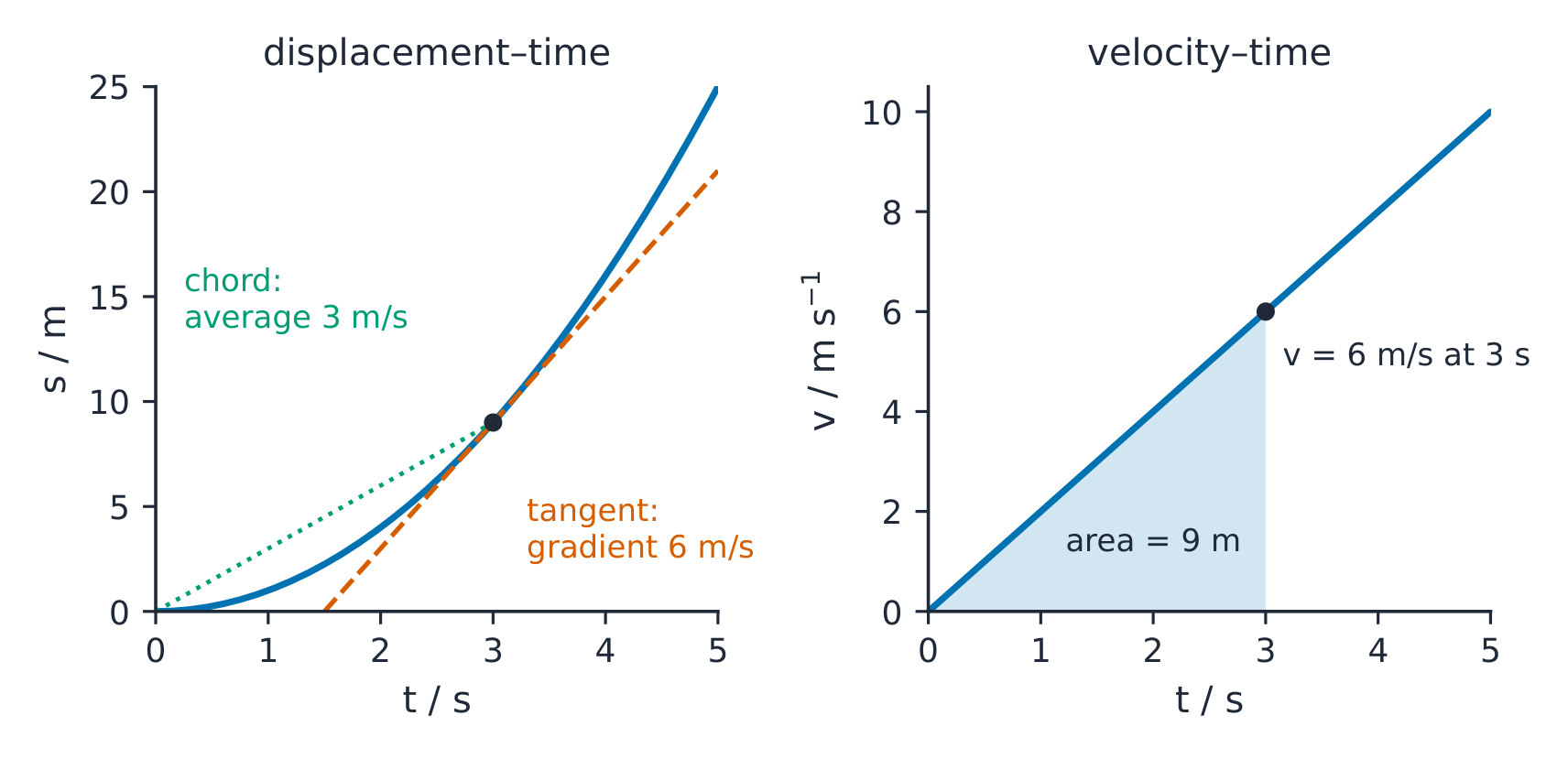
- A displacement–time gradient gives velocity. For the invented relation s = t², the tangent at 3 s has gradient 6 m/s; the interval from 0 to 3 s has average velocity 3 m/s. A tangent estimates an instantaneous value, while a chord gives an interval average. A nonzero displacement intercept can simply be a chosen starting position.
- A velocity–time gradient gives acceleration; signed area gives displacement. Acceleration–time area gives change in velocity. Units provide a check: velocity multiplied by time gives length. The figure links the tangent with the matching velocity graph, whose area to 3 s is 9 m; a curved graph is not automatically evidence that every plotted quantity is increasing.
Count negative displacement without subtracting travelled distance
- Suppose a model object moves at +4 m/s for three seconds, then −2 m/s for two seconds, with the reversal interval idealized as negligible. Signed areas are +12 and −4 m. Displacement is +8 m, while total distance is 16 m. Over five seconds, average velocity is +1.6 m/s and average speed 3.2 m/s.
- A line below a velocity–time axis does not mean negative distance, and a downward-sloping positive-velocity line need not mean backwards travel. Find where velocity changes sign before summing distance. On an acceleration graph, negative area changes velocity in the negative direction; it does not specify displacement without further information.
A model object moves at +4 m/s for three seconds and −2 m/s for two seconds, with an idealized negligible reversal interval. Find total distance travelled.
Difficulty 2/5 · 140 coins + a small bonus on first completion today
The two distances are |4| × 3 = 12 m and |−2| × 2 = 4 m. Total distance = 12 + 4 = 16 m. Signed displacement = 4 × 3 + (−2) × 2 = +8 m. Total time = 3 + 2 = 5 s, so average speed = 16/5 = 3.2 m/s and average velocity = 8/5 = +1.6 m/s.
Select a constant-acceleration equation from the unknowns
- Under constant acceleration, a straight velocity–time line gives v = u + at and trapezium area gives s = (u + v)t/2. Combining them gives the remaining forms below. List known quantities with signs, the desired quantity and the unused quantity before selecting an equation.
- These relations concern displacement and signed components. They are not valid over a whole interval with changing acceleration merely because the initial and final velocities are known. A changing drag force may require a graph or a different model. Check dimensions and whether the numerical solution describes the actual time interval.
Separate reaction travel from uniform braking
- A model car at 25 m/s stops uniformly over 50 m. Taking travel as positive, v² = u² + 2as gives acceleration −6.25 metres per second squared; average velocity 12.5 m/s gives braking time four seconds. Negative acceleration here opposes positive velocity, so the speed decreases.
- In a separate model, initial speed is 30 m/s, reaction time 0.70 s and subsequent deceleration magnitude six metres per second squared. Reaction travel is 21 m; braking distance is 75 m, giving total stopping distance 96 m. Do not apply the braking acceleration during a reaction interval assumed to have unchanged speed, or confuse stopping time with braking time.
A model car travels at 30 m/s during a 0.70 s reaction interval, then brakes uniformly with acceleration opposite motion of magnitude 6.0 metres per second squared. Find total stopping distance.
Difficulty 2/5 · 140 coins + a small bonus on first completion today
Reaction distance 30 × .70 = 21 m. Braking distance 30²/(2 × 6) = 75 m. Total 96 m; the braking acceleration is not applied during the assumed constant-speed reaction interval.
Keep gravitational acceleration through the highest point
- Take upward as positive for a ball launched vertically at 12 m/s, with no drag. Acceleration is −9.8 metres per second squared throughout. Time to the highest point is about 1.22 s and height gain about 7.35 m. Zero velocity at the top does not switch gravity off.
- Return to the same height takes about 2.45 s and gives velocity −12 m/s under this model. The descent has negative velocity and negative acceleration, so speed increases. Symmetry needs the same launch/landing height and the stated constant-gravity/no-drag assumptions; it is not a rule for every thrown object or landing surface.
A model ball is launched vertically upwards at 12 m/s with negligible drag. Use g = 9.8 metres per second squared to find its height gain to the highest point.
Difficulty 2/5 · 140 coins + a small bonus on first completion today
Set final vertical velocity to zero: height = 12²/(2 × 9.8) ≈ 7.35 m. Acceleration remains downward at the highest point even though velocity is zero.
Resolve a projectile while keeping one shared time
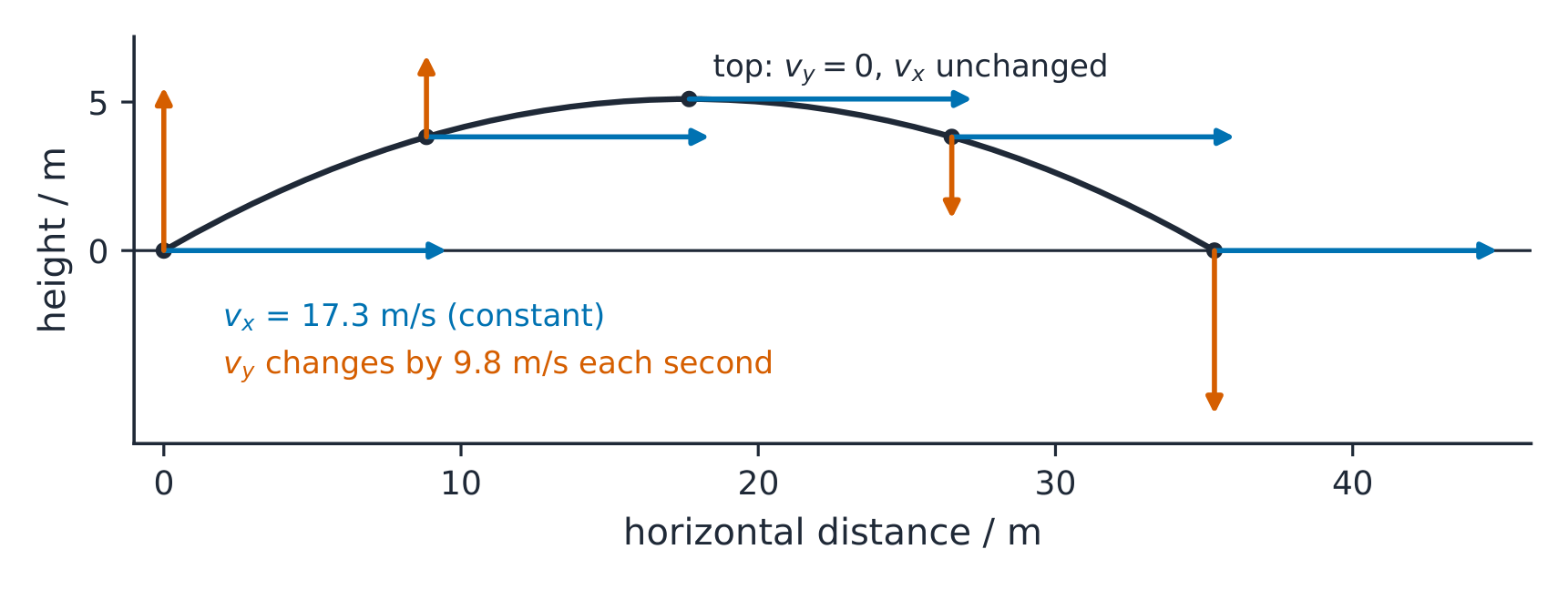
- In still air with resistance neglected, horizontal acceleration is zero and vertical acceleration is downward g. For launch speed u at angle θ above horizontal, horizontal and vertical initial components are u cos θ and u sin θ. The same elapsed time links x and y; they are not separate trips taking unrelated times.
- At the top of an angled trajectory, vertical velocity is zero while horizontal velocity remains nonzero. The path is parabolic in this model. A horizontal launch and a drop from the same height land together if their initial vertical velocities are both zero and their gravitational conditions match; differing initial vertical components change that comparison.
Use the vertical fall to time a horizontal launch
- A model ball leaves a 1.25 m table at horizontal speed 3.0 m/s. From 1.25 = 9.8t²/2, time is about 0.505 s. Horizontal distance is then about 1.52 m. Vertical landing speed is about 4.95 m/s downward; combining it with the horizontal component gives speed about 5.79 m/s at about 58.8 degrees below horizontal.
- A separate dart moving horizontally at 12 m/s reaches a board 3.0 m away in 0.25 s. Its drop is about 0.306 m. Solve for time from whichever component has enough information, then use that same time in the other component. Keep unrounded intermediate values when forming the final speed or angle.
A model ball leaves a 1.25 m table horizontally at 3.0 m/s, with no drag. Using g = 9.8 metres per second squared, find horizontal distance to the ground.
Difficulty 2/5 · 140 coins + a small bonus on first completion today
Vertical fall gives t = √(2 × 1.25/9.8) ≈ .505 s; horizontal distance = 3t ≈ 1.52 m. The same elapsed time is used in both components.
Check the landing height before using a range shortcut
- A model launch at 20 m/s and 30 degrees above horizontal gives components about 17.32 and 10.0 m/s. Returning to the same level takes about 2.04 s, giving range 35.35 m and maximum height 5.10 m. The zero-time solution of the vertical equation describes launch, not a second landing.
- For equal launch/landing height with constant g and no drag, 45 degrees gives maximum range at fixed speed and complementary angles give the same range. A cliff, raised target or resistance invalidates that unrestricted shortcut. State the vertical displacement and choose its sign before assuming a symmetric flight.
A model projectile launches at 20 m/s, 30 degrees above horizontal, and lands at the same level without drag. Using g = 9.8 metres per second squared, find its horizontal range.
Difficulty 2/5 · 140 coins + a small bonus on first completion today
Resolve launch velocity: ux = 20 cos30° ≈ 17.32 m/s and uy = 20 sin30° = 10.0 m/s. At the original height, 0 = uyt − gt²/2. Excluding t = 0 gives t = 2uy/g = 20/9.8 ≈ 2.041 s. Range = uxt = (20 cos30°)(20/9.8) ≈ 35.35 m. A different landing height requires solving for a different flight time.
Retain the initial downward component in a cliff launch
- A model stone leaves a 30 m cliff at 15 m/s, 20 degrees below horizontal. Taking down positive gives initial components about 14.10 m/s horizontally and 5.13 m/s vertically. Solve 30 = 5.13t + 4.9t² for the positive time, about 2.01 s; horizontal distance is about 28.27 m.
- Gravity-only energy accounting also gives landing speed from v² = u² + 2gh, about 28.51 m/s here. This does not by itself give landing direction or flight time, which still depend on components. Do not use zero initial vertical velocity for a downward launch or accept a negative-time root outside the stated interval.
A model stone is launched at 15 m/s, 20 degrees below horizontal, from a 30 m cliff. With no drag and g = 9.8 metres per second squared, find positive flight time.
Difficulty 2/5 · 140 coins + a small bonus on first completion today
Take down positive: uy = 15 sin20° ≈ 5.1303 m/s. From h = uyt + gt²/2, 4.9t² + uyt − 30 = 0. The positive quadratic root is t = [−uy + √(uy² + 4 × 4.9 × 30)]/9.8 ≈ 2.00563 s, or 2.01 s. The other root is negative and outside the flight interval.
Qualify drag effects using components and relative motion
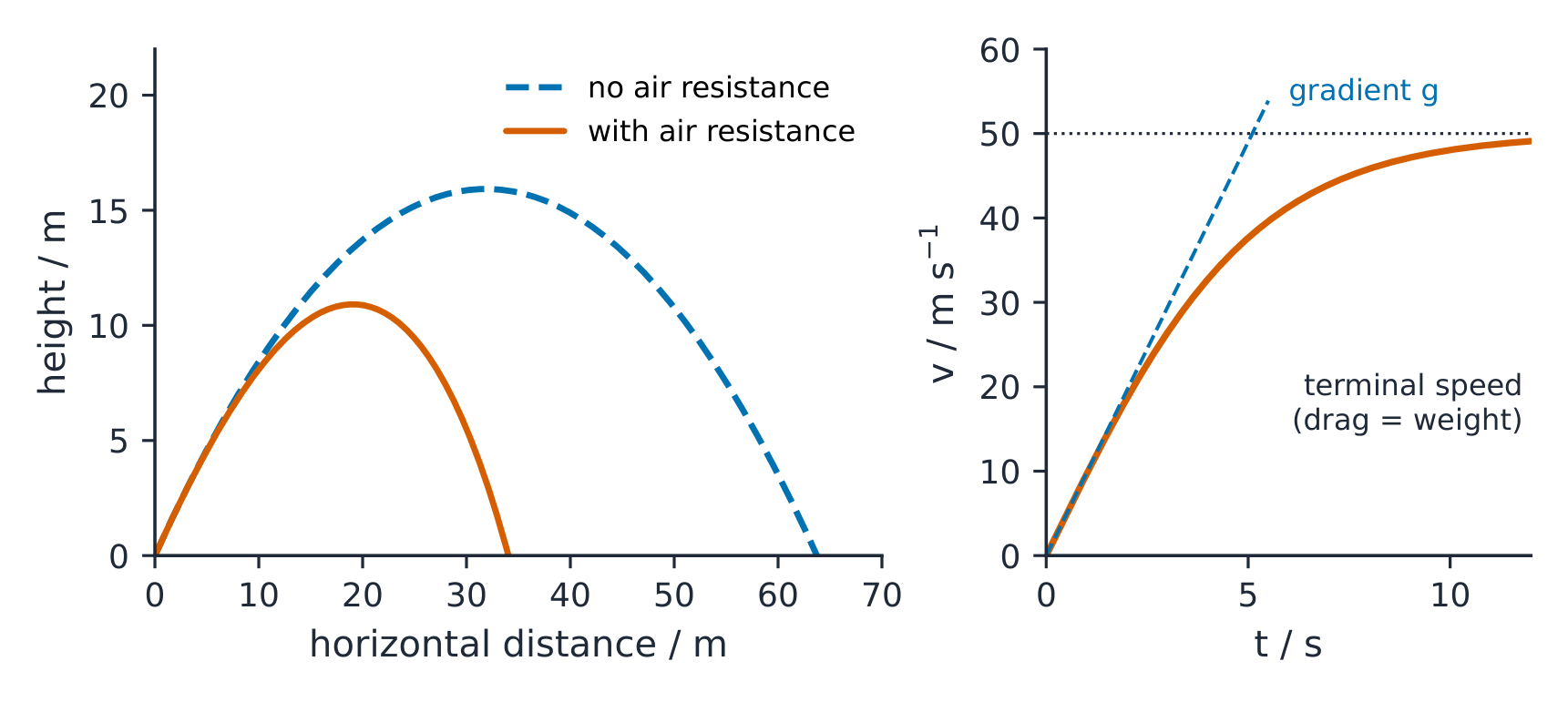
- In still air, drag opposes the projectile's motion through the fluid. It reduces horizontal speed, shortens range and lowers the maximum height relative to the same launch without resistance. The trajectory becomes asymmetric and non-parabolic. A rising projectile's vertical drag adds to weight; during descent its upward component opposes weight.
- The total acceleration includes horizontal drag too, so its magnitude need not stay below g throughout projectile descent. This differs from a one-dimensional vertical fall with speed below terminal speed. Wind changes velocity relative to the air, so an assumption about still air matters. Do not apply constant-g kinematic equations unchanged while claiming to include significant drag.
Explain terminal motion through balanced forces rather than no forces
- For a vertical fall initially below terminal speed, drag grows as speed rises, reducing the downward resultant and acceleration. When drag balances weight, acceleration is zero but downward velocity is nonzero. A velocity–time curve levels off; its gradient, rather than its height, approaches zero.
- Opening a parachute can make upward drag exceed weight, slowing the downward motion until a lower terminal speed is approached. Larger effective area usually lowers terminal speed under comparable conditions; greater mass with the same relevant shape/area requires more drag to balance weight. Terminal values depend on air density, posture and equipment rather than one universal number. Landing is a further transition to rest.
A model skydiver descends at a steady terminal speed in still air. Which statement follows?
Difficulty 1/5 · 100 coins + a small bonus on first completion today
Balanced forces permit constant velocity. A parachute can initially increase drag above weight and slow descent until a lower terminal speed is approached.
Test a motion model using measurements and independent checks
- A light gate gives average speed over the card length divided by blocking time; a suitably short card can approximate instantaneous speed, subject to timing resolution and acceleration during passage. Video needs a calibrated scale, known frame interval and consistent tracking. Repeats reveal scatter but do not remove shared calibration or perspective errors.
- State sign convention, initial conditions, component directions and acceleration assumptions. Use graph shape, signed area, units and an alternative calculation to check the result. Explain when drag, height differences or measurement limits invalidate a shortcut. A correct number is not enough if it came from a model that contradicts the stated conditions.
Explain how you would model and measure a projectile, then identify what changes when resistance matters. Use a graph or numerical consistency check and distinguish acceleration components from total magnitude.
Check the model before the equation; measurement evidence and independent representations reveal invalid shortcuts.