Fission: conserve charge and nucleons, account for energy
Introduced| English | Meaning |
|---|---|
| chain reaction/tʃeɪn rɪˈækʃn/ | A process in which products of one reaction trigger further reactions of the same kind, as neutrons can do in nuclear fission. |
| fission/ˈfɪʃn/ | The splitting of a heavy nucleus into two lighter nuclei, with a release of energy. |
What would explain this observation?
- A neutron can trigger a heavy nucleus to split, releasing energy and further neutrons. Whether the process becomes a chain reaction 链式反应 depends on what happens to those neutrons.
Build the model
- In nuclear fission 核裂变 a heavy nucleus splits into lighter nuclei.
- Proton number and nucleon number balance in a nuclear equation.
- The total rest mass can decrease; the difference corresponds to released energy through E = Δmc².
- fission: Splitting of a heavy nucleus into lighter nuclei.
- chain reaction: A sequence in which products initiate further events.

What permits a continuing fission chain reaction?
Difficulty 1/5 · 100 coins + a small bonus on first completion today
A continuing chain needs enough successful successor fissions on average after neutron escape and non-fission absorption. One successor per fission on average gives steady expected rate; a growing rate is not automatically an explosion. Charge remains conserved.
Match each technical term to its precise meaning.
Difficulty 2/5 · 140 coins + a small bonus on first completion today
Use the definitions to distinguish related quantities and processes.
Choose evidence that can test it
- Separate conservation of nucleon number from conservation of total energy.
- Released neutrons may initiate further fissions, escape or be absorbed.
- A controlled reactor and an uncontrolled chain reaction have different neutron-management conditions.
In the lab: Balance a supplied nuclear equation, use the specified mass data and identify the system. Analyse models or published reactor data; this is not a school attempt to produce fission or handle reactor materials.
Which two habits make the investigation or model in this case more defensible?
Difficulty 2/5 · 140 coins + a small bonus on first completion today
Stating the conditions and assumptions lets others repeat the work exactly, and recording the supporting evidence lets them check the conclusion. Hiding disagreeing results removes the evidence that could challenge a wrong conclusion, and one measurement can never establish a wider claim.
Work from known quantities
- Known: U-235 absorbs one neutron, forming Ba-141, Kr-92 and three neutrons.
- Nucleon balance: 235+1 = 141+92+3 = 236.
- Proton balance: 92 = 56+36.
- A mass decrease of 2.0×10⁻²⁸ kg corresponds to 1.8×10⁻¹¹ J using c=3.0×10⁸ m/s.
Your turn: A U-235 nucleus plus one neutron produces fragments with mass numbers 141 and 92. How many neutrons balance the equation?
Balance integer labels; use mass data for energy
U-235 plus one neutron has 236 nucleons and 92 protons. Test the Ba-141, Kr-92 and three-neutron products, then calculate 1.8 × 10⁻¹¹ J from the separately stated mass decrease of 2.0 × 10⁻²⁸ kg.
A U-235 nucleus plus one neutron produces fragments with mass numbers 141 and 92. How many neutrons balance the equation?
Difficulty 2/5 · 140 coins + a small bonus on first completion today
The result is 3 neutrons. Known: U-235 plus one neutron gives fragments 141 and 92. Nucleon balance: 235 + 1 = 141 + 92 + n, so n = 236 - 233 = 3 neutrons. Proton numbers must balance separately (92 = 56 + 36 for barium and krypton).
Check the conclusion and its limits
- Mass number is not a precise mass in kilograms.
- Balanced integer labels alone do not calculate the released energy.
- Radioactive decay and neutron-induced fission are not interchangeable descriptions.
Not true: A balanced nucleon-number equation alone gives the energy release in joules. Integer mass and charge labels only check conservation; they say nothing about energy. The released energy comes from the small decrease in actual MASS via E = mc^2, which needs measured masses, not mass numbers.
- In nuclear fission a heavy nucleus splits into lighter nuclei.
- Separate conservation of nucleon number from conservation of total energy.
- Watch for: mass number is not a precise mass in kilograms.
A balanced nucleon-number equation alone gives the energy release in joules.
Difficulty 1/5 · 100 coins + a small bonus on first completion today
Integer mass and charge labels only check conservation; they say nothing about energy. The released energy comes from the small decrease in actual MASS via E = mc^2, which needs measured masses, not mass numbers.
Splitting of a heavy nucleus into lighter nuclei: write the technical term.
Difficulty 1/5 · 100 coins + a small bonus on first completion today
fission means Splitting of a heavy nucleus into lighter nuclei.
Write from the data given
- A U-235 nucleus plus one neutron produces fragments with mass numbers 137 and 95.
- Find how many neutrons balance the nucleon number. That count is not the energy release in joules.
A U-235 nucleus plus one neutron produces fragments with mass numbers 137 and 95. How many neutrons balance the nucleon number, and why does that balanced equation not give the energy release in joules?
Initial nucleon number is 235 + 1 = 236. Fragments contain 137 + 95 = 232, so free-neutron count is 236 − 232 = 4. Each neutron contributes one nucleon. Energy release still needs the actual rest-mass difference and Q = Δmc²; integer mass numbers do not state it.
In an invented nucleon-balance model, U-235 plus one neutron produces fragments of mass numbers 137 and 95, with the remaining products all neutrons. How many neutrons balance the nucleon number?
Difficulty 1/5 · 100 coins + a small bonus on first completion today
Initial nucleon number is 235 + 1 = 236. Fragment total is 137 + 95 = 232. Each remaining neutron has nucleon number 1, so the count is 236 − 232 = 4. Other options — 3 (the lesson fragments 141 and 92); 236 (the initial nucleon total).
Separate fission from an ordinary radioactive transition
- Fission splits a heavy nucleus into two medium-mass fragments, usually with further neutrons and released energy. The fragments need not have equal masses. Spontaneous fission needs no incoming neutron; neutron-induced fission follows neutron absorption into a sufficiently excited nuclear state. Absorption does not guarantee fission: some captured neutrons lead to other outcomes.
- In one example, uranium-235 absorbs a neutron and produces barium-141, krypton-92 and three neutrons. Other fragment combinations and neutron counts are possible. A drawing of one channel is an example, not a rule that every fission produces those two elements or exactly three neutrons. Energy and particle bookkeeping must refer to the particular reaction being modelled.

Does every neutron absorbed by a heavy nucleus necessarily produce fission?
Difficulty 1/5 · 100 coins + a small bonus on first completion today
Induced fission is one possible outcome of absorption in suitable nuclear states. Fragment and emitted-neutron numbers vary.
Balance every particle before calculating energy
- For $\mathrm{n}+{}^{235}_{92}\mathrm{U}\to{}^{140}_{54}\mathrm{Xe}+{}^{94}_{38}\mathrm{Sr}+x\mathrm{n}$, the left nucleon total is $236$. The fragments contain $140+94=234$, so $x=2$. Charge balances separately: $92=54+38$. Free neutrons contribute to nucleon number and rest mass even though they have no electric charge.
- These integer labels count nucleons; they are not exact masses in u or kilograms. A balanced equation alone cannot tell us released joules or even replace an energetics check for a proposed channel. Use supplied measured/assigned masses consistently. If atomic masses are used here, electron counts cancel because the neutral fragments together have the same total proton number as the parent atom.
U-235 plus one neutron produces Xe-140, Sr-94 and x neutrons. Find x.
Difficulty 2/5 · 140 coins + a small bonus on first completion today
Total nucleon number is 236. Fragments contain 234; the remaining two are free neutrons. Charge also balances: 92 = 54 + 38.
Calculate a channel energy from rest masses
- For the xenon/strontium example, use assigned atomic masses U-235 235.043930 u, Xe-140 139.921641 u, Sr-94 93.915361 u, and neutron 1.008665 u. Initial rest-mass sum is $235.043930+1.008665=236.052595$ u. Final sum is $139.921641+93.915361+2(1.008665)=235.854332$ u. The difference is $0.198263$ u, not the zero difference between the integer nucleon totals.
- With $1\ \mathrm{u}\,c^2=931.5$ MeV, $Q=\Delta m c^2=0.198263\times931.5=184.68$ MeV, or about $2.955\times10^{-11}$ J using $1\ \mathrm{MeV}=1.60\times10^{-13}$ J. Positive $Q$ is an initial rest-energy decrease appearing as kinetic energy and radiation. Total energy remains conserved; the mass sums omit that released energy rather than showing energy appearing from nothing.
Use atomic masses U-235 235.043930 u, Xe-140 139.921641 u, Sr-94 93.915361 u, neutron 1.008665 u; include two outgoing neutrons. With 1 u c² = 931.5 MeV, find Q.
Difficulty 2/5 · 140 coins + a small bonus on first completion today
Initial mass is 235.043930 + 1.008665 = 236.052595 u. Final mass is 139.921641 + 93.915361 + 2(1.008665) = 235.854332 u. Hence Δm = 236.052595 − 235.854332 = 0.198263 u and Q = 0.198263 × 931.5 = 184.6819845 MeV ≈ 185 MeV. Keep the unrounded Q for later conversion to joules. Integer mass numbers alone do not provide this small rest-mass difference.
Compare total binding energies, including free neutrons
- The products of a favourable fission channel are more tightly bound overall. Binding energy is the energy required to separate a nucleus completely into free nucleons. Thus $Q=B_\mathrm{products}-B_\mathrm{reactants}$ when the same nucleon content is accounted for. Greater product binding means a smaller product rest-mass sum; it does not mean we must supply the positive difference to make the reaction happen.
- For the balanced xenon/strontium channel, assign U-235 binding energy per nucleon 7.6 MeV and a fragment average 8.5 MeV. Initially $B=235(7.6)=1786$ MeV; afterwards the 234 bound nucleons give $B=234(8.5)=1989$ MeV, so the estimate is 203 MeV. Free neutrons have zero nuclear binding energy. Rounded average data give an estimate; they need not reproduce a more precise channel-mass calculation exactly.
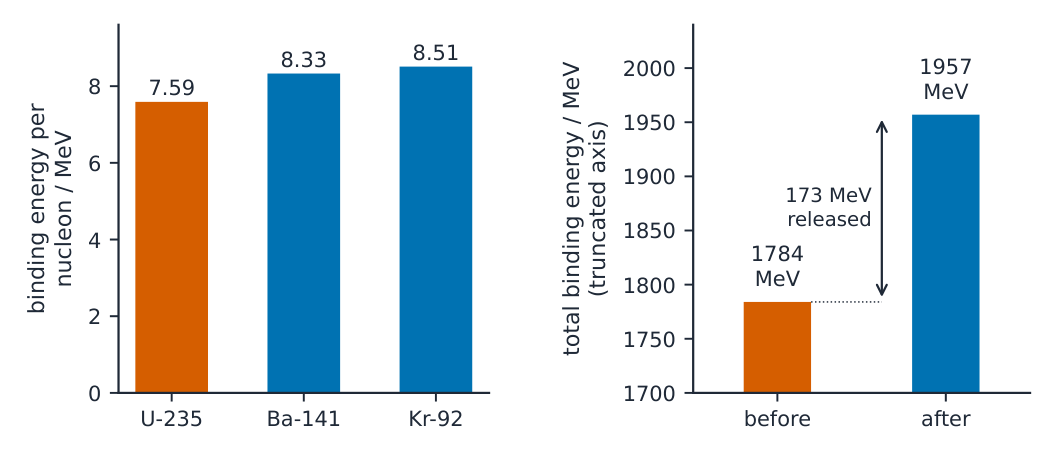
For U-235 + n → Xe-140 + Sr-94 + 2n, assign U binding 7.6 MeV per nucleon and fragment mean 8.5 MeV per bound nucleon. Estimate released energy.
Difficulty 2/5 · 140 coins + a small bonus on first completion today
Initial binding is 235 × 7.6 = 1786 MeV. The fragments contain 234 bound nucleons, giving 1989 MeV. The increase is 203 MeV; free neutrons have zero nuclear binding energy.
Follow where the released energy goes
- Fragment kinetic energy is transferred through collisions to the fuel, producing thermal energy. Neutron slowing and absorbed radiation can also contribute. Radioactive fragments may release more energy later. An immediate mass calculation for one channel and a quoted average reactor energy per fission are different models; do not silently substitute a rounded 200 MeV for every specifically calculated reaction energy.
- For thermal-power exercises we will assign deposited energy of 200 MeV, or $3.20\times10^{-11}$ J, per fission. This treats the chosen value as heat available within the model. In a detailed balance, energy carried away by weakly interacting particles need not be deposited in the reactor. State the boundary and energy definition before relating reaction count to power.
Why distinguish calculated channel Q from assigned deposited energy per fission?
Difficulty 1/5 · 100 coins + a small bonus on first completion today
State the system boundary and energy definition before dividing thermal power by an assigned per-fission heat.
Explain a chain without assuming every neutron succeeds
- Released neutrons may cause further fissions, escape, or be absorbed without causing fission. A chain reaction continues through the successful ones. In a simple generation model, one successful successor per fission on average gives a steady expected fission rate; fewer makes it decline and more makes it grow. It is the average number of new fissions caused, not merely the number of neutrons emitted, that determines the trend.
- The branching picture deliberately assumes every shown neutron succeeds. Real populations have losses and fluctuations. A growing fission rate is not automatically an explosion: controlled power increases are possible, and time response and feedback matter. Conversely, a steady chain can produce substantial thermal power; steady does not mean inactive or free of heat-management needs.
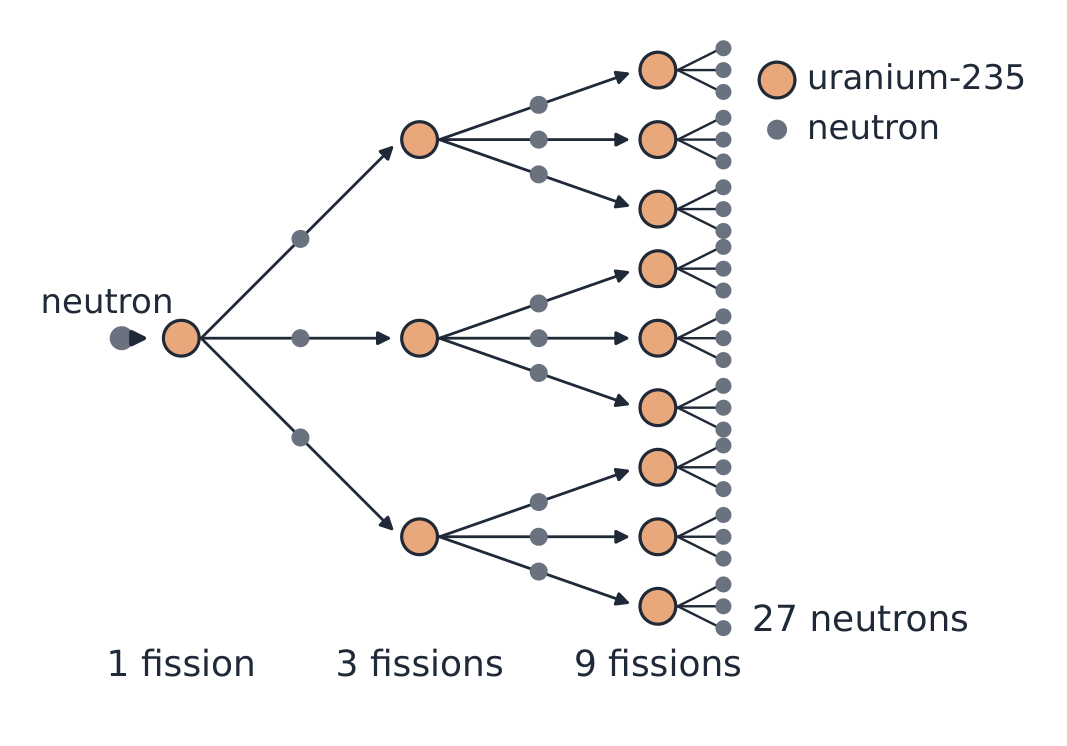
Which condition gives a steady expected fission rate in the simple generation model?
Difficulty 1/5 · 100 coins + a small bonus on first completion today
The relevant average includes escape and non-fission absorption. A steady chain can produce high thermal power.
A model fission population is growing. What follows?
Difficulty 1/5 · 100 coins + a small bonus on first completion today
Time response, feedback and neutron management matter. Do not equate any increasing rate with an explosion.
Interpret critical conditions without a universal mass
- A critical chain is self-sustaining at steady expected rate under specified conditions. Critical mass is a minimum mass for that balance with specified material and physical conditions, not a number that depends only on the element name. Neutron leakage and absorption matter alongside composition and the surrounding system. A sample below its sustaining conditions does not automatically become non-radioactive.
- Natural uranium is mostly uranium-238 with roughly 0.7% uranium-235. Many light-water reactors use a higher uranium-235 fraction to support their neutron balance. Other reactor designs can use natural uranium, and fast-neutron fission of uranium-238 is possible. Avoid the claims that all reactors need enriched uranium or that uranium-238 can never fission.
Which statement properly qualifies critical mass?
Difficulty 1/5 · 100 coins + a small bonus on first completion today
A neutron-chain balance and ordinary radioactive decay are different. Composition and neutron losses affect the sustaining condition.
Distinguish slowing from absorbing neutrons
- In a thermal reactor, a moderator transfers neutron kinetic energy to nuclei through collisions so more neutrons reach energies favourable for uranium-235 fission. Light nuclei can remove a large fraction of a neutron's energy in a collision; useful moderator materials also avoid excessive neutron absorption. Water and graphite are materials containing suitable nuclei, rather than being themselves single nuclei.
- Control rods instead absorb neutrons, reducing those available to continue the chain. Inserting absorbers can lower the fission rate; withdrawing them can permit a controlled rise. Water may act as both moderator and coolant, but the functions differ: neutron-energy transfer and thermal-energy transport. Fast reactors do not thermalise their chain neutrons with a moderator.
Which pair correctly distinguishes functions?
Difficulty 1/5 · 100 coins + a small bonus on first completion today
The same material can have several roles, but slowing, absorption and heat transport describe different mechanisms.
Explain why shutdown still needs cooling
- Suppressing the self-sustaining chain prevents its continuing normal fission power. It does not remove radioactive products already formed in the fuel. Their decays continue releasing energy, so residual decay heat must still be carried away. An answer that says inserting control rods instantly removes all heat confuses control of a reaction population with removal of stored and continuing thermal energy.
- Shielding attenuates radiation reaching people or surroundings; containment and fuel barriers limit escape of radioactive material. Cooling removes heat. One function does not automatically perform the others. Discuss these roles at the level of a published system or classroom model; this course does not involve making a reactor, manipulating sources, or trying to establish a physical chain reaction.
Why is cooling still necessary after suppressing the self-sustaining chain?
Difficulty 1/5 · 100 coins + a small bonus on first completion today
Shutdown controls the chain. Decay heat and stored thermal energy still need removal; shielding and containment serve other functions.
Trace the circuits in the stated reactor design
- In the pressurised-water example, primary coolant stays liquid at high pressure and carries heat from the core to a steam generator. Across intact heat-exchanger walls, heat enters a separate secondary water circuit without normal bulk mixing. Secondary steam drives the turbine and generator; a condenser returns it to liquid, rejecting heat to a cooling system. The separate circuit limits transfer of radioactive primary material to turbine equipment.
- This is a design-specific diagram. The Department of Energy's comparison also describes boiling-water reactors, where steam forms in the reactor vessel and goes to the turbine. Do not describe the illustrated secondary steam generator as compulsory for every reactor. In both models, the turbine receives thermal energy and the generator converts mechanical energy to electrical energy; fission does not generate current directly by producing electrons in the wires.
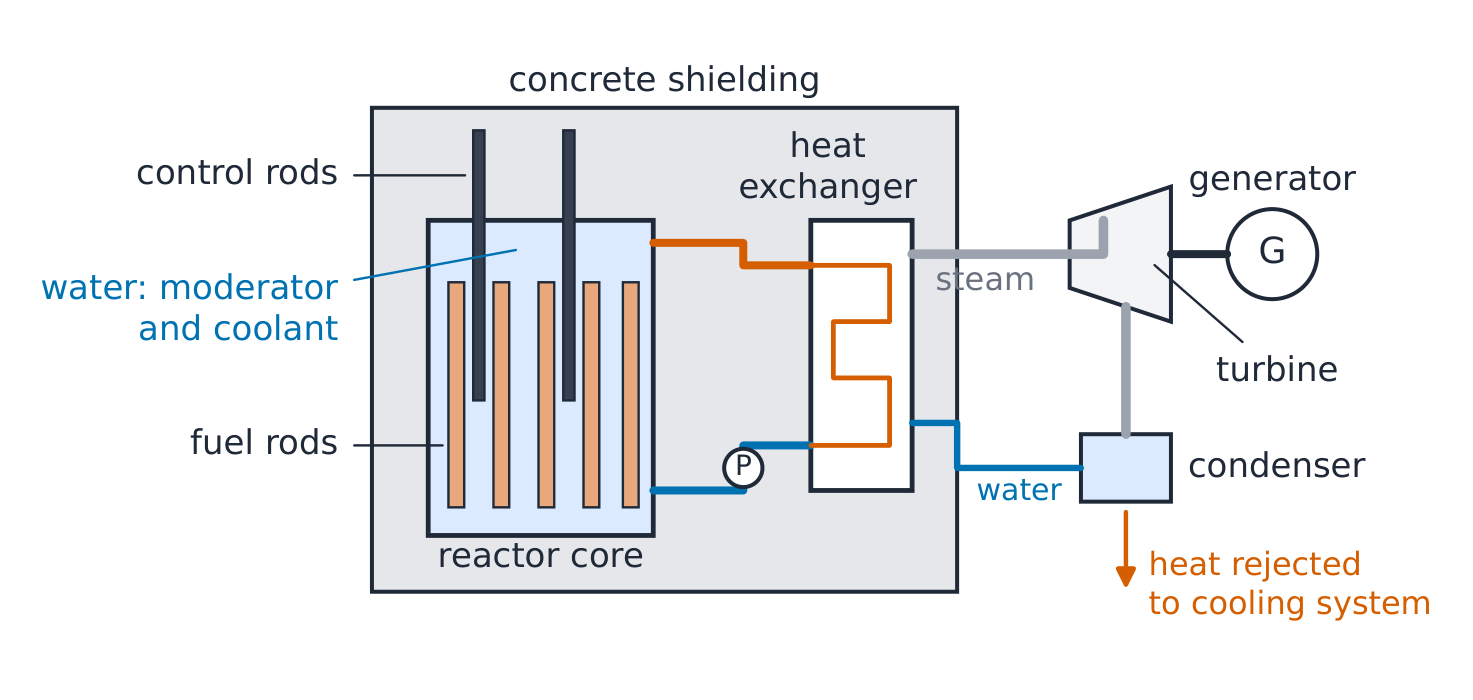
Does every power reactor require the illustrated separate primary/secondary steam-generator circuit?
Difficulty 1/5 · 100 coins + a small bonus on first completion today
The diagram is design-specific. Both the chosen circuit and the rejected-heat path must be identified.
Use efficiency before counting fissions
- In an assigned model, electrical output is 600 MW and thermal-to-electrical efficiency is 32%. Thermal input must be larger: $P_\mathrm{th}=P_\mathrm{el}/\eta=600/0.32=1875$ MW. Rejected power is $1875-600=1275$ MW. Multiplying 600 by 0.32 would apply the efficiency in the wrong direction and underestimate the required input.
- With assigned deposited energy $E_f=3.20\times10^{-11}$ J per fission, rate is $\dot N=P_\mathrm{th}/E_f=5.859375\times10^{19}$ fissions per second. Convert MW to W before dividing by joules. This is a reaction rate, not an amount of fuel per year; a duration and mass per nucleus are still needed.
Electrical power is 600 MW and efficiency .32. Find thermal input power.
Difficulty 2/5 · 140 coins + a small bonus on first completion today
Pth = Pel/η = 600/.32 = 1875 MW. Rejected power is 1875 − 600 = 1275 MW.
Convert reaction count into idealised fuel consumption
- For $3.16\times10^7$ s of steady operation, the preceding rate gives $1.85156\times10^{27}$ fissions. Approximate one uranium-235 nucleus as $235(1.661\times10^{-27})=3.90335\times10^{-25}$ kg. Multiplying gives about 723 kg of uranium-235 fissioned in the assigned year. Keep unrounded intermediate values and round the final result to match the supplied data.
- This is the mass of uranium-235 actually fissioned under the model. It is not the mass of all enriched uranium, oxide pellets, cladding or fuel assemblies loaded and replaced. Real fuel does not consist entirely of uranium-235, and not every loaded nucleus fissions. A comparison with coal also needs a stated coal energy per kilogram and comparable efficiency assumptions, not just the sizes of two objects.
A 600 MW electrical station has efficiency .32. Assign 3.20 × 10⁻¹¹ J deposited per fission, 3.16 × 10⁷ s operation and nucleus mass 235 × 1.661 × 10⁻²⁷ kg. Find U-235 mass actually fissioned.
Difficulty 2/5 · 140 coins + a small bonus on first completion today
Thermal input Pth = Pel/η = (600 × 10⁶)/0.32 = 1.875 × 10⁹ W. Fission rate = Pth/Ef = (1.875 × 10⁹)/(3.20 × 10⁻¹¹) = 5.859375 × 10¹⁹ per second. Number fissioned = rate × time = (5.859375 × 10¹⁹)(3.16 × 10⁷) = 1.8515625 × 10²⁷. One nucleus has mass 235(1.661 × 10⁻²⁷) = 3.90335 × 10⁻²⁵ kg. Thus mass fissioned = (1.8515625 × 10²⁷)(3.90335 × 10⁻²⁵) = 722.72965 kg, or 720 kg to two significant figures (723 kg to three). This is mass actually fissioned, not total fuel-assembly loading.
Read a waste curve as a stated mixture model
- Primary fission fragments are often neutron-rich for their size and undergo beta-minus decay, with gamma emission possible from excited daughters. A fuel inventory contains many nuclides with different half-lives, plus actinides produced during irradiation. A rapidly declining early component and a more persistent later component can therefore coexist. A mixture's total activity generally has no one constant half-life.
- The figure is invented: initial activities 1000 and 10 arbitrary units have half-lives 30 and 30 000 years. Each component halves according to its own clock; the total is their sum. It is not a calculation of a real spent-fuel assembly, a comparison with an unspecified mass of ore, or a threshold at which disposal becomes safe. Activity, emitted energy, heat deposition and exposure risk are related but distinct quantities.
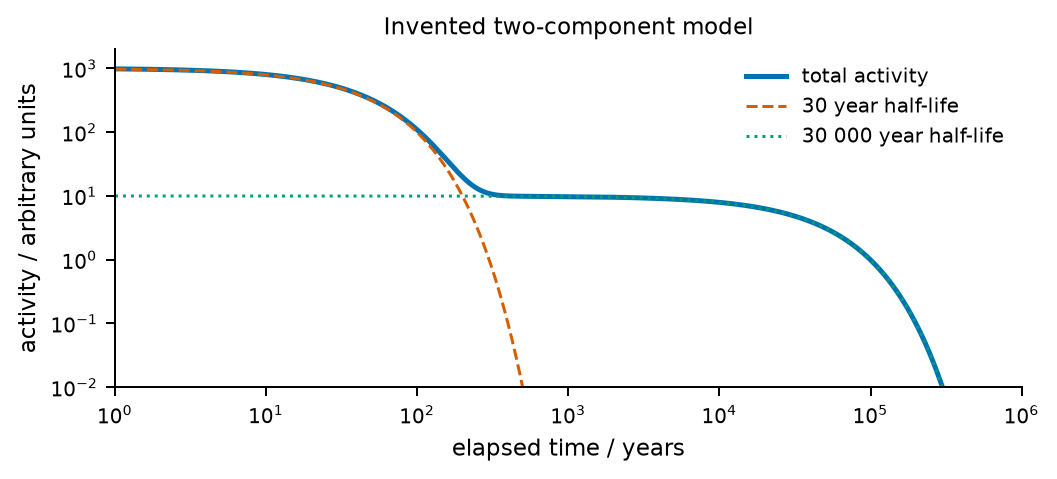
In an invented mixture, a long-lived component starts at activity 10 arbitrary units with half-life 30000 years. Find that component’s activity after 30000 years.
Difficulty 2/5 · 140 coins + a small bonus on first completion today
One half-life leaves 5 units of that component. The short-lived component follows its own half-life; the mixture need not have one exponential decay constant.
Distinguish storage, reprocessing and disposal
- Recently removed fuel requires decay-heat removal and radiation shielding; water pools can provide both. Later licensed dry-cask storage is another managed stage. Reprocessing recovers some reusable material but leaves radioactive residues, so it is not the disappearance of waste. Some liquid high-level residues can be immobilised in glass; unreprocessed spent-fuel assemblies need not be turned into glass.
- Waste routes depend on half-lives, activity, heat generation and material form, as ARPANSA's classification explanation illustrates. Suitable low-level waste may use engineered near-surface disposal, while long-lived or heat-generating waste needs a different isolation case. Geological disposal aims to use packages and suitable rock for long-term passive isolation; monitored storage and final disposal are different stages.
Which statement correctly distinguishes waste-management stages?
Difficulty 1/5 · 100 coins + a small bonus on first completion today
Cooling, shielding, storage, conditioning and disposal address different properties. Vitrification can suit some reprocessing residues, not a universal route for all fuel.
Evaluate electricity choices with a defined comparison
- Fission can supply sustained electricity with low direct operational carbon emissions and a high energy density in fuel. These advantages do not mean zero lifecycle emissions or guaranteed output in every condition. Construction, fuel preparation, mining, maintenance, cooling-water availability and decommissioning affect a whole-system comparison. State whether a figure describes generation only or the full lifecycle.
- Long-lived waste, decay heat, accident risk, cost, construction time, security and public acceptance also matter. Explain an effect and a relevant timescale instead of claiming one feature settles every choice. Repository assessment must consider groundwater, material degradation and future change; it does not assume one perfect container lasts forever or that every future generation must actively run the same cooling system indefinitely.
What is a defensible interpretation of low direct operational carbon emissions?
Difficulty 1/5 · 100 coins + a small bonus on first completion today
Specify the comparison boundary. One generation benefit does not settle the whole-system assessment.
Explain the complete fission energy system
- Begin with a particular balanced channel, distinguish integer labels from measured masses, and calculate the rest-energy decrease or total binding-energy increase. Track free neutrons separately from bound nucleons. State whether an assigned per-fission energy is immediate channel energy or deposited heat, then use efficiency, power, duration and nucleus mass in a consistent sequence.
- Complete the explanation with neutron losses, moderator/control-rod/coolant roles, the chosen circuit, rejected heat and continuing decay heat after shutdown. Connect waste properties to storage and disposal choices, and identify the assumptions behind any comparison. A good answer can explain why steady power, a balanced nuclear equation and a declining activity curve each support a specific conclusion without proving every wider claim.
Explain a complete fission-to-electricity model, including equation/energy accounting, neutron roles, plant efficiency, shutdown and waste.
Connect each stage through the quantity it transfers or controls, and keep model-specific assumptions visible.